French uranium mines in Africa and Europe -A health and safety nightmare for local communities!
“…At all the French uranium mines where it made radiological surveys, the CRIIRAD laboratory discovered situations of environmental contamination and a lack of proper protection of the inhabitants against health risks due to ionizing radiation.
This is due to the lack of proper regulations, a poor awareness of the radiological hazards associated with uranium and its by products, insufficient monitoring practices, the lack of controls by the local and national administration, etc.
When the mines are shut down, the radioactive waste remains, and it seems that the costs for managing this radioactive legacy will have to be largely supported by the society, not the companies.
If such a situation occurs in a so-called “developed country” one should fear what could actually happen in other parts of the world.The preliminary mission made by CRIIRAD to Niger confirmed this fear. In Gabon, the improvement of the conditions in which tailings are disposed is being paid for by the European Community and not by the mining company.
The former workers and local population do not benefit any more from medical care and they receive no compensation when they become sick, years and decades after the mine shut down….”

Radiological hazards from uranium mining
Bruno Chareyron
CRIIRAD (Commission de Recherche et d’Information Indépendantes sur la Radioactivité), Immeuble CIME, 471 av Victor Hugo, 26 000 Valence, FRANCE, Email : bruno.chareyron@criirad.org
 Abstract. At all the French uranium mines where it made radiological surveys, the CRIIRAD laboratory discovered situations of environmental contamination and a lack of proper protection of the inhabitants against health risks due to ionizing radiation. Radiological problems are not only to be addressed during mining or milling operations but also on the longer term after mine closure.
Uranium and its by-products
All natural uranium isotopes (238U, 234U, 235U) are radioactive. The most common isotope, 238U, decays naturally into a succession of 13 other radioactive nuclides. All are metals (thorium 230, radium 226, lead 210, polonium 210, etc) except one, radon 222, which is a radioactive gas.
Uranium and its decay products emit various ionizing radiation such as alpha and beta particles and gamma radiation.

The Earth’s crust has a typical 238U activity of about 40 Becquerels per kilogram (Bq/kg). Since the creation of the Earth, this level of radiation has decreased by two-fold because 238U half-life is very long and equal to the age of the planet earth (4.5 billion years).
This presence of natural uranium in the Earth crust, and therefore in numerous building materials made out of natural minerals, is the main source of exposure of mankind to ionizing radiation.
This is especially due to the diffusion of radon gas from the soil and materials containing uranium- and its accumulation in the air inside buildings and dwellings.
This radiological hazard is now well documented and International (The International Commission on Radiological Protection, ICRP) and European (Euratom) regulations determine recommendations and action levels in order to lower radon concentration inside buildings and reduce cancer risks.
The health impacts of ionizing radiation even at low doses include the increase of various types of cancers, genomic instability, life-shortening and negative impacts on all the body functions.
Radiological situation before extraction
The activities of uranium ores have an important variability. Typical ore with a uranium content of 0.2 % has a 238U activity of about 25,000 Bq/kg. The total activity, including all the 238U by-products and the 235U decay chain will therefore exceed 360,000 Bq/kg. Such material should be managed with a great deal of caution due to the risks of exposure to ionizing radiation.
As long as the ore remains buried underground – the depth being a few tens and even a few hundreds of meters – the radiation levels at the surface of the earth remain low and usually have the same order of magnitude as of typical natural radiation levels. Except in places where the ore reaches the ground surface (typically a few square meters), the protection offered by the soil is usually sufficient to reduce the risks for the people living in the area.
Indeed, alpha and low energy beta particles are stopped by a thin layer of soil (much less than 1 cm.). Even penetrating gamma radiation does not cross a layer of soil of a few meters. Regarding the radiological characteristics of air and water, the situation is more complex. Nevertheless before mining activities most of the radon gas remains trapped inside the soil. Because of its short half-life (3.8 days) a lot of the gas atoms will disintegrate inside the soil during their migration before reaching the biosphere.
The amount of nuclides in underground water may remain low if the minerals containing uranium are trapped in unpermeable layers.

Radiological situation during uranium extraction
The radiological situation is reversed as soon as the uranium extraction begins. There are many reasons for this.
Radioactive dust is transferred to the atmosphere by mining operations, extraction and crushing of ore, uranium milling, management of waste rocks and tailings. This has to be emphasized because some of the nuclides contained in the uranium decay chains (such has thorium 230) are very radiotoxic when inhaled.
For example, when inhaled, a given activity of actinium 227 (part of the 235U decay chain) gives a radiation dose 5 times higher than the same activity of plutonium 238 (Euratom 1996).
Radon gas is transferred to the atmosphere by the vents of the mines and by diffusion from radioactive rocks and tailings (Chareyron and Castanier 1994).
Surface and / or underground water is contaminated by uranium and its by products. Some of them are very radiotoxic when ingested (Chareyron and Castanier 1994). Lead 210 and polonium 210 for example are among the most radiotoxic elements. When ingested, a given activity of polonium 210 gives a radiation dose 4.8 times higher than the same activity of plutonium 239 (Euratom 1996).
Huge amounts of waste rocks, with activities exceeding the normal activity of the earth crust by one to two orders of magnitude are dispersed into the environment and may be used for landfill, road construction or even building (Chareyron 2002b).
Huge amounts of radioactive tailings (with typical total activities exceeding 100,000 and even 500,000 Bq/kg) are generated and stored without proper confinement (Chareyron and Castanier 1994).
Long term contamination after mines closure
Even decades after the shut down of uranium mines and mills, the radioactive contamination of the environment will remain. This is due to the fact that 238U half life is very long (4.5 billion years).
But even the tailings from the mills – whose uranium content is lower than the initial uranium concentration in the ore – will remain radioactive on the long term.
They contain all the radioactive metals included in the uranium decay chain which have not been extracted in the mill, especially thorium 230 and radium 226 whose half lives are 75,000 years and 1,600 years respectively.
This long term impact will occur in many ways. Some examples are given below, based on studies performed by the CRIIRAD laboratory since 1992 in France (and Niger).
Transfer of radionuclides to the aquatic environment
Accumulation of radioactive metals in sediments and plants of rivers, ponds, and lakes by contaminated waters from former mines (and also tailing deposits, uncovered waste rock deposits, etc.) is a problem that is not yet properly addressed by
the companies.

The CRIIRAD laboratory discovered that sediments, aquatic plants and soil from river banks downstream former uranium mines have such a contamination that they deserve in many cases the terminology: “radioactive waste” (238U activity or the activity of some of its by-products were exceeding 10,000 Bq/kg).
Some results are summarized in tables above (Table 1) and below (Tables 2 to
4).
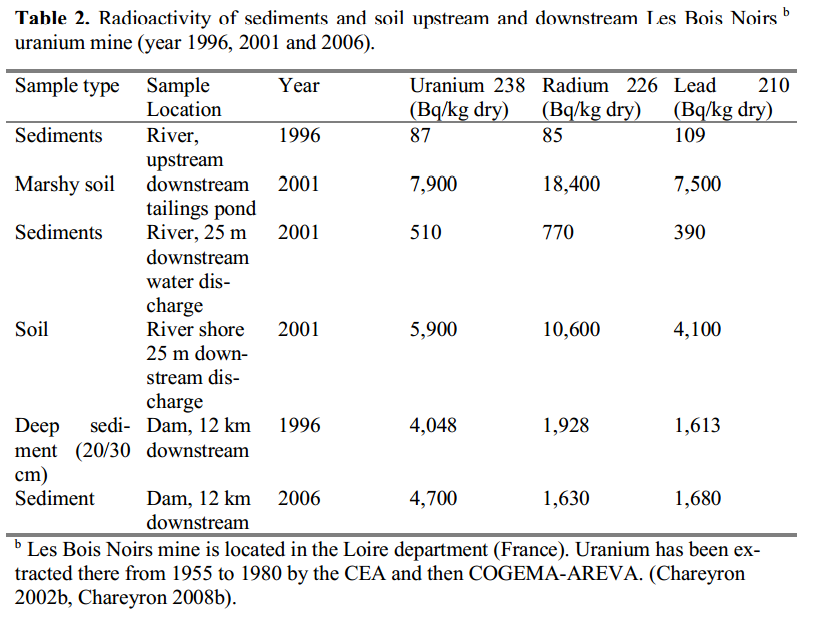
As shown in the table above (Table 2) the accumulation of uranium and or radium downstream uranium mines is usually more intense for surface soil sampled from the river shore than for river sediments (one order of magnitude in this example).
Bioaccumulation of radioactive metals can be extremely high in the biota. In some cases, the contamination of aquatic plants by radium 226 downstream uranium mines can exceed 100,000 Bq/kg dry (Table 3). This shows that the mine water treatment system is not operating properly. The problem of bioaccumulation is usually not taken into consideration by the companies nor the administrations in charge of environmental monitoring and regulatory control.
It should be noted as well that radioactive metals are transported far away from the mines. At Les Bois Noirs mine, uranium accumulation in sediments is still 54 times above background value 12 km downstream the mine (Table 2). Uranium and radium accumulation in aquatic plants are 4 to 6 times above background value 30 km downstream the discharge pipe from the mine (Table 3).


Dispersal of radioactive minerals
At many places, radioactive minerals from the mines are kept by local people or former workers unaware of the radiological hazards which are, in some cases, very significant.
For example, the CRIIRAD laboratory discovered in France that an inhabitant living near Les Bois Noir former uranium mine was keeping a sample of waste rock with a dose rate of 1 milliSievert per hour at the surface of the stone (Chareyron, 2002a). This figure is about 5,000 times above local background level.
The gamma doserate was 18.3 microSievert per hour at a distance of one meter.
Staying at a distance of 1 meter during only 10 minutes per day will lead to exceeding the annual maximum permissible dose for members of the public i.e. 1 milliSievert per year (Euratom, 1996).
Dispersal of radioactive waste rocks and radon gas accumulation
Re-use of radioactive waste rocks for landfill has been in some areas a common practice. CRIIRAD demonstrated that several places near a French uranium mine were contaminated including the car park of a restaurant, the yard of a farm, several sawmill buildings, kilometres of path and roads, etc. (Chareyron 2002b).
In one case, a sawmill building had been built several decades ago directly on the radioactive waste rocks taken at the mine. Due to gamma radiation and radon gas accumulation, the radiation dose inside the building could exceed the annual maximum permissible dose for members of the public by a factor exceeding 20.
The mining company had therefore to pay during year 2003, for the evacuation of 8,000 m3 of radioactive waste rock from the sawmill back to the former open pit (Chareyron 2002b).
Dispersal of contaminated scrap metal
Dispersal and re-use of contaminated scrap metal from the mines or mills has also been a common practice.
During 2003, the CRIIRAD laboratory discovered in Niger that radioactive scrap metal was sold in Arlit city. One piece was a pipe from the uranium mill. It was sold without previous decontamination and the 226Ra activity of the crust inside the pipe exceeded 200,000 Bq/kg. Such a practice cannot be justified. The mining company COGEMA (now known as AREVA) stated that before 1999, no radiation limit was used for scrap metal recycling. Later, a dose limit of 1 microGray per hour at a distance of 50 cm had been applied. Such a limit is much too high. If someone uses such metallic pieces inside his house – which is common in African countries –staying 3 hours per day at a distance of 50 cm will lead to exceed the annual maximum permissible dose for members of the public.
(Chareyron 2003, 2005b).At present, discussions are still going on with the mining company, localNGO’s and the administration, in order to decide whether radioactive rocks usedat other places will or will not be evacuated (ski resort house, garage of a citizen, etc.).
Radioactive material have been detected again in 2007 inside private houses or at scrap merchants (Chareyron 2008a).
Problems posed by the disposal of tailings
The disposal of radioactive tailings and their control on the long term, has not received yet satisfying solutions, taking into consideration their activity, radiotoxicity and long half-lives. Some examples from France (where about 50 million tons of tailings are stored) and Niger are given below.
In France 1.5 million tons of tailings have been dumped in a former open pit (Bellezane mine) but the CRIIRAD laboratory discovered that the finest fraction of the radioactive material could reach the underground galleries underneath the pit. Furthermore, the mine water treatment plant was not efficient enough to prevent the contamination of the river and meadows downstream (Chareyron and Castanier 1994, Chareyron 2006).
In Niger, more than 20 million tons of radioactive tailings are stored in the open air, near SOMAÏR and COMINAK mills, a few kilometers away from the cities of ARLIT and AKOKAN (about 70,000 inhabitants). Radon gas and radioactive dust can be scattered away by the powerfull winds of the desert (Chareyron 2003,
2005b, 2008a).
Conclusion
At all the French uranium mines where it made radiological surveys, the CRIIRAD laboratory discovered situations of environmental contamination and a lack of proper protection of the inhabitants against health risks due to ionizing radiation.
This is due to the lack of proper regulations, a poor awareness of the radiological hazards associated with uranium and its by products, insufficient monitoring practices, the lack of controls by the local and national administration, etc.
When the mines are shut down, the radioactive waste remains, and it seems that the costs for managing this radioactive legacy will have to be largely supported by the society, not the companies.
If such a situation occurs in a so-called “developed country” one should fear what could actually happen in other parts of the world. The preliminary mission made by CRIIRAD to Niger confirmed this fear. In Gabon, the improvement of the conditions in which tailings are disposed is being paid for by the European Community and not by the mining company. The former workers and local population do not benefit any more from medical care and they receive no compensation when they become sick, years and decades after the mine shut down.
References
Chareyron B, Castanier C (1994) CRIIRAD, Etudes radioécologiques sur la division mini-
ère de la Crouzille, Février 1994
Chareyron B (2002a) Compte rendu de mesures effectuées par le laboratoire de la
CRIIRAD sur un bloc de minerai d’uranium présent chez un particulier de la commune
de Saint-Priest-La-Prugne (Loire)
Chareyron B (2002b) Rapport CRIIRAD N°03-38, Bilan radioécologique du Site Bois
Noirs, octobre 2002
Chareyron B (2003) Note CRIIRAD N°03-40. Compte rendu de mission à Arlit (Niger) du
3 au 11 décembre 2003. Décembre 2003
Chareyron B (2004) Rapport CRIIRAD N°04-05. Contrôles radiologiques préliminaires
dans l’environnement de la mine d’uranium de Saint-Pierre (Cantal). Mars 2004
Chareyron B (2005a) Note CRIIRAD N°05-02. Analyse de sédiments lors de la vidange du
lac de Saint-Pierre (Cantal). Mars-avril 2005
Chareyron B (2005b) Note CRIIRAD N°05-17. Impact de l’exploitation de l’uranium par
les filiales de COGEMA-AREVA au Niger. Avril 2005
Chareyron B (2006) Note CRIIRAD N°06-41. Remarques sur le projet COGEMA-AREVA
de stockage de boues et sédiments contaminés sur le site de Bellezane (Haute-Vienne).
Juin 2006
Chareyron B, Constantin-Blanc T (2007) Rapport CRIIRAD N°07-68 Expertise 2006 Phase
2 Tome 1 Milieu aquatique. Situation radiologique de la mine d’uranium de SaintPierre (Cantal) et de son environnement. Octobre 2007
Chareyron B (2008a) Note CRIIRAD N°08-02 AREVA : du discours à la réalité –
L’exemple des mines d’uranium du Niger. Janvier 2008
Chareyron B (2008b) Note de synthèse CRIIRAD N°08-50 Ancien site d’extraction
d’uranium AREVA des Bois Noirs / Suivi CRIIRAD-Collectif des Bois Noirs 2006-
2007. Avril 2008
EURATOM (1996) Directive 96/29/Euratom du Conseil, du 13 mai 1996, fixant les normes
de base relatives à la protection sanitaire de la population et des travailleurs contre les
dangers résultant des rayonnements ionisants. L 159
Source
http://www.criirad.org/actualites/uraniumfrance/Synthese_PDF/anglais.pdf
No comments yet.
1 This Month

of the week – Shut Down Drone Warfare!


Tell the Ukrainian Government to Drop Prosecution of Peace Activist Yurii Sheliazhenko

Petition to revoke the licensing of the Near Surface Nuclear Disposal Facility (NSDF) at Chalk River. https://www.ourcommons.ca/petitions/en/Petition/Details?Petition=e-7247
To see nuclear-related stories in greater depth and intensity – go to https://nuclearinformation.wordpress.com
-
Archives
- April 2026 (57)
- March 2026 (251)
- February 2026 (268)
- January 2026 (308)
- December 2025 (358)
- November 2025 (359)
- October 2025 (376)
- September 2025 (257)
- August 2025 (319)
- July 2025 (230)
- June 2025 (348)
- May 2025 (261)
-
Categories
- 1
- 1 NUCLEAR ISSUES
- business and costs
- climate change
- culture and arts
- ENERGY
- environment
- health
- history
- indigenous issues
- Legal
- marketing of nuclear
- media
- opposition to nuclear
- PERSONAL STORIES
- politics
- politics international
- Religion and ethics
- safety
- secrets,lies and civil liberties
- spinbuster
- technology
- Uranium
- wastes
- weapons and war
- Women
- 2 WORLD
- ACTION
- AFRICA
- Atrocities
- AUSTRALIA
- Christina's notes
- Christina's themes
- culture and arts
- Events
- Fuk 2022
- Fuk 2023
- Fukushima 2017
- Fukushima 2018
- fukushima 2019
- Fukushima 2020
- Fukushima 2021
- general
- global warming
- Humour (God we need it)
- Nuclear
- RARE EARTHS
- Reference
- resources – print
- Resources -audiovicual
- Weekly Newsletter
- World
- World Nuclear
- YouTube
-
RSS
Entries RSS
Comments RSS
 nuclear-news
Leave a comment