3 Weeks to Save the Lakes – No Nuke Dump! Weekends Demonstration and links
http://www.facebook.com/PetitionNOLakeDistrictNuclearDump
http://www.facebook.com/3WeeksToSaveTheLakes
http://www.facebook.com/SouthWestAgainstNuclear

Published on Jan 19, 2013
Ditch the Nuke Dump! Demo -19th Jan at Bowness Bay
Over 100 people turned up to show their support for Cumbria County Council voting NO on the 30th January. Over 100 letters were signed to put on a giant postcard to the Leader of Cumbria County Council. There was life affirming music provided by Handbrake Shirley and a great atmosphere of camaraderie in our determination to stop the government’s insane plan to turn Cumbria into a nuclear sacrifice zone.

Make 30th January the day that Cumbria says NO to the Nuke Dump
info here on contacting the Councils to say NO:
http://mariannewildart.wordpress.com/2013/01/08/make-30th-jan-ditch-the-dump-…
Dear Eddie Martin,
Geological Dumping of Nuclear Waste
On 30th January you are going to take the most important decision of any
Cumbria County Council Leader before you. Your decision will speak for the
whole of Cumbria, which has been misrepresented as a “willing community.”
To say ‘yes’ would mean unquantifiable damage to the ‘brand’ of Cumbria.
The real cost, however, would be psychological and physical trauma through
countless generations, as Cumbria would be increasingly and irreversibly
blighted.
Say NO — end this mad plan now. Then all money and expertise can go into
ensuring the existing wastes are looked after safely on the 6km Sellafield
site rather than expanding and increasing the danger to ever more waste
over a much increased area.
DITCH THE DUMP, Bowness, Cumbria
http://www.facebook.com/events/475165439214892/
KESWICK, Cumbria — campaigners will be out and about leafleting, and
collecting
signatures for the giant postcard
SILLOTH, Cumbria on the evening of 19th Jan a gig organised by Solway Plain
Against the Nuclear Dump featuring the brilliant song featured on Radio 4
: ‘Other Road to Hell’
BRIDGWATER, Somerset
Solidarity demo will be held on 19th Jan outside the railway station in
Bridgwater where highly dangerous radwaste is transferred on its way to
Sellafield in the middle of Bridgwater town right next to Eastover Primary
School.
http://www.facebook.com/events/381612195268541/?ref=3
Handbrake Shirley – wonderful music
http://www.facebook.com/handbrakeshirley
Japan -Cut State Funding To Terminal Patients So They “can die quickly” -Aso

Published on Jan 21, 2013
Note: Beam flash from Unit 3 @ 3:10
time lapse x4 slow
Deputy Prime Minister and Finance Minister Taro Aso caused a stir Monday in talks on social security reforms when he said the medical system should be changed so that the many terminal patients now using “government money” for expensive treatment “can quickly pass away.”
http://www.japantimes.co.jp/text/nn20130122a5.html
NHK News;
Contractors fail to pay decontamination workers
NHK has learned that some contractors failed to pay a special allowance to workers who remove radioactive fallout from the Fukushima nuclear accident.
Japan’s Nuclear Regulation Authority has drafted an outline of new safety standards for nuclear power plants. The new rules are expected to ensure that the country’s nuclear power plants can withstand severe accidents like the one at the Fukushima Daiichi plant.
Nuclear plant operators payout amount revealed
NHK has learned that nuclear power plant operators in Japan have charged users about 90 million dollars a year to cover payouts to local authorities hosting their facilities.
http://fukushima-diary.com/
Issued thermometers in reactor2 indicate 208℃ and 134℃
Decontamination on asphalt can decrease the radiation level only by 20%
Black substance in a pool of Soma city, “25.58 μSv/h of α, β, γ and X”
http://www.youtube.com/watch?feature=player_embedded&v=uc842aYQB1o
UK – Areva, Toshiba eye nuclear fuel producer Urenco – sources
“…A financial markets source close to the discussions said that private equity houses KKR (KKR.N) and CVC were also interested in striking a deal for Urenco…”
By Karolin Schaps and Christoph Steitz
LONDON/BERLIN | Mon Jan 21, 2013 6:37pm GMT
(Reuters) – France‘s Areva (AREVA.PA) and Japan’s Toshiba Corp (6502.T) are considering bids for nuclear fuel producer Urenco, but British, German and Dutch authorities disagree over what to do with the ultra-secret firm, industry sources said.
Britain is keen to sell its 33 percent stake, and German utilities RWE (RWEG.DE) and E.ON (EONGn.DE) are talking to potential buyers over their combined 33 percent, but the Dutch government is not considering a sale.
Analysts estimate that the Buckinghamshire, UK-based uranium enrichment firm is worth 2.5 billion to 3.6 billion euros, but some of the sellers are hoping for as much as 12 billion euros.
Both Areva and Toshiba, which owns U.S. reactor vendor Westinghouse, declined to comment.
Any transaction would require an agreement between the three governments due to the firm’s unique corporate structure. It was set up by the 1971 Treaty of Almelo, which governs technology transfers and the company’s ownership.
An industry source close to the situation said that there has been a lot of discussion among Urenco shareholders, but given their different motivations and the complications of the treaty, it is very well possible that nothing will happen this year.
A spokesman for the UK’s Department for Business, Innovation and Skills said on Monday that Britain was considering a sale of its Urenco stake and that the government was discussing its options with Urenco’s other shareholders but that no formal position had been taken yet.
He declined to comment on indications of interest the government had received from any bidders.
A spokeswoman for the Dutch ministry for economic affairs said that German utilities RWE (RWEG.DE) and E.ON (EONGn.DE) are seeking to sell their Urenco stakes and are talking to potential buyers but added that the Dutch government is not considering a sale of its 33 percent stake.
E.ON and RWE declined to comment.
STRONG INTEREST
Despite the apparent disagreement between shareholders, several sources said there was already strong interest in Urenco.
Urenco, which had 2011 sales of 1.3 billion euros and net income of 359 million, is the second-largest of four major nuclear fuel producers, behind Russia‘s Tenex but ahead of U.S. firm USEC Inc (USU.N) and Areva, according to World Nuclear Association data.
USA -DOE Issues new strategy for nuclear waste management and disposal

On January 11, 2013, the Department of Energy (“DOE”) issued its response to the recommendations of the Blue Ribbon Commission on America’s Nuclear Future regarding next steps for spent nuclear fuel management and disposal in the United States. As expected, the DOE “strategy” sets out “broad steps” to be taken in the future, rather than near-term actions. Indeed, most of DOE’s recommendations will require new legislation prior to implementation.
According to the DOE report, the Administration now plans, within the next 10 years, to build the capability to begin addressing the federal government’s commitment to dispose of waste. This reflects a fifty-year delay from the original plan: the Nuclear Waste Policy Act requires that DOE accept used nuclear fuel beginning in 1998. The new goal is to have a permanent repository operating by 2048.
Please see full article below for more information.
Client Alert Energy
Pillsbury Winthrop Shaw Pittman LLP http://www.pillsburylaw.com | 1
January 18, 2013
DOE Issues New “Strategy” for Nuclear Waste Management and Disposal
by Jay E. Silberg and Anne Leidich
On January 11, 2013, the Department of Energy (“DOE”) issued its response to the recommendations of the Blue Ribbon Commission on America’s Nuclear Future regarding next steps for spent nuclear fuel management and disposal in the United States. As expected, the DOE “strategy” sets out “broad steps” to be taken in the future, rather than near-term actions. Indeed, most of DOE’s recommendations will require new legislation prior to implementation.
Long-Term Plans
According to the DOE report, the Administration now plans, within the next 10 years, to build the capability to begin addressing the federal government’s commitment to dispose of waste. This reflects a fifty-year delay from the original plan: the Nuclear Waste Policy Act requires that DOE accept used nuclear fuel beginning in 1998. The new goal is to have a permanent repository operating by 2048.
South Korea -Policy of Reprocessing Spent Nuclear Fuel May Invite Nuclear Threats
“…The organization stressed, “Only 1% of nuclear materials can be used by reprocessing spent nuclear fuel, and this is possible when a fast reactor is successfully developed. But no country is successfully operating a fast reactor, and most of them have already abandoned such plan.”…”

JAN.22.2013 | The News > Korea
The Korean Federation for Environmental Movement asked the President-elect to withdraw request for revision of Korea-U.S. Civilian Nuclear Cooperation Agreement.
In its statement announced on January 17, the Korean Federation for Environmental Movement said, “President-elect Park Geun-hye officially asked the U.S. delegation on January 16 to revise the Korea-U.S. Civilian Nuclear Cooperation Agreement, allowing Korea to reprocess spent nuclear fuel. But this move contradicts with her pledge of ‘preparing the foundation for supply and demand of safe and sustainable energies’.”
The Federation continued, “It is a dangerous plan to reprocess spent nuclear fuel that cannot be compared with nuclear power generation. It is a nuclear proliferation policy that threatens safety and peace of the world as well as those in East Asia.”
The Federation also pointed out, “The nuclear power industry and researchers argue that it is possible to recycle 96% of spent nuclear fuel by reprocessing it and resolve problems of high cost and storage facilities by reducing radioactive waste for final stage treatment. But this is out of touch with reality, and it is a deed of cheating politicians and people who are not aware of the situation.”
And the environmental organization argued, “No country succeeded in securing economic feasibility in reprocessing spent nuclear fuel or solved problems in treating such fuel despite efforts. Instead, these countries were exposed to dangers, such as various accidents at reprocessing facilities, leakage of radioactive substance, and workers’ exposure to radiation.”
Nuclear-Powered Batteries Hit China but Tritium dose underestimated.
01/14/2013
Nuclear-Powered Batteries Hit China, Claim to Last for 20-Years Without Charging
Yes, you can actually buy nuclear-powered batteries from online sellers in China for a whopping $2720. It’s purported to last for 20-years without needing to be recharged and is made from nano-tritium. Researchers say that the amount of tritium extracted from 1L of sea water can release the energy equivalent of 300L of gasoline in one complete nuclear fusion. Continue reading for a picture of the actual battery and more information.
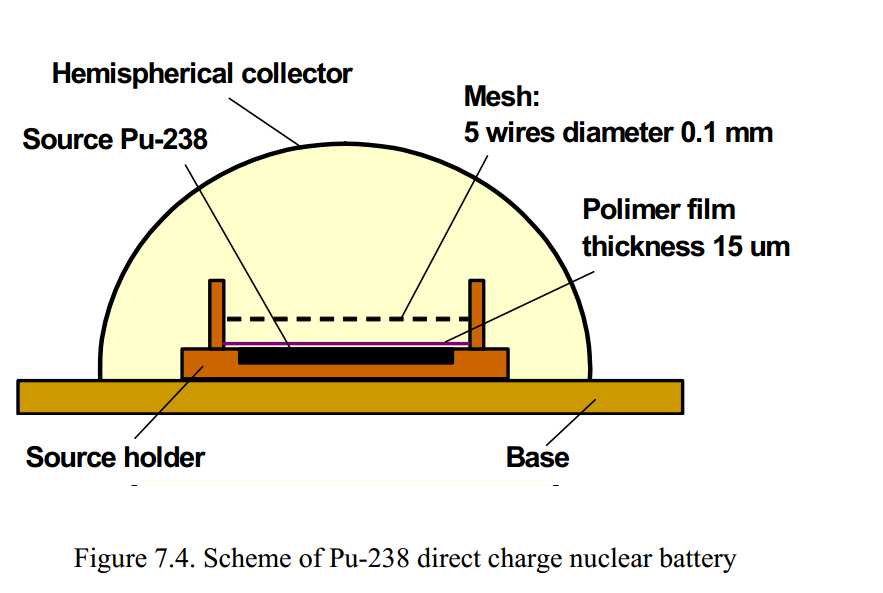
NUCLEAR BATTERIES WITH TRITIUM
AND PROMETHIUM-147 RADIOACTIVE SOURCES
BY
GALINA NIKOLAYEVNA YAKUBOVA
https://www.ideals.illinois.edu/bitstream/handle/2142/16849/1_Yakubova_Galina.pdf?sequence=3
Chinese Advert

Tritium Hazard Report: Pollution and Radiation Risk from Canadian Nuclear Facilities
Publication – June 11, 2007
Canada Considering Nuclear Reactors in Alberta Tar Sands Fields -Designed by Bill Gates?
“…The wisdom of dotting Canada’s remote northern landscape with mini reactors has yet to be debated, but with Harper’s conservative government and the figures stated above, it seems likely that mini reactors in the Great White North are most likely a done deal….”
“…Toshiba’s new mini reactor will produce only 10,000-50,000 kilowatts, about one to five percent the power of a regular nuclear reactor, according to company sources, with the steam generated in the reactor pumped underground. Toshiba reportedly plans to construct a nuclear reactor building underground, with an earthquake-absorbing structure.
Besides potential earthquakes, the buried reactor will have to cope with temperatures as cold as –40C in winter and 30C in the summer….”
http://gizmodo.com/5499923/an-underground-nuclear-reactor-powered-by-bill-gates-money

By John Daly | Mon, 21 January 2013 22:42
Like them or hate them, Alberta, Canada’s tar sands deposits of bitumen or extremely heavy crude oil, are the world’s largest. The province’s resources include the Athabasca, Peace River and Cold Lake deposits in the McMurray Formation, which consist of a mixture of crude bitumen, a semi-solid form of crude oil, admixed with silica sand, clay minerals, and water.
According to the U.S. government’s Energy Information Administration, “Canada controls the third-largest amount of proven reserves in the world, after Saudi Arabia and Venezuela… Canada’s proven oil reserve levels have been stagnant or slightly declining since 2003, when they increased by an order of magnitude after oil sands resources were deemed to be technically and economically recoverable. The oil sands now account for approximately 170 billion barrels, or 98 percent, of Canada’s oil reserves.”
Lying under 54,000 square miles of forest and bogs, the bitumen tar sands are estimated to be comparable in magnitude to the world’s total proven reserves of conventional petroleum.
But exploiting the tar sands comes at a significant environmental cost.
Oil sands pollution is not a topic that Ottawa is keen to publicize. In 2009 the Canadian government acknowledged that it deliberately had excluded data indicating a 20 percent increase in annual pollution from Canada’s oil sands industry from a 567-page report on climate change that it was required to submit to the United Nations.
Quite aside from the despoliation of the landscape, Alberta’s oil sands have been found to be one of the major causes of air pollution in Canada, as Tar sands facilities were found to be among the top four highest polluters of volatile organic compounds, a major air contaminant, along with acid rain.
Related Article: Looking at the Technologies that could Herald the Nuclear Revolution
That pollution rap sheet could soon include nuclear, as Toshiba is developing “mini” nuclear reactors to be used to mine Canadian oil sands, with an initial deployment projected by 2020.
Why nuclear power? It is estimated that approximately 90 percent of the Alberta oil sands are too far below the surface to use open-pit mining. Making liquid fuels from oil sands requires energy for steam injection and refining. Mining oil sands is water intensive; drilling one well consumes 5.5 acre-feet of water each year, and the production of one gallon of oil requires thirty-five gallons of water.
Kashmir -Police sound nuclear war bugle!
“…The state police’s Disaster Response Force advises people to stay calm during a nuclear event.
“Blast wind will generally end in one or two minutes after burst and burns, cuts and bruises are no different than conventional injuries. Dazzle is temporary and vision should return in few seconds.”…”
Hiroshima after the bomb

Amid Indo-Pak tension at LoC, people asked to remain prepared
By Reader Correspondent
Published: Tue, 22 January 2013 10:44 PM
Srinagar: The state police Monday issued a detailed public awareness notice through a local English language daily about what the people should and should not do in the event of a nuclear attack or use of chemical and biological weapons.
The awareness notice comes at a time when a flare up along the Line of Control in Poonch sector appeared to threaten escalation of violence between India and Pakistan.
The notice issued by the Inspector General of Police, Home Guard, Civil Defence and State Disaster Response Force (SDRF) Jammu Kashmir sets out in detail instructions to the people about what to do before, during and after a nuclear war.
One of the principle instructions asks the people in the state to construct basements “where the whole family can stay for a fortnight”.
“In case no basement is available then in an open space in front of your house, construct bunkers as in conventional war, as some protection is better than no protection,” reads the notice.
The information though certainly very useful for those living in a region often described as the most dangerous flashpoint in the world and bitterly contested by nuclear-armed India and Pakistan could refresh memories of the two wars the two countries have fought over it.
The awareness notice asks residents that they should stock up emergency shelters with “non-perishable foods and water to be replaced regularly before getting unhygienic.”
“Construct toilet facilities at the basement, store ample candles and battery lights, remove stock of flammables, if any.”
Residents have also been asked to keep battery operated miniature transistor TV sets in the basement shelters for listening in to instructions that may be announced by civil defence authorities during such a disaster.
The instructions are wide ranging.
USA -Nuclear Reactor Vessel Can’t Move from Port of Savannah
“…Williams says the vessel won’t be needed at the construction site until March. However, Clements says that’s because the project is behind schedule. He says it’s already over budget as well by about $900 million dollars. (Georgia Power disputes many of the cost overruns.)
Still Clements says the issue of not being able to move the reactor vessel is just another example of the problems that have plagued this project from the begnning, with rate payers footing the bill. He says if there is a plan to move it, the public needs to know and how the delay may be impacting the cost. “They just need to explain it in my opinion to the public and if it’s costing the Georgia ratepayer any more money,” he said….”
By: JOANN MERRIGAN | WSAV News 3
Published: January 21, 2013
Savannah, GA) The Alliance for Nuclear Accountability is concerned about what it says is a 300 ton problem. It’s talking about the nuclear reactor vessel that came from Korea last month as part of the new project at Plant Vogtle near Waynesboro. The concrete vessel was made in Korea and came by ship to the Port of Savannah. Once there, it was loaded onto a specially built rail car for the trip to Plant Vogtle (about 100 miles.)

But the Alliance says it didn’t get very far. “The NRC says it made it about a quarter of a mile and there was this big “shift” and the train stopped. And they came back to the Port and it’s been sitting there since December 15,” says Tom Clements from the Alliance.
“Georgia Power customers that are paying for the new nuclear plant are basically in the dark,” he says. “We don’t know what the plan is on moving this thing. Can they move it? Is the delay costing us.”
We found the rail car for ourselves and took our own video. We were told by Clements that the reactor vessel is underneath the blue tarp.
“They haven’t demonstrated they can carry it to Plant Vogtle,” said Clements.
Westinghouse ,one of the construction partners, designed the rail car to distribute the weight of the reactor vessel which is about the equivalent of 200 automobiles. Clements questions if the car needs repairs or if the rail lines can ultimately support the weight of 300 tons.
1 This Month

of the week – Shut Down Drone Warfare!


Tell the Ukrainian Government to Drop Prosecution of Peace Activist Yurii Sheliazhenko

Petition to revoke the licensing of the Near Surface Nuclear Disposal Facility (NSDF) at Chalk River. https://www.ourcommons.ca/petitions/en/Petition/Details?Petition=e-7247
To see nuclear-related stories in greater depth and intensity – go to https://nuclearinformation.wordpress.com
-
Archives
- April 2026 (68)
- March 2026 (251)
- February 2026 (268)
- January 2026 (308)
- December 2025 (358)
- November 2025 (359)
- October 2025 (376)
- September 2025 (257)
- August 2025 (319)
- July 2025 (230)
- June 2025 (348)
- May 2025 (261)
-
Categories
- 1
- 1 NUCLEAR ISSUES
- business and costs
- climate change
- culture and arts
- ENERGY
- environment
- health
- history
- indigenous issues
- Legal
- marketing of nuclear
- media
- opposition to nuclear
- PERSONAL STORIES
- politics
- politics international
- Religion and ethics
- safety
- secrets,lies and civil liberties
- spinbuster
- technology
- Uranium
- wastes
- weapons and war
- Women
- 2 WORLD
- ACTION
- AFRICA
- Atrocities
- AUSTRALIA
- Christina's notes
- Christina's themes
- culture and arts
- Events
- Fuk 2022
- Fuk 2023
- Fukushima 2017
- Fukushima 2018
- fukushima 2019
- Fukushima 2020
- Fukushima 2021
- general
- global warming
- Humour (God we need it)
- Nuclear
- RARE EARTHS
- Reference
- resources – print
- Resources -audiovicual
- Weekly Newsletter
- World
- World Nuclear
- YouTube
-
RSS
Entries RSS
Comments RSS
 nuclear-news