Launch of new Russia sub class to put more nuclear missiles at sea
“….Indeed, Kurdrik has been skeptical of the perceived submarine build up in the North – a sabre Putin has largely rattled to protect enormous oil and gas reserves in the Russian Arctic….”
“….A recent report published by the Federation of American Scientists estimates that Russia has a total of 144 missiles with 350 warheads deployed on submarines currently.
Between 30 and 40 of the missiles are on the two to three operativing Delta-III class vessels based in the Pacific, and the rest on submarines based in Gadzhiyevo near the border to Norway. The total number for both fleets will increase to 172 missiles with as many 624 warheads by 2022 – nearly twice as MANY as today, according to the American estimates….”
“….Indeed, looking at a map of the existing nuclear weapons free zones, it only takes a glance to be reminded that a nuclear-free Arctic would bring some balance in a world where most nuclear weapons free zones are located in the South….”
Russia’s first Borey class ballistic missile nuclear submarine – and its first strategic submarine since 1992 – the Yury Dolgoruky, was officially commissioned Thursday to great fanfare and the presence of Russian president Vladimir Putin via video feed – to Russia’s Northern Nuclear Fleet.
14/01-2013
Bellona
Russian Defense Minister Sergei Shoigu attended the flag hoisting ceremony at the Sevmash shipyard in Severodvinsk in northern Russia, RIA Novosti reported. The signing of the acceptance act by the Defense Ministry took place on December 29.
The Borey class submarines are expected to form the core of Russia’s strategic submarine fleet, replacing the aging Project 941, or NATO Typhoon class, and Project 667 class, or Delta- Delta-4 boats.
Russia is planning to build eight Borey and Borey-A class subs by 2020.
With the commissioning of the sub comes an increase in the number of strategic nuclear warheads deployed from Russia’s Kola Peninsula.
It also brings with it no small measure of Soviet-style jingoism: Upon the hoisting of the sub’s flag, Dmitry Rogozin, Russia’s Vice Premier and former ambassador to NATO posted a tweet to his twitter account reading “shiver bourgeoisie. You’re done for.”
A Borey class strategic submarine is 170 meters long, has a hull diameter of 13 meters, and a crew of 107, including 55 officers, a maximum depth of about 450 meters and a submerged speed of about 29 knots.
All the Borey class strategic submarines carry up to 16 Bulava ballistic missiles with multiple warheads, RIA Novosti reported. In sum, the launch of the Borey Class would mean no fewer that 600 new nuclear warheads in Russian waters.
In total, eight Borey-class submarines will enter service over the next ten years. Beginning with the fourth submarine, the number of missiles, the number of missiles each sub will carry is expected to be 20 instead of 16. In other words, similar to the Typhoon-class submarines which gained fame during the Cold War.
The next two Borei Class subs, the Vladimir Monomakh and the Alexander Nevsky are currently in Severdvink awaiting more sea trials.
Bellona’s Igor Kudrik, an expert on the Russian navy, characterized the release of the Borey Class as “bragging” from Putin’s Russia.
“The US outspends the Russians dramatically, where Russia is unable to produce anything reliable or working due to enormous corruption.”
Kudrik said that even though the Yury Dolgoruky has been commissioned, it could take years before it is put into a working state
It is expected that four of the eight Borey class submarines will be put into service in the Pacific and that the other four will remain with the northern fleet
According to the Barents Observer news portal , the Borey Class will replace two Delta III subs where in the North they will operate together with the Delta IV and Borey will operate together for at least a decade.
Kudrik was skeptical the Deltas would continue to operate, given that each was reaching the end of its 30-year engineered life span – even though they been upgrades, and further cast aspersions on the efforts toward the Borey.
“How can you expect anything serious from the clowns of Rogozin’s type,” he said.
Indeed, Kurdrik has been skeptical of the perceived submarine build up in the North – a sabre Putin has largely rattled to protect enormous oil and gas reserves in the Russian Arctic.
He pointed to the even newer class of Yasen submarinesthe Navy is trying to put to sail with little success. The lead ship in this class, the Severodvinsk – a multipurpose nuclear sub meant be a first alert against missile cruisers from western countries – was designed in 1992, is being assembled from old parts and has been crippled by budget overruns.
Constructed by the Sevmash, the Severodvinsk– designated by the identification number K-329, and the first of the project 885 Yasen Class – was to have been passed to the Russian Navy by Sevmash in 1998, after first construction began on it in1993. Several missed deadlines later, the boat was to be launched in 2010. That was then delayed until 2011.
According to reports in business daily Kommersant and official government mouthpiece Izvestia, the latest sea trial indicates the sub likely will not be ready until summer of 2013.
One of the problems, according to an anonymous source cited by Interfax, is that the reactor not only doesn’t deliver enough power for the vessel, but that the vessel’s operation is also noisy – something undesirable in the stealth mode in which submarines are to operate.
Yet the deployment of nuclear missiles in the Barents Sea by the Russian navy is seeing a stark spike not seen since the 2006 upgrade of the Delta IV Class. As the new Borey-class enters service, the numbers of nuclear warheads will steadily increase until the six Delta-IV vessels are be removed from service, presumably around 2020.
A recent report published by the Federation of American Scientists estimates that Russia has a total of 144 missiles with 350 warheads deployed on submarines currently.
Between 30 and 40 of the missiles are on the two to three operativing Delta-III class vessels based in the Pacific, and the rest on submarines based in Gadzhiyevo near the border to Norway. The total number for both fleets will increase to 172 missiles with as many 624 warheads by 2022 – nearly twice as MANY as today, according to the American estimates.
http://www.bellona.org/articles/articles_2012/launch_borey
FRIDAY, JULY 31, 2009
Arctic Freeze
John is right to place the Obama-Medvedev nuclear weapons stockpile reduction commitment in the context of what’s left of the global non-proliferation regime, which will hold a five-year review next year, in 2010. In a piece I wrote in April after President Obama delivered his speech in Prague, I expained why the five Nuclear Weapon States recognized under the treaty will be pressed hard to show that they’re delivering on their legal obligation to curb vertical proliferation. And how important this is to diminish the threats from horizontal proliferation.
The number of known States possessing nuclear weapons has almost doubled since the Treaty on the Proliferation of Nuclear Weapons (NPT) was adopted in 1968. It would be wrong to say that the NPT has been a complete failure because the number of Nuclear Weapons States would be higher if it had not existed. But one cannot on the one hand tear apart the principles and letter of the treaty — as the five formal Nuclear Weapon States have done most of this time, and continue at varying degrees including in the case of the US and China not ratifying the Comprehensive Nuclear Test Ban Treaty (CTBT), and ask the rest of the world to adhere to it. I’m very curious to know what will come out of the Global Summit on Nuclear Security the US Government wants to host in 2010, because indeed it’s time to think out of the NPT box. Ban Ki-Moon is trying hard, but it’s tough when the largest part of the UN budget comes from Nuclear Weapons States.
John Willis proposes a Nuclear Free Arctic as a goal. “Russia and the US can take the lead on a treaty to impose a permanent ban on nuclear weapons (and nuclear-powered vessels) in the Arctic region“, says Willis who (as a good Canadian) also thinks it would give his government something good to do.
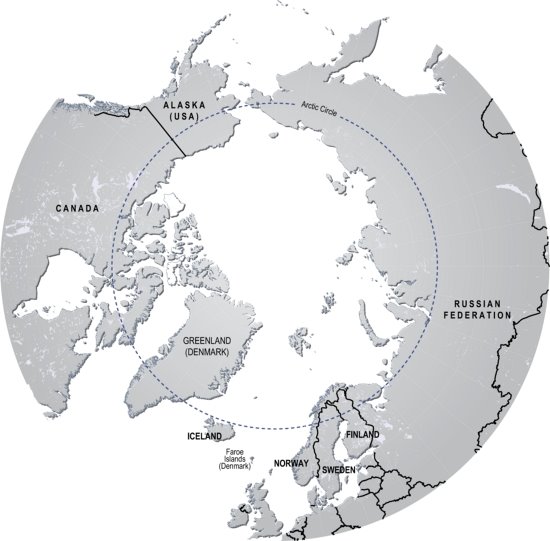
Indeed, looking at a map of the existing nuclear weapons free zones, it only takes a glance to be reminded that a nuclear-free Arctic would bring some balance in a world where most nuclear weapons free zones are located in the South.

Willis’ Nuclear Free Arctic model would include nuclear-powered vessels. That’s interesting. Not only because we know there are plenty of nuclear submarines under what’s left of the ice-flow. Not only also because the Arctic happens to be the only maritime region where a full blown nuclear meltdown is known to have happened, on board the Soviet nuclear icebreaker Lenin in the 1960s. But also because the Arctic is where a new generation of nuclear installations, floating nuclear power stations are about to be deployed.
We’ve already discussed floating nuclear reactors many times Chez Rémi. The last thing I read, on the website of World Nuclear News in the month of June, was that the assembly of the first “floating” 35 MW reactor had been completed in St.Petersburg
According to World Nuclear News, an All-Russian Acceptance Committee says the reactor meets “required standard” (it sounds good, but…I wonder who’s set the standard?).
The reactor was due to be transported in June to the Baltiysky Zavod ship-building company in St.Petersburg to be placed into the keel of the first floating plant. The first plant will house two KLT-40S reactors, the second of which is being built now.
The first floating plant is expected to be in operation in 2012, to provide energy for the exploitation of Arctic minerals expected to become available with the retreat of the icecap. Unless of course, John Willis and his friends in Canada and elsewhere, stand up and say “Wait a moment! We don’t want any floating Chernobyls on our doorstep!”
No comments yet.
1 This Month

of the week – Shut Down Drone Warfare!


Tell the Ukrainian Government to Drop Prosecution of Peace Activist Yurii Sheliazhenko

Petition to revoke the licensing of the Near Surface Nuclear Disposal Facility (NSDF) at Chalk River. https://www.ourcommons.ca/petitions/en/Petition/Details?Petition=e-7247
To see nuclear-related stories in greater depth and intensity – go to https://nuclearinformation.wordpress.com
-
Archives
- April 2026 (103)
- March 2026 (251)
- February 2026 (268)
- January 2026 (308)
- December 2025 (358)
- November 2025 (359)
- October 2025 (376)
- September 2025 (257)
- August 2025 (319)
- July 2025 (230)
- June 2025 (348)
- May 2025 (261)
-
Categories
- 1
- 1 NUCLEAR ISSUES
- business and costs
- climate change
- culture and arts
- ENERGY
- environment
- health
- history
- indigenous issues
- Legal
- marketing of nuclear
- media
- opposition to nuclear
- PERSONAL STORIES
- politics
- politics international
- Religion and ethics
- safety
- secrets,lies and civil liberties
- spinbuster
- technology
- Uranium
- wastes
- weapons and war
- Women
- 2 WORLD
- ACTION
- AFRICA
- Atrocities
- AUSTRALIA
- Christina's notes
- Christina's themes
- culture and arts
- Events
- Fuk 2022
- Fuk 2023
- Fukushima 2017
- Fukushima 2018
- fukushima 2019
- Fukushima 2020
- Fukushima 2021
- general
- global warming
- Humour (God we need it)
- Nuclear
- RARE EARTHS
- Reference
- resources – print
- Resources -audiovicual
- Weekly Newsletter
- World
- World Nuclear
- YouTube
-
RSS
Entries RSS
Comments RSS
 nuclear-news

Leave a comment