UAE, Argentina sign civil nuclear pact – honest!
“…At the time of the 1992 bombing of the Israeli Embassy, Argentina was engaged in
discussions about training Iranian scientists at Argentina’s nuclear facility, and,
through 1993, it delivered promised shipments of low-enriched uranium for Iran’s
nuclear program….”
Graph coutesy of eia.gov

By: AFP | January 15, 2013
ABU DHABI – The UAE and Argentina signed on Monday an agreement to cooperate in the field of peaceful nuclear energy during a visit by President Cristina Kirchner, the state news agency WAM reported. The memorandum of understanding was signed by Emirati Foreign Minister Sheikh Abdullah bin Zayed al-Nahayan and his Argentine counterpart Hector Timerman, WAM said. Kirchner and UAE President Sheikh Khalifa bin Zayed al-Nahayan attended the signing ceremony after discussions on bilateral cooperation between their countries, WAM said. The UAE announced in mid-July that it would begin building two of four nuclear power plants in partnership with a SKorean consortium, as part of plans to produce power from 2017.
Despite being a major oil exporter, the UAE has opted for nuclear, seeing it as a proven, environmentally promising and commercially competitive source of electricity, upon which it relies to produce all of its drinking water via desalination.
With the four plants scheduled to be operating by 2020, the UAE hopes that nuclear energy can provide up to a quarter of its electricity needs, which are forecast to soar to 40 gigawatts from 15.5 currently.
‘Corruption’ arrests in South Korea
12 July 2012
“…Prosecutors have arrested 22 people as they investigate alleged widespread corruption surrounding Korea Hydro and Nuclear Power’s (KHNP’s) procurement processes…”
http://www.world-nuclear-news.org/C_KHNP_corruption_arrests_1206121.html
Nuclear Threat in the Eastern Mediterranean
The Case Against Turkey’s Akkuyu Nuclear Plant
2000
“….Concerns about Turkey’s potential involvement in nuclear weapons proliferation have continued in the
1990s. International pressure was required in 1990-91 to force an end to joint plans by Argentina and Turkey
to build the CAREM-15, a 25 MW reactor in their respective countries. If the rating was 25 MW thermal, the
electrical rating would have probably peaked at about 9 or 10 MWe, although the Argentine representatives
suggested that the reactor could also be used for district heating or desalination.[323] Yalcin Sanalan, a
former Director of TAEA was more frank when he stated that the CAREM-25 was “…too small for electricity
generation and too big for research or training, however, very suitable for plutonium production” thus making
it a very real proliferation risk. American opposition to the joint Argentine/Turkish project was made
clear[324] , and Sanalan “concluded that such an ambiguous project would decrease the chances of Turkey in
its current and future quest for large-scale nuclear power plants…”.[325] Although the nuclear cooperation
agreement between Turkey and Argentina has remained in place, Turkey cancelled the reactor project in
1991, following pressure from the United States and others.[326]….”
Page 68
http://www.cnp.ca/issues/nuc-threat-mediterranean.pdf
Back to the Future
Argentina Unravels
Douglas Farah, Senior Fellow Transparency and Financial Investigations
International Assessment and Strategy Cente
Jan 2013
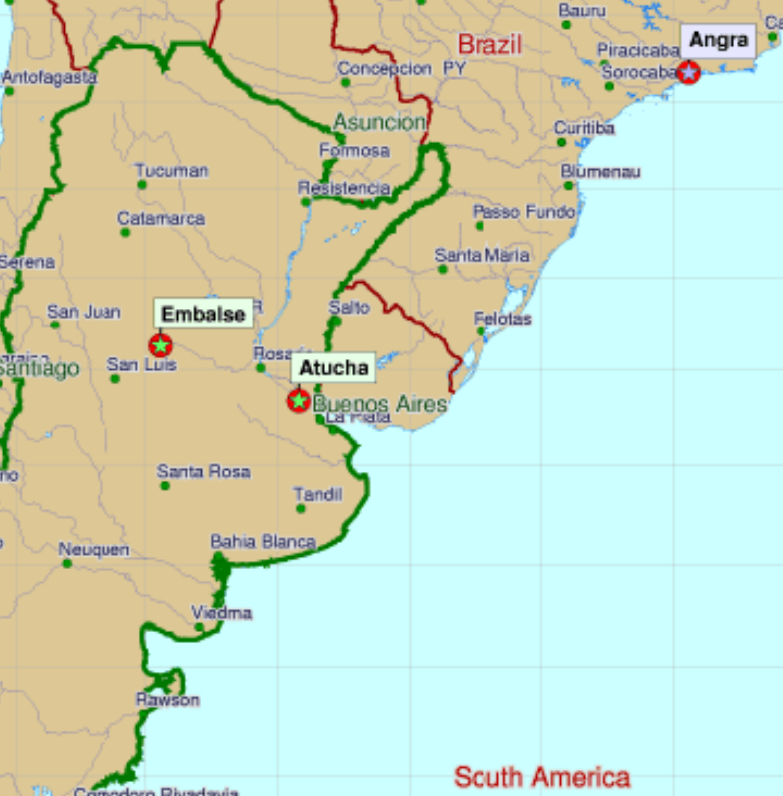
Figure 2: Map of Argentina showing its two nuclear power plants. Image taken from
http://www.icjt.org/npp/drzava.php?drzava=1
“…
Argentina’s growing economic crisis has also significantly increased Iran’s economic
leverage: the Islamic republic is a significant buyer of Argentine wheat, soy, beef and
other agricultural products. Since 2006, bilateral trade has increased notably, with
Argentina running a significant trade surplus. From 2007 to 2008, Argentinian
exports to Iran almost tripled, from $100 million to $266 million. By 2009,
Argentina’s exports to Iran reached $855.4 million while its imports were just $9.4
million. Exports for 2011 are estimated to be about $2 billion.23
Perhaps the most interesting component to the new relationship is the possibility of
Argentina aiding Iran in its nuclear program, for which there is a precedent but
which would represent a clear rupture with the international community aligned
with the United States and Europe. While the possibility of nuclear cooperation is
viewed as remote by many analysts, the little-studied precedents make such
collaboration feasible.
At the time of the 1992 bombing of the Israeli Embassy, Argentina was engaged in
discussions about training Iranian scientists at Argentina’s nuclear facility, and,
through 1993, it delivered promised shipments of low-enriched uranium for Iran’s
nuclear program….”
Page 14
http://www.strategycenter.net/docLib/20121204_Farah_BackToTheFuture.pdf
No comments yet.
1 This Month

of the week – Shut Down Drone Warfare!


Tell the Ukrainian Government to Drop Prosecution of Peace Activist Yurii Sheliazhenko

Petition to revoke the licensing of the Near Surface Nuclear Disposal Facility (NSDF) at Chalk River. https://www.ourcommons.ca/petitions/en/Petition/Details?Petition=e-7247
To see nuclear-related stories in greater depth and intensity – go to https://nuclearinformation.wordpress.com
-
Archives
- April 2026 (91)
- March 2026 (251)
- February 2026 (268)
- January 2026 (308)
- December 2025 (358)
- November 2025 (359)
- October 2025 (376)
- September 2025 (257)
- August 2025 (319)
- July 2025 (230)
- June 2025 (348)
- May 2025 (261)
-
Categories
- 1
- 1 NUCLEAR ISSUES
- business and costs
- climate change
- culture and arts
- ENERGY
- environment
- health
- history
- indigenous issues
- Legal
- marketing of nuclear
- media
- opposition to nuclear
- PERSONAL STORIES
- politics
- politics international
- Religion and ethics
- safety
- secrets,lies and civil liberties
- spinbuster
- technology
- Uranium
- wastes
- weapons and war
- Women
- 2 WORLD
- ACTION
- AFRICA
- Atrocities
- AUSTRALIA
- Christina's notes
- Christina's themes
- culture and arts
- Events
- Fuk 2022
- Fuk 2023
- Fukushima 2017
- Fukushima 2018
- fukushima 2019
- Fukushima 2020
- Fukushima 2021
- general
- global warming
- Humour (God we need it)
- Nuclear
- RARE EARTHS
- Reference
- resources – print
- Resources -audiovicual
- Weekly Newsletter
- World
- World Nuclear
- YouTube
-
RSS
Entries RSS
Comments RSS
 nuclear-news
Leave a comment