Time to move nuclear wastes to dry cask storage
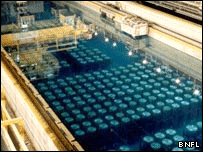 as the second anniversary of the Fukushima Daiichi nuclear accident in Japan draws near, some members of Congress say it is time to reduce the risk posed by spent fuel by moving some of it to dry casks.
Ron Wyden, an Oregon Democrat, will take over as the committee’s chairmanwhen Congress begins its new session next month. In an interview on Monday, he pointed out that the department collects about $750 million a year in waste disposal fees at the rate of one-tenth of a cent per kilowatt-hour generated by the reactors that feed those utilities. Yet the government is spending nearly nothing, he noted……
Mr. Wyden said the committee would have to take a broad look at the issue of the Energy Department’s nuclear waste fund. “The utilities are obviously unhappy they’re paying the money,’’ which is being “hijacked” for other purposes, he said — namely, deficit reduction. The fund now has a balance of $25 billion. “There is a lot of frustration” about the money and the lack of progress, he said.
Collecting money at the same rate at which it is being spent has precedents. “That is how the Nuclear Regulatory Commission is funded,” Mr. Wyden pointed out. Most of the commission’s budget comes from licensing fees.
The electric power industry has been pressing for cuts in the fees, as have some state officials who regulate the utilities. Whether Congress will go along is not clear, but every part of the nuclear waste question is now on the table.
The waste disposal fees were enshrined as law in the 1980s and are the last surviving element of a three-decade-old national consensus that the Energy Department should evaluate candidate sites, pick the best one and build a repository for nuclear wastes there. (Congress eventually told the department not to bother looking beyond Yucca Mountain — an idea that seemed to meet with the approval of everybody outside Nevada for a long while.)
A blue-ribbon commission that President Obama appointed after shelving the Yucca Mountain plan recommended starting over and searching for a new site in a process based on the host state’s consent, as opposed to forcing a repository on an unwilling Nevada.
That implies that a permanent repository is many years into the future, possibly beyond the lifetimes of many of the reactors now operating. Dominion said in October that it would close its Kewaunee nuclear plant in Wisconsin. And with the current glut of natural gas, more closings seem possible, which means leaving the wastes behind — “stranded,” as Mr. Wyden put it — at the sites of defunct reactors.
Meanwhile, as the second anniversary of the Fukushima Daiichi nuclear accident in Japan draws near, some members of Congress say it is time to reduce the risk posed by spent fuel by moving some of it to dry casks.
Alison Macfarlane, who took over as chairwoman of the Nuclear Regulatory Commission in June, expressed support for that step before assuming her post but has not pressed it lately. Mr. Wyden proposes examining the reactors on a case-by-case basis, focusing on those with a boiling water design of the type used at Fukushima, to consider which ones should have their spent fuel pools partly emptied.http://green.blogs.nytimes.com/2012/12/18/come-january-another-try-on-nuclear-waste/?smid=fb-share
No comments yet.
1 This Month

of the week – Shut Down Drone Warfare!


Tell the Ukrainian Government to Drop Prosecution of Peace Activist Yurii Sheliazhenko

Petition to revoke the licensing of the Near Surface Nuclear Disposal Facility (NSDF) at Chalk River. https://www.ourcommons.ca/petitions/en/Petition/Details?Petition=e-7247
To see nuclear-related stories in greater depth and intensity – go to https://nuclearinformation.wordpress.com
-
Archives
- April 2026 (91)
- March 2026 (251)
- February 2026 (268)
- January 2026 (308)
- December 2025 (358)
- November 2025 (359)
- October 2025 (376)
- September 2025 (257)
- August 2025 (319)
- July 2025 (230)
- June 2025 (348)
- May 2025 (261)
-
Categories
- 1
- 1 NUCLEAR ISSUES
- business and costs
- climate change
- culture and arts
- ENERGY
- environment
- health
- history
- indigenous issues
- Legal
- marketing of nuclear
- media
- opposition to nuclear
- PERSONAL STORIES
- politics
- politics international
- Religion and ethics
- safety
- secrets,lies and civil liberties
- spinbuster
- technology
- Uranium
- wastes
- weapons and war
- Women
- 2 WORLD
- ACTION
- AFRICA
- Atrocities
- AUSTRALIA
- Christina's notes
- Christina's themes
- culture and arts
- Events
- Fuk 2022
- Fuk 2023
- Fukushima 2017
- Fukushima 2018
- fukushima 2019
- Fukushima 2020
- Fukushima 2021
- general
- global warming
- Humour (God we need it)
- Nuclear
- RARE EARTHS
- Reference
- resources – print
- Resources -audiovicual
- Weekly Newsletter
- World
- World Nuclear
- YouTube
-
RSS
Entries RSS
Comments RSS
 nuclear-news
Leave a comment