What made the atomic scientists tick?
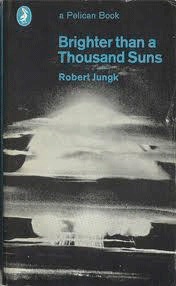 Character before knowledge, Online Opinion, by Noel Wauchope 10 Jan 13, ” Brighter than a Thousand Suns”, A Personal History of the Atomic Scientists, by Robert Jungk, was first published in 1956. “Why are we interested only in what scientists do, and not in what they are? ” This opening question informs Jungk’s entire book. Jungk conversed with many of the scientists of the early days of atomic research, and through until 1954. With the earliest conversations, Jungk was struck by ”the arbitrary and unnatural separation of scientific research from the reality of the individual personality”. To Jungk, it was this division that ”allowed the creation of such monstrosities as the atomic bomb and the hydrogen bomb”.
To this day, many nuclear scientists think of their work as purely mathematical and technical. The human results of nuclear weapons are none of their business. Others, especially after Hiroshima, suffered “their great crisis of conscience”……..
From then on, it was a rush to test the bomb, and then use it, before the Japanese surrendered. Three atomic bombs were built. The first – tested: if the test was a failure – it would be reported as a “girl” – if successful a “boy”.
For the second and third bombs, 67 Scientists petitioned the government to warn the Japanese first – a petition that was prevented by General Groves from reaching the White House. Enrico Fermi commented “Don’t bother me with your conscientious scruples! After all, the thing is superb physics!”
The $2 billion Manhattan Project would be seen as a senseless waste of money, if Japan surrendered. Truman authorised the bombing of Hiroshima and Nagasaki. Oppenheimer explained later that his Interim Committee’s recommendation was “a technical opinion”.
The reactions of the scientists were conflicted……
Robert Jungk’s account of the men, and some women, too, who developed atomic weapons , is set against the background of the big events of the time, with a sympathetic attitude to the pressures and problems that surrounded these people.
From 1951 to 1955 the general attitude of atomic scientists was one of enthusiasm for the hydrogen bomb (1000 times more powerful than the first atomic bomb). Jungk muses on this: “How is one to explain such macabre enthusiasm which had swept away all the earlier scruples and objections to the Super monster?” http://www.onlineopinion.com.au/view.asp?article=14554
No comments yet.
1 This Month
Chernobyl: The Lost Tapes – A good documentary on Chernobyl on SBS available On Demand for the next 3 weeks– https://www.sbs.com.au/ondemand/tv-program/chernobyl-the-lost-tapes/2352741955560

of the week–London Campaign for Nuclear Disarmament

Tell the Ukrainian Government to Drop Prosecution of Peace Activist Yurii Sheliazhenko
To see nuclear-related stories in greater depth and intensity – go to https://nuclearinformation.wordpress.com
-
Archives
- April 2026 (139)
- March 2026 (251)
- February 2026 (268)
- January 2026 (308)
- December 2025 (358)
- November 2025 (359)
- October 2025 (376)
- September 2025 (257)
- August 2025 (319)
- July 2025 (230)
- June 2025 (348)
- May 2025 (261)
-
Categories
- 1
- 1 NUCLEAR ISSUES
- business and costs
- climate change
- culture and arts
- ENERGY
- environment
- health
- history
- indigenous issues
- Legal
- marketing of nuclear
- media
- opposition to nuclear
- PERSONAL STORIES
- politics
- politics international
- Religion and ethics
- safety
- secrets,lies and civil liberties
- spinbuster
- technology
- Uranium
- wastes
- weapons and war
- Women
- 2 WORLD
- ACTION
- AFRICA
- Atrocities
- AUSTRALIA
- Christina's notes
- Christina's themes
- culture and arts
- Events
- Fuk 2022
- Fuk 2023
- Fukushima 2017
- Fukushima 2018
- fukushima 2019
- Fukushima 2020
- Fukushima 2021
- general
- global warming
- Humour (God we need it)
- Nuclear
- RARE EARTHS
- Reference
- resources – print
- Resources -audiovicual
- Weekly Newsletter
- World
- World Nuclear
- YouTube
-
RSS
Entries RSS
Comments RSS
 nuclear-news
Leave a comment