The Avian and Wildlife Costs of Fossil Fuels and Nuclear Power

“…Within the uncertainties of the data used, the estimate means that wind farm-related avian fatalities equated to approximately 46,000 birds in the United States in 2009, but nuclear power plants killed about 460,000 and fossil-fueled power plants 24 million…”
Benjamin K. Sovacool
Lee Kuan Yew School of Public Policy – Centre on Asia and Globalisation
June 30, 2012
Journal of Integrative Environmental Sciences vol. 9, no. 4, December 2012, 255-278
Vermont Law School Research Paper No. 04-13
Abstract:
Environmentalists and environmental scientists have criticized wind energy in various forums for its negative impacts on wildlife, especially birds. This article highlights that nuclear power and fossil-fuelled power systems have a host of environmental and wildlife costs as well, particularly for birds. Therefore, as a low-emission, low-pollution energy source, the wider use of wind energy can save wildlife and birds as it displaces these more harmful sources of electricity. The paper provides two examples: one relates to a calculation of avian fatalities across wind electricity, fossil-fueled, and nuclear power systems in the entire United States. It estimates that wind farms are responsible for roughly 0.27 avian fatalities per gigawatt-hour (GWh) of electricity while nuclear power plants involve 0.6 fatalities per GWh and fossil-fueled power stations are responsible for about 9.4 fatalities per GWh. Within the uncertainties of the data used, the estimate means that wind farm-related avian fatalities equated to approximately 46,000 birds in the United States in 2009, but nuclear power plants killed about 460,000 and fossil-fueled power plants 24 million. A second example summarizes the wildlife benefits from a 580-MW wind farm at Altamont Pass in California, a facility that some have criticized for its impact on wildlife. The paper lastly highlights other social and environmental benefits to wind farms compared to other sources of electricity and energy.
Number of Pages in PDF File: 26
http://papers.ssrn.com/sol3/Delivery.cfm/SSRN_ID2198024_code1250463.pdf?abstractid=2198024&mirid=1
Kazakhstan’s nuclear legacy – Euronews video
14/04/2010
At the elderly care home in Semipalatinsk, we met 85 year old Praskovya. Semipalatinsk, or Semey, is a city 150 kilometers from the main Soviet nuclear weapons test site.

Praskovya is a former warehouse manager who used to work in a small town bordering the restricted area in the 1950s. She witnessed one of the nuclear explosions: “We were curious, so we went outside to watch. When the explosion happened, it looked like a large bowl, with black smoke and flames coming from the bowl. Then it rolled into a ball, and a smoke column went up, and at the top, the mushroom appeared. And then the soldiers came and made us leave the street, shouting “it’s not allowed, it’s not allowed”. But we already saw everything interesting. And then everyone got health problems. I’ve had headaches all my life.”
After a wave of popular protests, the Semipalatinsk site was closed in 1991. It had carried out 456 secret nuclear tests.
President of Kazakhstan, Nursultan Nazarbayev, took the decision to close down the facility: “Even senior leaders of Kazakhstan were not allowed to know about the ongoing tests until 1990, until Gorbachev’s glasnost and the opportunity to speak. And as a result of demands from the people, who already knew and understood the complexity and gravity of the issues, I took the only right decision – despite difficulties at the time. The military-industrial complex of the Soviet Union was against it and the Soviet leadership was also against it.”
However, the closure could not reverse the environmental damage to the region, which has more than a million inhabitants, most of which are villagers. Radioactive fallout from nuclear blasts have given Semey and neighboring villages abnormally high rates of cancer and birth defects.
Local oncology centers are screening tens of thousands of patients, trying to detect and treat tumors at early stages. People living in the area are still predisposed to breast and pulmonary cancer.
Tleugaysha Makenova suffers from breast cancer: “I live in a district close to the test zone. Last year I was diagnosed with breast cancer. I had to have an operation and radiation therapy. I didn’t see any explosions myself, but my parents talked about the effects of the blasts on the people. My husband got cancer too – he’s already dead.”
Ed Ou – On Semipalatinisk nuclear victims and other projects
“…So I went to document the city and villages surrounding the test site. I was quickly struck by people’s perseverance and compassion, tirelessly caring for their children born with severe birth defects and handicaps. It was a very underreported issue, but an important cautionary tale that shows what happens when governments and militaries worry more about their political and military might than their own people — something that unfortunately plays out in so many ways to this day…”
How did you get from Canada to being a photojournalist in the Middle East at such a young age?
I was born in Taiwan, and my family moved to Canada long before I can remember. I grew up in Vancouver, a very multicultural city where more or less everyone I knew were immigrants who came from a far-flung corner of the world. In university, I studied languages and international relations, and so my focus in school was the Middle East, as all eyes of the world were on the Muslim world after 9/11. As part of my studies, I ended up in the Middle East as a political science student studying Arabic and Hebrew and trying to academically understand the forces that lead us to conflict. It was a time of intense turmoil in the region, so it didn’t take long to get caught up in the news.
I got into journalism because I found there was a disconnect between academia and the realities of what happened on the ground. In school we would study histories and political systems with such dispassionate analysis that the human toll of politics and conflict became lost in statistics and academic nomenclature. Seeing the troubled outcome of poor political decisions firsthand in the Middle East made me want to report on human stories, and look at how everyday citizens are affected by conflict. I began to shoot images for news wires — the Associated Press and Reuters — covering breaking news and feature stories. While I did not officially train as a photographer, I was lucky to be shooting next to some of the best photographers in the world, many of whom took me under their wing and taught me how to chase news, hone my personal vision and tell stories. I’ve been working in the Middle East, Africa, and Central Asia for the last few years, continuing to shoot news and long-term documentary projects, often working with The New York Times.


Even when you photograph harrowing subject matter, your images are visually very artistic. How do you balance aesthetics and narrative when you’re reporting on a story?
The perfect photo has the ability to take a singular moment and make viewers connect with the people in the frame. We live in a world where we are inundated by imagery, but strong photography balances aesthetics with storytelling value, which gives us information but draws us in to ask more questions. While we may come from different cultures, speak different languages and practice different religions, at end of the day, we are all human. So wherever I make photographs, I try to find moments that show not what makes us different, but universal moments that anybody can relate to, regardless of background. In my storytelling, I try to spend time building intimacy with subjects so the essence of their characters, their hopes, dreams, or flaws and insecurities come out — so they become the ones who are telling their own stories.
The most important thing about journalism is that our photographs serve as evidence that these events we have captured occurred. Whether it is to hold governments and armies to account for their actions, inform the public on injustices and exploitation playing out in our communities, or to create a time capsule of the defining moments in our history for future generations to look back on, they must represent the truth. Of course, “truth” is so subjective, so I spend a lot of time trying to be objective, to photograph people without judgment and without my own personal politics. It is often difficult.
Tell me about the images in Under a Nuclear Cloud. This strikes me as a quietly powerful, hidden story.
I started reading about Central Asia in university, and I realized that I knew very little about the region. The more I dug, the more I was taken aback by the scope of injustices that occurred during the Cold War. In the Semipalatinsk region of northeastern Kazakhstan, hundreds of nuclear weapons were test-detonated by the Soviet military, exposing millions of civilians to nuclear radiation and poisoning the land. Many are still affected to this day, with babies born with a high number of birth defects and conditions linked to radiation.
Talks with IAEA may fail if Iran’s nuclear rights not considered
TEHRAN, Jan. 9 (Xinhua) —
Head of Atomic Energy Organization of Iran (AEOI), Fereidoon Abbasi, said Wednesday that the upcoming talks with the International Atomic Energy Agency (IAEA) may fail if they do not consider Iran’s rights to peaceful nuclear activities and enter the negotiations with “prejudgements.”
Adoption of a cooperative approach by the UN nuclear agency would lead to the settlement of all problems, Abbasi was quoted as saying by semi-official Fars news agency.
“If the representatives of the Agency enter the talks with no prejudgment and aim to clarify the reality and give consideration to our country’s rights, they will certainly reach results in their next meeting with us; but if they want to enter talks with prejudgment, I don’t think that they can attain any result,” said the Iranian official.
In the meantime, Abbasi underlined that Iran will not accept any undertakings outside the framework of the Non-Proliferation Treaty (NPT), adding that Tehran will continue enriching uranium to the levels of 5 percent and 20 percent at its facilities based on the country’s needs, according to the report.
He said Iran has received proposals from the Western and Asian countries for the construction of new nuclear facilities in the Islamic republic, according to Press TV.
The Iranian official stressed that despite the hostile policies of the Western countries toward Iran, their companies are after their own interests.
Both the IAEA and Iran announced progress in December talks towards an agreement the IAEA believes would allow the agency to resume inquiry into the nuclear facilities in Iran.
The IAEA said that it looked forward to finalize the framework in the new round of discussions in Tehran on Jan. 16, and start implementing it soon.
The IAEA urges Iran to open access to the Iranian Parchin military site, saying Tehran might have conducted explosive experiment which is suspected to link to Iran’s nuclear program, and suggests Iran is now removing those evidence.
Iran said it has no interests in developing nuclear weapon, and its nuclear activities is for peaceful purpose, while the Western states suspect Iran is heading for a nuclear bomb.
http://www.shanghaidaily.com/article/article_xinhua.asp?id=118150
As 2013 begins, nuclear lobby active, but not winning hearts and minds

Christina Macpherson’s websites & blogs
Unless a new nuclear disaster occurs, the global nuclear lobby is set for a pretty successful 2013. Japan is to re-invigorate its nuclear industry, China is going ahead with a big nuclear plant, Fukushima is off the media radar, and the world is being subtly conned into loving low level radiation, and new gee-whiz nuclear reactors.
And yet – “If You Don’t Fight, You Lose” – so we antinukes press on, both against nuclear energy/nuclear weapons, and for real action on climate change. I, for one, want my grandchildren to know that I tried.
- Japan ‘s government planning not only to restart nuclear reactors, but to import spent nuclear fuel rods from Asian countries, and get a nuclear reprocessing industry going. Also hoping to get nuclear weapons. Many business and civic leaders on side with the government, but the public not happy. Fukushima news fades from the media, except for reassuring bland statements on how safe the people are , radiation no real problem.
- China- the great hope of the global nuclear industry – to build a big nuclear power plant, and forge ahead with new nuclear technology and sales. A pity that Chinese cyberbugs are turning up in other countries’ computer system, and are now suspected in USA’s Los Angeles nuclear weapons laboratory. China’s nuclear industry must be just fine, because that we don’t hear of anti-nuclear dissidents in China/ (Oh, I forgot, because totalitarian China does not tolerate dissidents)
- France – what a pickle! Their civil nuclear energy is so entwined with their nuclear weapons, and they can’t afford to make their aging nuclear reactors safe, and they can’t afford to shut them down, either.
- India does nuclear deal with Russia (very lucrative for Russia), and determinedly represses protests. yet still, people are protesting in their thousands, against Kudankulam and Jaitapur nuclear plants.
- UK’s Cumbria agonises over plan to host nuclear waste burial. UK govt agonises over Scotland not wanting to keep Trident nuclear weapons base, and agonisies even more over the financing problems for their new nuclear reactors – Chinese money to the rescue?
- Iran – the usual back and forth of Israeli brinkmanship, and international efforts to negotiate with Iran.
- USA agonising as usual over its nuclear wastes and paralysis of its “new nuclear” industry. Meanwhile a star-studded array of scientists prepares for the most informative symposium March 11-12 in New York – The Medical and Ecological Impacts of the Fukushima Nuclear Accident nuclearfreeplanet.org
Fukushima cleanup led by company that built the nuclear reactors
 NY Times: Japan’s cleanup denounced — “A disgrace… absolutely irresponsible” — Company that built all six Fukushima reactor buildings is leading ‘decontamination’ http://enenews.com/nytimes-japans-cleanup-denounced-disgrace-absolutely-irresponsible-company-built-all-six-fukushima-reactor-buildings-control-decontamination
January 8th, 2013
Title: Japan’s Cleanup After a Nuclear Accident Is Denounced
Source: NYTimes
Author: HIROKO TABUCHI; Makiko Inoue contributed reporting
Date: January 7, 2013
The decontamination crews at a deserted elementary school here are at the forefront of what Japan says is the most ambitious radiological cleanup the world has seen […]
Recent reports in the local media of cleanup crews dumping contaminated soil and leaves into rivers has focused attention on the sloppiness of the cleanup.
[…] the central and local governments have handed over much of the 1 trillion yen decontamination effort to Japan’s largest construction companies. […]
Kajima also built the reactor buildings for all six reactors at the Fukushima Daiichi plant, leading some critics to question why control of the cleanup effort has been left to companies with deep ties to the nuclear industry. […]
“What’s happening on the ground is a disgrace” -Masafumi Shiga, president of Shiga Toso, a refurbishing company based in Iwaki, Fukushima
“This isn’t decontamination — it’s […] absolutely irresponsible” -Tomoya Yamauchi, an expert in radiation measurement at Kobe University
See also: Gundersen: Truly appalling nuclear event in Japan — A lot of people are very, very concerned (AUDIO)
Fukushima clean-up mess – a disaster on top of the nuclear disaster
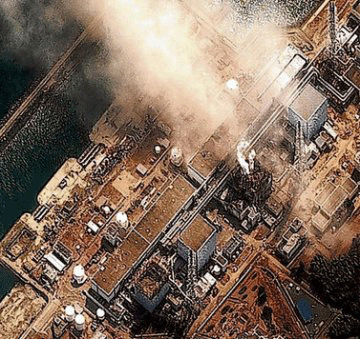 Fukushima Cleanup Workers Have Been Dumping Contaminated Debris Into Rivers http://www.businessinsider.com/fukushima-radiation-cleanup-still-primitive-22-months-after-the-tsunami-2013-1#ixzz2HX4rP6eZ Michael Kelley | Jan. 8, 2013, After a massive earthquake and subsequent tsunami struck Japan on March 11, 2011, officials promised to use cutting-edge technology from across the globe to mount the most ambitious radiological
  cleanup humanity has ever seen.
But it appears that the $11.5 billion, multi-decade effort has become part of the nuclear disaster. Continue reading
North Carolina will fight proposal for uranium mine in Virginia
NC opposition builds to proposed Virginia uranium mine, WRAL.com, 8
Jan 13, MANSON, N.C. — As legislation that would allow uranium mining
in Virginia advances through that state’s legislature, opposition to
the move is growing in North Carolina.
A group of Virginia lawmakers voted Monday to approve a bill that
would lift a 31-year-old ban on uranium mining and allow the practice
in Chatham, Va., where a 119 million-pound deposit of uranium – the $7
billion vein is the largest in the U.S. – is located.
The bill now goes to the full legislature, which convenes Wednesday.
“North Carolina will be fighting this,” Continue reading
Tentative step towards uranium mining in Virginia, but opposition persists
While environmental groups have led the charge against mining, the
Virginia Farm Bureau Federation took the unexpected step of opposing
mining, and municipal groups have also joined in the opposition.
Virginia Beach, which draws public drinking water from southern
Virginia, has also taken a stand against mining, as well as other
cities in Hampton Roads.
Virginia uranium mining wins 1st legislative test January 7, 2013
RICHMOND, Va. (AP) — Proposed uranium mining in Virginia easily
survived its first legislative test Monday, with lawmakers
recommending the development of regulations for the mining of the
radioactive ore.
Those rules — and whether a 30-year ban on such mining is lifted —
ultimately would need to be approved by the General Assembly.
The Coal and Energy Commission voted 11-2 in support of legislation
proposed by Sen. John Watkins that would have the effect of limiting
mining to one company and the only known, commercially viable deposit
of uranium in the state: Virginia Uranium Inc…..
Asked why he would limit uranium mining in the state, Watkins said:
“Because I want the bill to pass.”
……..Robert G. Burnley, a former director of the Virginia
Department of Environmental Quality who now is affiliated with the
Southern Environmental Law Center, said the legislation is a “de
facto” vote on ending the 31-year ban. Continue reading
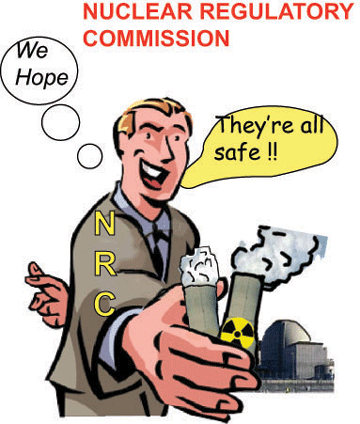
Nuclear Regulatory Commission gives slaps on the wrist for safety violations
 Hurricane Sandy blew through, spinning houses off foundations,
blowing holes in barrier islands and wrecking lives. In the midst of
this mayhem, Oyster Creek sounded a modest alarm.
there is the impression, built up year after empirical year, that
the N.R.C. is a tiger denuded of claws. Even the agency’s internal
monitors found it was notoriously cautious about actions that might
cost plants time and money.
“I get the feeling we’re
regulating with our fingers crossed.”
At a Nuclear Plant, Hurricane Brings More Worry, NYT By MICHAEL POWELL
January 7, 2013“……Rising waters in Barnegat Bay threatened to
submerge the pumps the plant uses to pull in water to cool its reactor
and spent-fuel pools. Had workers with Exelon Corporation, which owns
Oyster Creek, been forced to turn off the water-intake pumps, they
might have had to dip fire hoses into the floodwaters to refill the
ever-hot pool. The plant issued an alert, the second lowest on the
four-stage scale established by the Nuclear Regulatory Commission.
At the same time, 39 of 42 warning sirens, which are perched on poles
for miles around the plant and intended to warn local residents in
event of a nuclear emergency, lost power. Continue reading
Mainstream media has gone quiet about Fukushima radioactive sea flows to USA
Media Silent on Fukushima Radiation Impact in US http://www.opednews.com/articles/Media-Silent-on-Fukushima-by-Brian-Lynch-130108-588.html
By Brian Lynch OpEdNews Op Eds 1/8/2013 Sometimes big news stories can only be seen by the shadows they cast. You would think that it should be easy to find detailed updates on the Fukushima disaster’s impact on our fishing industry, milk production, global radiation distribution patterns, etc. You would be mistaken. The massive media coverage following the initial disaster has fallen nearly silent. Some frustrated environmental advocates have suggested that there is a media blackout. Probably not, but media follow-up stories are few and far between these days.
In July of last year there were major stories about Fukushima and the plume of radiation reaching across the Pacific Ocean towards North America. On July 16, 2012, Deborah Dupre of the Examiner reported the following:
“As hair falls out of a Fukushima victim’s head, a new German study reports that North America’s West Coast will be the area most contaminated by Fukushima cesium of all regions in Pacific in 10 years, an “order-of-magnitude higher” than waters off Japan, according to a new German study followed by a former New York Times journalist going inside the no-entry zone and reporting radiation levels over 10 times higher than Tepco’s data.”
The article was accompanied by this scary graphic:
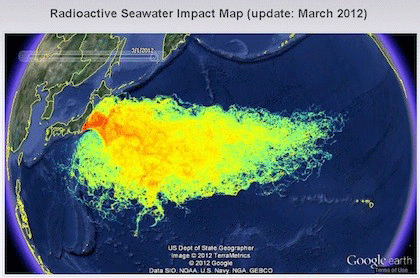
Radioactive Seawater Impact Map by Radioactive Seawater Impact Map Credits: US Department of State Geographer, TerraMetrics, Google
http://www.examiner.com/article/fukushima-west-coast-cesium-slam-ahead-hair-falling-out-tepco-data-flaw?cid=PROD-redesign-right-next
Continue reading
Pakistan gets affordable solar panels, a winning strategy in Asia
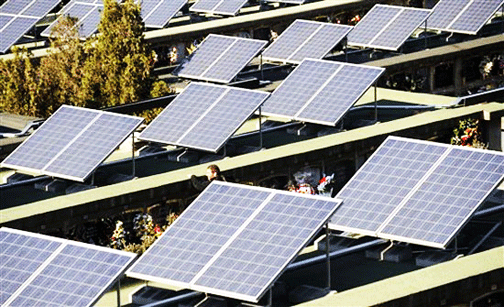 “We are aiming to make sure that any person who installs the house solar system will have monthly instalments equal to their current monthly electricity bill,” said Khurram. Given the fact that grid electricity in Pakistan is cheap, but unreliable, it is likely that many will find that proposition highly tempting.
The company is confident that the venture will prove to be financially viable. Adeel Anwar, the finance director of the company, said that he expects its revenues to touch €150 million (Rs19.2 billion) within the first year. CAE officials feel they can then double that number within three years.
 Renewable energy: German firm to set up first solar panel plant in Pakistan http://tribune.com.pk/story/491194/renewable-energy-german-firm-to-set-up-first-solar-panel-plant-in-pakistan/ By
  Imran Rana January 8, 2013 FAISALABAD: German renewable energy company CAE plans to invest more than €100 million (Rs12.9 billion) in setting up the first solar panel manufacturing facility in Pakistan, and the second of its kind in Asia.
In an exclusive interview with The Express Tribune, Shahzada Khurram, the only Pakistani director of the company, shared its plans of becoming a leading supplier of renewable energy equipment in the country. “Pakistan is going through one of the worst energy crises, and it is time to think about renewable energy as a way to make good money in the sector,” said Khurram. Continue reading
Chinese technology removed from US nuke weapons lab – a security risk
US Nuclear Lab Removed Chinese Tech Due To National Security Risk Gizmodo, 9 Jan 13 ASHLEY FEINBERG After recently discovering that its computer systems contained several Chinese-made network switches, a major US nuclear weapons lab has replaced at least two components because of national security concerns.
According to a document acquired by Reuters:
A letter from the Los Alamos National Laboratory in New Mexico, dated November 5, 2012, states that the research facility had installed devices made by H3C Technologies Co, based in Hangzhou, China. H3C began as a joint venture between China’s Huawei Technologies Co and 3Com Corp, a U.S. tech firm, and was once called Huawei-3Com. Hewlett Packard Co acquired the firm in 2010.
The US government has previously expressed concerns about Huawei and any potential ties to the Chinese military and government, although the company denies that the Chinese military holds any influence over its business and the security of its products……
In October, the House Intelligence Committee issued an investigative report on Huawei and ZTE, claiming they “cannot be trusted to be free of foreign state influence” and pose “a security threat to the United States and to our systems”. http://www.gizmodo.com.au/2013/01/us-nuclear-lab-removed-chinese-tech-due-to-national-security-risk/
Federal Appeals judge sides with NRC against environment groups
 AUDIO Anti-Nuclear Groups Won’t Have Role In Seabrook Re-Licensing
http://www.nhpr.org/post/anti-nuclear-groups-wont-have-role-seabrook-re-licensing
By ROGER WOOD, 8 Jan 13
Anti-Nuclear groups are disappointed by a recent Federal Court
decision regarding their role in the Seabrook Nuclear Plant
re-licensing process. On Friday, the Federal Appeals Court in Boston
rejected the petition from three anti-nuclear groups to re-instate
their intervenor status in the plant’s re-licensing application. The
petition sought to overturn a Nuclear Regulatory Commission ruling
excluding them from public hearings on the issue. A Three judge panel
decided that the NRC’s Atomic Safety and Licensing board erred in
granting opponents of the plant intervenor status. Doug Bogen, of the
Seacoast Anti-Pollution League says that the groups sought to make the
point that wind power could replace nuclear energy.
“It seemed pretty clear that the judges were taking the side of the
industry and the NRC. At least, they didn’t seem inclined to go
against their decision.”
NextEra Energy seeks a 20 year extension of its current license, which
expires in 2030. Bogen says he now believes that the Seabrook Plant
will ultimately receive its operating extension.
Don’t be duped by the thorium hype
Thorium nukes are just the 21st century version of “too cheap to meter” that the nuke lobby was pushing in the last century. They always have some amazing technology just around the corner, but it’s just a smokescreen to distract from what they are trying to sell now.
Learn a few facts and you won’t be so easily duped:
Thorium: Back to the Dream Factory
Benefits of thorium as alternative nuclear fuel are ‘overstated’
1 This Month

of the week – Shut Down Drone Warfare!


Tell the Ukrainian Government to Drop Prosecution of Peace Activist Yurii Sheliazhenko

Petition to revoke the licensing of the Near Surface Nuclear Disposal Facility (NSDF) at Chalk River. https://www.ourcommons.ca/petitions/en/Petition/Details?Petition=e-7247
To see nuclear-related stories in greater depth and intensity – go to https://nuclearinformation.wordpress.com
-
Archives
- April 2026 (103)
- March 2026 (251)
- February 2026 (268)
- January 2026 (308)
- December 2025 (358)
- November 2025 (359)
- October 2025 (376)
- September 2025 (257)
- August 2025 (319)
- July 2025 (230)
- June 2025 (348)
- May 2025 (261)
-
Categories
- 1
- 1 NUCLEAR ISSUES
- business and costs
- climate change
- culture and arts
- ENERGY
- environment
- health
- history
- indigenous issues
- Legal
- marketing of nuclear
- media
- opposition to nuclear
- PERSONAL STORIES
- politics
- politics international
- Religion and ethics
- safety
- secrets,lies and civil liberties
- spinbuster
- technology
- Uranium
- wastes
- weapons and war
- Women
- 2 WORLD
- ACTION
- AFRICA
- Atrocities
- AUSTRALIA
- Christina's notes
- Christina's themes
- culture and arts
- Events
- Fuk 2022
- Fuk 2023
- Fukushima 2017
- Fukushima 2018
- fukushima 2019
- Fukushima 2020
- Fukushima 2021
- general
- global warming
- Humour (God we need it)
- Nuclear
- RARE EARTHS
- Reference
- resources – print
- Resources -audiovicual
- Weekly Newsletter
- World
- World Nuclear
- YouTube
-
RSS
Entries RSS
Comments RSS
 nuclear-news