Tarapur Atomic Power Station (TAPS) – people’s lives in danger
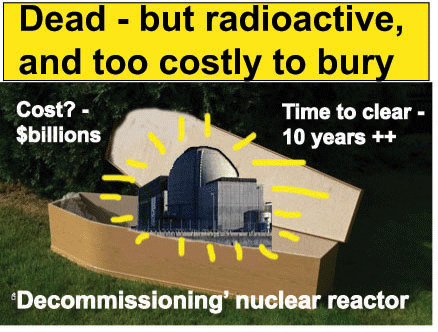
The decommissioning cost of a nuclear reactor (about $300 million-5.6 billion) is more than the cost of construction and commissioning. That’s why TAPS hasn’t been decommissioned despite the American manufacturers’ advice to the government to do so in 1995
 When life is cheaper than nuclear power, Jan 7, 2013, By Dilnaz Boga | Place: Mumbai | Agency: DNA Poonam Hambire, a resident of Ghivali village, 12km from Boisar in Thane district, is at the forefront of the anti-nuclear agitation against the Tarapur Atomic Power Station (TAPS). “Women have to come forward as false cases are slapped against the male protesters in Tarapur,” she alleges.
Her village lies within the 1.6km radius around one the country’s oldest nuclear reactors built by General Electric in the 1960s. It’s the same model as Japan’s Fukushima reactor. The effects of radiation are obvious in every home not only in Ghivali but also in the neighbouring villages.
At Hambire’s home, her eight-year-old nephew’s garlanded photo adorns the wall. “He died of lung cancer, but we couldn’t get his medical reports from the government heath centre. It’s hard to talk about it as his father who is employed at the plant will lose his job. None of the sick villagers get their medical papers,” she claims.
Grievances galore
Most of India’s 20 reactors are on the list of the most unreliable 50 in the world and are being monitored by the IAEA, says former navy captain Dr Buddhi Subbarao, who has a PhD in nuclear technology from IIT-B and is an advocate in the Supreme Court.
The decommissioning cost of a nuclear reactor (about $300 million-5.6 billion) is more than the cost of construction and commissioning. That’s why TAPS hasn’t been decommissioned despite the American manufacturers’ advice to the government to do so in 1995, Subbarao adds.
Ramakrishna Tandel, secretary, Maharashtra Machimar Kruti Samiti, who has led the fishermen’s community in the area for years, says, “The mangroves have dried due to the hot water released from the plant’s cooling system. We have found boiled fish 2km away from shore. The breeding patterns of the fish have also changed and our businesses have collapsed.”
“Forget listening to our grievances, they don’t even let us stand at the gate. We are sandwiched between TAPS and the sea. Earlier, we had 28 boats, and 10 families would live off each boat. Now, we have just one,” he adds. The government has proposed 14 more nuclear plants in the area.
The discharge has increased considerably after TAPS 3 and 4 started, say villagers. The adjoining sea and creek continue to bear the brunt and many species of fish have diminished completely. Chronic illnesses are on the rise, observes environmentalist Girish Raut. … http://www.dnaindia.com/mumbai/report_when-life-is-cheaper-than-nuclear-power_1786292
No comments yet.
1 This Month


18 March Webinar @ 1 PM EST: An Assessment of SMR Projects: The Case of Canada
register for the zoom:
https://us02web.zoom.us/webinar/register/WN_o8BIIOUvQ2ONJR1nta65DQ#/registration


of the week – STOP SMALL MODULAR REACTORS IN CANADA
To see nuclear-related stories in greater depth and intensity – go to https://nuclearinformation.wordpress.com
-
Archives
- March 2026 (140)
- February 2026 (268)
- January 2026 (308)
- December 2025 (358)
- November 2025 (359)
- October 2025 (376)
- September 2025 (258)
- August 2025 (319)
- July 2025 (230)
- June 2025 (348)
- May 2025 (261)
- April 2025 (305)
-
Categories
- 1
- 1 NUCLEAR ISSUES
- business and costs
- climate change
- culture and arts
- ENERGY
- environment
- health
- history
- indigenous issues
- Legal
- marketing of nuclear
- media
- opposition to nuclear
- PERSONAL STORIES
- politics
- politics international
- Religion and ethics
- safety
- secrets,lies and civil liberties
- spinbuster
- technology
- Uranium
- wastes
- weapons and war
- Women
- 2 WORLD
- ACTION
- AFRICA
- Atrocities
- AUSTRALIA
- Christina's notes
- Christina's themes
- culture and arts
- Events
- Fuk 2022
- Fuk 2023
- Fukushima 2017
- Fukushima 2018
- fukushima 2019
- Fukushima 2020
- Fukushima 2021
- general
- global warming
- Humour (God we need it)
- Nuclear
- RARE EARTHS
- Reference
- resources – print
- Resources -audiovicual
- Weekly Newsletter
- World
- World Nuclear
- YouTube
-
RSS
Entries RSS
Comments RSS
 nuclear-news
Leave a comment