Earth’s Forecast Looks Warm and Full of Volcano Eruptions -Not good for nuclear future
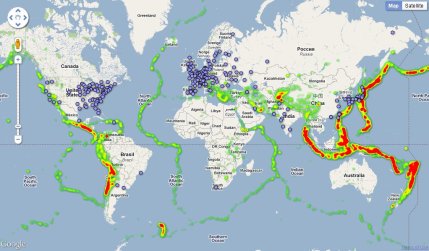
Worldwide map of nuclear power stations and earthquake zones (Maptd)
As Planet Warms, More Lava Could Find Surface
6 January 2013
scientificamerican
Over a long enough time scale, warmer temperatures mean increased volcanic activity, according to new research
By Nathanael Massey and ClimateWire
The effect of volcanic eruptions on climate has been one of the more hotly contested topics in the global warming debate. Seized upon briefly by climate skeptics as analternative to human-caused warming, eruptions are now understood by mainstream science to result most often in net cooling for a period of up to several years.
Few researchers, however, have considered that an inverse relationship might also exist — that over time, climate might have an effect on the planet’s igneous activity.
Yet those are precisely the findings of new research from the GEOMAR Helmholtz Center for Ocean Research Kiel in Germany. Operating over a long enough time scale, sustained warmer temperatures lead to increased frequency of volcanic activity, the research finds.
Building off research by the Collaborative Research Center, which spent 10 years exploring volcanic regions, the GEOMAR team analyzed the layers of ash left in sea beds in Central America. From these, the team was able to reconstruct a history of eruptions dating back some 460,000 years, said volcanologist Steffen Kutterolf.
In analyzing that historical record, the researchers saw a distinct pattern emerge, he said. “There were periods when we found significantly more large eruptions than others,” he said.
When they overlaid those patterns with climate data for the same period, it became clear that periods of enhanced volcanic activity corresponded with periods of sharp temperature rise and accelerated glacier melt.
To corroborate their theory, the team needed to look beyond Central America, and core samples collected by the International Integrated Ocean Drilling Program (IODP) provided an expedient way to do so. Those samples, taken from seafloor sediments and rocks, constitute one of the most complete geological records available to scientists. And in that record, the team’s theory appeared to be reaffirmed.
“We found the same pattern from these cores as in Central America,” said GEOMAR geophysicist Marion Jegen.
Pushing apart tectonic plates
But how to explain the correlation? Volcanoes are products of geologic forces operating in the Earth’s lower strata; climate plays out most visibly in weatherpatterns and surface temperatures. How could these seemingly separate spheres interact?
Through collaborative work with researchers at Harvard University and extensivecomputer modeling, the GEOMAR team arrived at a possible explanation. A warming climate would eliminate a large portion of the ice massed at the northern and southern poles, they hypothesized, lessening the pressure on continents and allowing them to spread.
In the fissures between geologic plates, lava would then find its way to the surface.
“In times of global warming, the glaciers are melting on the continents relatively quickly,” said Jegen. “At the same time, the sea level rises. The weight on the continents decreases, while the weight on the oceanic tectonic plates increases.”
“Thus, the stress changes within the Earth to open more routes for ascending magma,” he added.
Periods of planetary cooling take much longer than warming phases, meaning a more gradual adjustment period for the Earth’s tectonic plates. Accordingly, volcanic activity during these periods tends to be more subdued, Jegen said.
While the researchers are unsure what effects the current phase of warming, accelerated by human-induced greenhouse gas emissions, might have on volcanic activity, it is unlikely that that activity will increase in any noticeable sense for at least a millennium, said Kutterolf.
Reprinted from Climatewire with permission from Environment & Energy Publishing, LLC. www.eenews.net, 202-628-6500
http://www.scientificamerican.com/article.cfm?id=as-planet-warms-more-lava-could-find-surface
2 Comments »
Leave a comment
1 This Month

of the week – Shut Down Drone Warfare!


Tell the Ukrainian Government to Drop Prosecution of Peace Activist Yurii Sheliazhenko

Petition to revoke the licensing of the Near Surface Nuclear Disposal Facility (NSDF) at Chalk River. https://www.ourcommons.ca/petitions/en/Petition/Details?Petition=e-7247
To see nuclear-related stories in greater depth and intensity – go to https://nuclearinformation.wordpress.com
-
Archives
- April 2026 (68)
- March 2026 (251)
- February 2026 (268)
- January 2026 (308)
- December 2025 (358)
- November 2025 (359)
- October 2025 (376)
- September 2025 (257)
- August 2025 (319)
- July 2025 (230)
- June 2025 (348)
- May 2025 (261)
-
Categories
- 1
- 1 NUCLEAR ISSUES
- business and costs
- climate change
- culture and arts
- ENERGY
- environment
- health
- history
- indigenous issues
- Legal
- marketing of nuclear
- media
- opposition to nuclear
- PERSONAL STORIES
- politics
- politics international
- Religion and ethics
- safety
- secrets,lies and civil liberties
- spinbuster
- technology
- Uranium
- wastes
- weapons and war
- Women
- 2 WORLD
- ACTION
- AFRICA
- Atrocities
- AUSTRALIA
- Christina's notes
- Christina's themes
- culture and arts
- Events
- Fuk 2022
- Fuk 2023
- Fukushima 2017
- Fukushima 2018
- fukushima 2019
- Fukushima 2020
- Fukushima 2021
- general
- global warming
- Humour (God we need it)
- Nuclear
- RARE EARTHS
- Reference
- resources – print
- Resources -audiovicual
- Weekly Newsletter
- World
- World Nuclear
- YouTube
-
RSS
Entries RSS
Comments RSS
 nuclear-news
Looks like you better change the name of this blog to “AGW-news” otherwise people might get confused.
hi richard… thank heavens global warming is fiction.. can you imagine all those tectonic plates moving around with thousands of reactors and spent fuel pools etc just lying around? volcaoes popping up all over the place!!
i am sure all this wierd weather is explanable..
liked the lenticular clouds over yorkshire
didnt like the record flooding in norway..
dont like the way ice melts etc but im no meteorologist,,,
i suppose its a case of proof of the pudding.. sort of thing..
on a serious note, i posted a couple of questions on this link for you to answer.. probably best to sort out the details in open forum.. might get some useful feedback on the situation
http://www.wakingtimes.com/2013/01/05/a-world-in-denial-underestimating-japans-nuclear-disaster/#comment-120776
caught last weeks rense show too.
great of tony to mention the thyroid issues.. this news is really censored.. imo
saikado hantai
happy new year by the way