Space travel may hasten Alzheimer in astronauts -Evidence of ionising radiation effecting the brain?
Space travel may hasten Alzheimer in astronauts

Sat Jan 5, 2013 11:30AM GMT
According to the study published in the journal PLOS ONE, when astronauts leave orbit for deep space missions to places like Mars they are exposed to constant shower of different radioactive particles which can accelerate changes in the brain that are associated with Alzheimer’s disease.
While space is full of radiation, the earth’s magnetic field generally protects the planet and people in low earth orbit from these particles, scientists clarified.
“Galactic cosmic radiation poses a significant threat to future astronauts,” said the senior author of the study M. Kerry O’Banion, M.D., Ph.D., a professor in the University Of Rochester Medical Center (URMC).
Russia to double nuclear missile tests for 2013 -What caused that then?
The strategic missile forces plans for 11 launches of intercontinental ballistic missiles in 2013, up from five last year.

Some of the missile-types deployed in Russia are getting older, and the main aim of the tests to blast off this year has the objectives of lifetime extension. By testing the missiles, their reliability can be proven.
Military Press reports that five launches of intercontinental ballistic missiles were conducted in 2012. Three of which were held by a pilot training program to develop the defense systems and improvement of combat equipment to secure the strategic missiles to overcome anti-missile defense systems.
Russia has repeatedly protested USA’s development of an anti-missile defense system.
The Vigil for December 2012 – Geneva and Paris IndependentWHO
2 – JANUARY – 2013
Since April 26, 2007, the Hippocratic Vigil has been held outside the WHO headquarters in Geneva, which now makes a total of 295 weeks without interruption. The vigil consists of a silent presence that aims to remind the World Health Organization of its obligations as set out in its constitution. We have added the name of Hippocrates to our description because of the ethical rules he instituted for health practitioners. As far as the protection of the health of people affected by the consequences of the nuclear industry is concerned, the World Health Organization ignores these rules.
The Vigil takes place outside the WHO headquarters in Geneva every working day from 8:00 am to 6:00 pm
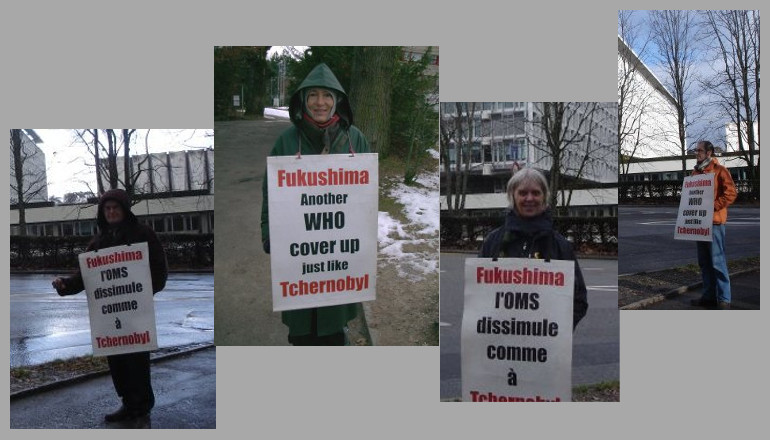
Week 293 – Geneva – 03 to 07 December 2012
Michel Monod (Geneva – Switzerland) – Sylvie Baldens (Gentioux – 23 – France)
Carole Bouvier (Cologny – Switzerland)
Philippe de Rougemont (Geneva – Switzerland)
(not photographed)
Françoise Bloch (Geneva – Switzerland)
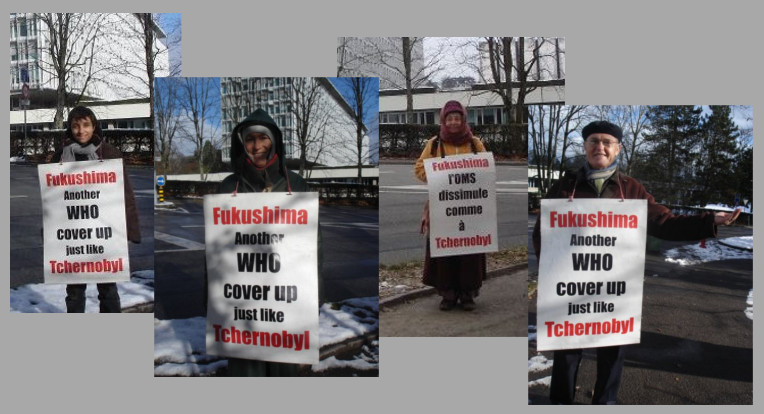
Week 294 – Geneva – 10 to 14 December 2012
Annick Steiner (Geneva – Switzerland)- Sylvie Baldens (Gentioux – 23 – France)
Lamamo (Aix les Bains – 73 – France) – Michel Monod (Geneva – Switzerland)
(not photographed)
Jean Yves Peillard (Clarafond – 74 – France)
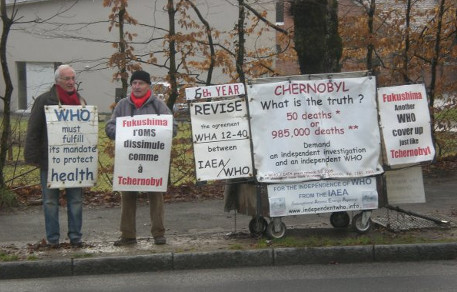
Week 295 – Geneva – 17 to 21 December 2012
David Shipley (Geneva – Switzerland) – Philippe Reculard (Auxerre – 89 – France)
(not photographed)
Isabelle Perrey (Aix les Bains – 73 – France) – Michel Monod (Geneva – Switzerland)
Alison Katz (Geneva – Switzerland))
We now believe it is important to address ourselves to those who are partly responsible for deciding WHO policy. It is for this reason that, on 9th November 2012, we began a Vigil outside the Ministry of Health in Paris. The Ministers of Health are the representatives of the member countries of WHO, and they are involved in deciding the policies and actions that this institution pursues in the area of radioprotection.
We will maintain this silent and peaceful vigil every Friday from 9am to 5pm outside the Ministry of Health in Paris, until France takes the necessary steps to ensure that WHO fulfils its mission to protect the population from radioactive pollution, and that a programme of independent research is put in place on a national and / or European level, on the theme of “Health and nuclear power”.
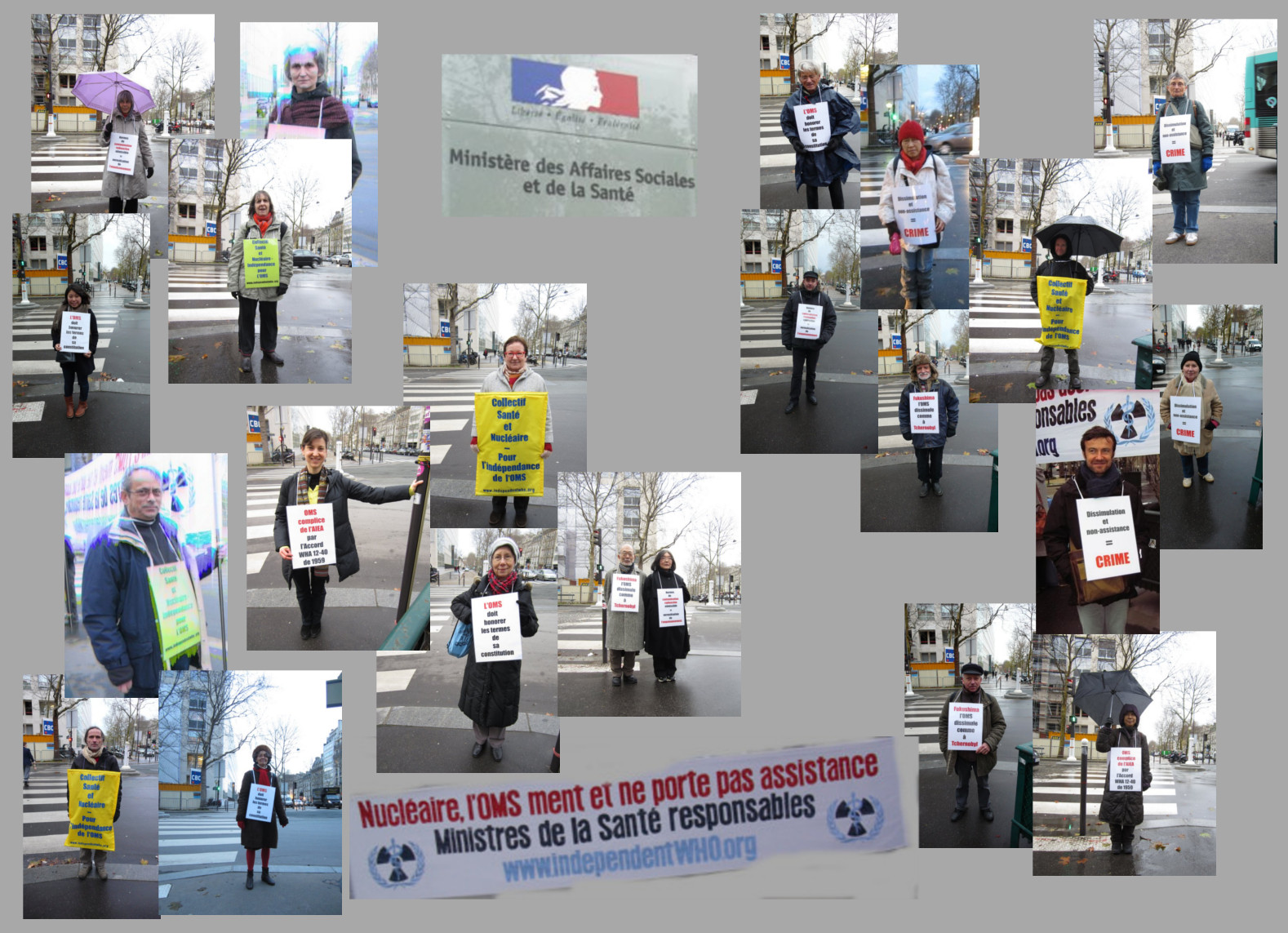
Vigil outside the Ministry of Health in Paris – December 2012
Taking part in the Vigil outside the Ministry of Health during December 2012 :
Midori Amo – Pauline Cabirol – Xavier Ciret – Philippe Clavière – Christophe Elain – Lionel Faure – Marie Magdeleine Fratoni – Etsuko Furukata – Chiaki Iwasaki – Dominique Lalanne – Martine Laroche – Serge Levillayer – Monique Levy – Dominique Maddaléna – Janick Magne – Anne Marie Minella – Jeannine Naudinet – Jean Pierre Pasquet – Monique Vilain – Mr et Mme Yamamoto
http://independentwho.org/en/2013/01/02/the-vigil-for-december-2012/
Corruption At “Decontaminating” Radioactive Towns In Japan

On Friday, Katsutaka Idogawa, mayor of Futaba, a ghost town of once upon a time 7,000 people near Fukushima No. 1, told his staff that evacuees might not be able to return for 30 years. Or never, given the age of many of them. He spoke in Kazo, Saitama Prefecture, where the town’s government has settled. It was the first estimate of a timeframe. But it all depends on successful decontamination efforts. And they’ve turned into a corruption scandal.
I’ve written about top-level corruption in the Japanese nuclear industry before [check out A Revolt, the Quiet Japanese Way or Whitewash versus Reality: “Disaster Made in Japan”], but this time, it hit the companies doing the decontamination work and the Environment Ministry.
The Ministry lined up 11 municipalities in Fukushima Prefecture for decontamination work: removing radioactive materials from the outside of buildings and from areas within 20 meters of buildings, roads, and farmland. It would be the initial process of the long-term goal to reduce airborne radiation level to under 0.23 microsievert per hour. Work has begun at four municipalities, for which ¥650 billion ($7.5 billion) has been earmarked. Big bucks, and it’s just the beginning.
The Ministry hired major construction companies, which in turn hired subcontractors, which then often hired sub-subcontractors to do the actual work, a murky process in Japan. The Ministry’s contracts stipulated how the decontamination had to be done and how radioactive waste had to be disposed of. Roofs, walls, and other surfaces would have to be washed by hand or with brushes. Power washers would not be allowed, except to clean gutters. Contaminated runoff would have to be collected and disposed of according to the rules. Contaminated leaves and soil would have to be placed in bags to prevent radiation from spreading. And dumping of radioactive materials is illegal. Violators would be fined or get thrown in the hoosegow for up to a year.
Alas, reporters of the Asahi Shimbun discretely watched and photographed, then interviewed decontamination workers at different sites. It was chilling. For example, leaves and soil contaminated by radioactive fallout weren’t put in bags and taken to collection sites for proper disposal but were dumped into rivers, at the bottom of slopes, or in other areas. Forbidden power washers were used to decontaminate houses, parking lots, and other areas; contaminated water splashed on neighboring structures, or was allowed to seep into the soil or reach the drainage system and eventually the river.
As a consequence, radiation levels after decontamination were in some cases significantly higher than they’d been before, as contaminated materials had become airborne, reaching in one case 2.9 microsieverts—near the catastrophic level at which the evacuation of residents would be required.
A Frenchmans experience in Japan since the nuclear disaster at Daichi
KNA Blog (French)
31 December 2012
Two French people in Japan
 |
| (13’37 “, Fr) |
Alexis Borreca , “Alex Japan”, gave cooking classes in Tokyo, where he lived with his wife and daughter Japanese. He built guitars too. Sickened and disgusted by the behavior of the media and government, he began posting videos daily from March 14, 2011, creating a big enough buzz on the Internet. Three months later, all his videos on Fukushima will be deleted without notice or explanation by YouTube.buzz on the Internet. Three months later, all his videos on Fukushima will be deleted without notice or explanation by YouTube.
 |
| (7’25 “, Fr) |
Mabesoone Lawrence , professor of comparative literature, still lives in Japan with his wife and daughter. He is also a member of the Watchers Fukushima and creator of the anti-nuclear movement of the ” Yellow Ribbon “. He did not hesitate to mobilize all his savings, ie 8,000 euros to buy a machine to measure the contamination of food. Since April 2012, he organized with the support of the Municipality of Nagano citizens measurement sessions foods, free and open to all.The original of this video dated June 27, 2011, that I offer a version that is I increased the volume a bit and fixed a problem with sync sound due to a defect in the video from 3’17 “. You will find here an interview with Lawrence about 30 minutes, dated February 2012.buy a machine to measure the contamination of food. Since April 2012, he organized with the support of the Municipality of Nagano citizens measurement sessions foods, free and open to all.
54% of cities hosting nuclear plants OK restart: sort of?

From the comments
zichiJAN. 07, 2013 – 10:22AM JST
@Heda_Madness
if as you say, the voters massively support nuclear energy, equally they also massively support a host of other ideas like changing Article 9, spending more on defense, spending ¥200 trillion on public works, maybe making atomic weapons, and so on…
……………………………………………………………………………………………………………………..

PenfoldJAN. 07, 2013 – 08:04AM JST
It’s only the mayors who agree, not the people..
………………………………………………………………………………………………………………………..

Of course the mayors or governors are the ones asked here. Who else could:
28% refrained from clarifying their position, the Yomiuri said, while two did not give valid answers.
……………………………………………………………………………………………………………………..
OK, now you can read the article.. 🙂 and check the comments..
54% of cities hosting nuclear plants OK restart: survey
JAN. 07, 2013 – 07:00AM JST
TOKYO — Japan Today
The majority of Japanese towns and cities hosting nuclear plants said they would agree to the reactors being restarted if the government guaranteed the safety of the facilities, a survey said Sunday.
All but two of Japan’s 50 reactors remain closed for safety checks following the Fukushima nuclear disaster triggered by the March 2011 quake-tsunami and must get the blessing of a new regulator before being restarted.
Despite the Fukushima crisis, 54% of the 135 mayors of communities located near nuclear plants said they would accept the restart of the reactors, according to the survey by the Yomiuri Shimbun newspaper.
Only 18% said they would not support reactor restarts, while 28% refrained from clarifying their position, the Yomiuri said, while two did not give valid answers.
The results run contrary to public opposition to reactor restarts, as the Fukushima nuclear meltdown has fuelled fear of nuclear power in Japan.
The survey outcome, however, reflects the harsh economic reality in the rural communities hosting nuclear facilities, which are usually major employers in the areas that often have no other industries, the Yomiuri said.
Fukushima’s crippled reactors went through meltdowns and explosions that sent radioactive materials in the surrounding areas, which is likely to be unfit for human activities for decades.
Fukushima – IndependentWHO the cons-forum “Nuclear Free Now» December 2012
“….Demonstration outside the conference venue IAEA in Koriyama
Denial is strong among the local population, the desire to forget the anxiety dominates but the consequences and the possibility that the disaster is even worse, it seems, is present in all minds. Highlight of this event: the spokesman of the IAEA came listen to speeches by representatives of different associations of victims. She was visibly moved to all the suffering but that said, she still has not crossed the barrier that separates us from it to associate with victims. In another ten disasters maybe …..”
22 – DECEMBER – 2012
Translated from French – Google
connected viseo with introduction in english
https://www.youtube.com/watch?v=hM-1bDfVfxo
In Japan, a cons-forum was organized by the group “Nuclear Free Now”, in Koriyama, a city 55 km from Fukushima, from 12 to 17 December 2012, in response to the ministerial meeting on nuclear safety organized on the same dates in this city by the Japanese government and the IAEA.
Against the organizers of the forum, a member wishing to make a presentation IndependentWHO the agreement WHO / IAEA activities of the group, so I participated in various events organized by “Nuclear Free Now. ”
~

In Tokyo, a first meeting was held on December 12 by “Friends of the earth Japan” (Friends of the Earth), with interventions of two Japanese associations on the situation in Fukushima, with a presentation of the IAEA by Reinhard Uhrig of the Austrian “Global 2000” and also with my intervention.
~
Thursday, December 13, the same presentations were made, this time in Fukushima, with a high point when the video I presented the watch to the Ministry of Health in Paris, the people of Fukushima have recognized one of them, now a refugee in France.

Presentation at Fukushima December 13, 2012
~
Friday, December 14, with the group of Europeans came to this forum-cons, we went for the day in the area particularly susceptible to contamination. Along the way, we saw workers decontaminating karcher roof houses and in various places, land or fields where topsoil has been removed. Contaminated, it is stored in big bags.

Contaminated soil is stored in bags
We start by visiting Iitate, a village evacuated in which, apart from workers engaged in decontamination, there is not a soul. Nothing special in this town, nothing to see, nothing to feel , only the beep / beep is heard geiger counter. Amazing thing that radioactivity distributed unevenly in leopard spots, but you can not see and can easely who wants to forget, before its consequences on health remind us of his presence. A Iitate, are stacked sandbags waiting for a destination that nobody seems to he the slightest idea. The issue of storing “waste” is already a very serious problem and volumes that will stop growing as decontamination to be performed is important. And for the moment, the candidates receiving the waste are reported to say …. they do not especially want. So, in some fields, we chose the dilution on the spot, the earth has been disturbed and mixed with the underlying layer, making every culture now impossible.
It is then that we realize Minamisouma. Near the east coast and the damage caused by the tsunami are still visible. It feels a little better power has been absolutely amazing and have this cataclysm ….human arrogance to think their nuclear power plants able to resist.
1 This Month


18 March Webinar @ 1 PM EST: An Assessment of SMR Projects: The Case of Canada
register for the zoom:
https://us02web.zoom.us/webinar/register/WN_o8BIIOUvQ2ONJR1nta65DQ#/registration


of the week – STOP SMALL MODULAR REACTORS IN CANADA
To see nuclear-related stories in greater depth and intensity – go to https://nuclearinformation.wordpress.com
-
Archives
- March 2026 (146)
- February 2026 (268)
- January 2026 (308)
- December 2025 (358)
- November 2025 (359)
- October 2025 (376)
- September 2025 (258)
- August 2025 (319)
- July 2025 (230)
- June 2025 (348)
- May 2025 (261)
- April 2025 (305)
-
Categories
- 1
- 1 NUCLEAR ISSUES
- business and costs
- climate change
- culture and arts
- ENERGY
- environment
- health
- history
- indigenous issues
- Legal
- marketing of nuclear
- media
- opposition to nuclear
- PERSONAL STORIES
- politics
- politics international
- Religion and ethics
- safety
- secrets,lies and civil liberties
- spinbuster
- technology
- Uranium
- wastes
- weapons and war
- Women
- 2 WORLD
- ACTION
- AFRICA
- Atrocities
- AUSTRALIA
- Christina's notes
- Christina's themes
- culture and arts
- Events
- Fuk 2022
- Fuk 2023
- Fukushima 2017
- Fukushima 2018
- fukushima 2019
- Fukushima 2020
- Fukushima 2021
- general
- global warming
- Humour (God we need it)
- Nuclear
- RARE EARTHS
- Reference
- resources – print
- Resources -audiovicual
- Weekly Newsletter
- World
- World Nuclear
- YouTube
-
RSS
Entries RSS
Comments RSS
 nuclear-news