The world will pay dearly for delaying action on climate change
Delay climate action – and pay: report, SMH, January 3, 2013 An
agreement by almost 200 nations to curb rising greenhouse gas
emissions from 2020 will be far more costly than taking action now to
tackle climate change, according to research published on Wednesday.
Quick measures to cut emissions would give a far better chance of
keeping global warming within an agreed U.N. limit of 2 degrees
Celsius (3.6F) above pre-industrial times to avert more floods,
heatwaves, droughts and rising sea levels.
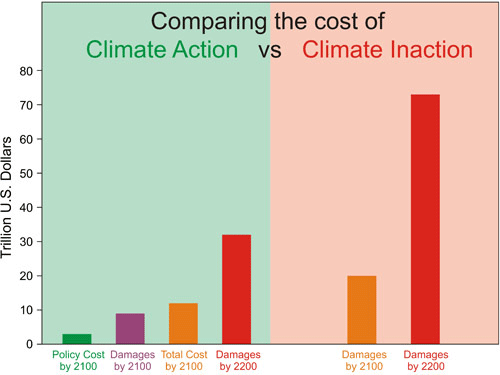
“If you delay action by 10, 20 years you significantly reduce the
chances of meeting the 2 degree target,” said Keywan Riahi, one of the
authors of the report at the International Institute for Applied
Systems Analysis in Austria.
“It was generally known that costs increase when you delay action. It
was not clear how quickly they change,” he told Reuters of the
findings in the science journal Nature based on 500 computer-generated
scenarios.
It said the timing of cuts in greenhouse gases was more important than
other uncertainties – about things like how the climate system works,
future energy demand, carbon prices or new energy technologies. The
study indicated that an immediate global price of $US20 a tonne on
emissions of carbon dioxide (CO2), the main greenhouse gas, would give
a roughly 60 percent chance of limiting warming to below 2C.
Wait until 2020 and the carbon price would have to be around $US100 a
tonne to retain that 60 percent chance, Riahi told Reuters of the
study made with other experts in Switzerland, New Zealand, Australia
and Germany.
And a delay of action until 2030 might put the 2C limit – which some
of the more pessimistic scientists say is already unattainable –
completely out of reach, whatever the carbon price.
“The window for effective action on climate change is closing
quickly,” wrote Steve Hatfield-Dodds of the Commonwealth Scientific
and Industrial Research Organisation in Australia in a separate
commentary in Nature.
Governments agreed to the 2C limit in 2010, viewing it as a threshold
to avert dangerous climate change. Temperatures have already risen by
0.8 degree C (1.4F) since wide use of fossil fuels began 200 years
ago.
No comments yet.
1 This Month

of the week – Shut Down Drone Warfare!


Tell the Ukrainian Government to Drop Prosecution of Peace Activist Yurii Sheliazhenko

Petition to revoke the licensing of the Near Surface Nuclear Disposal Facility (NSDF) at Chalk River. https://www.ourcommons.ca/petitions/en/Petition/Details?Petition=e-7247
To see nuclear-related stories in greater depth and intensity – go to https://nuclearinformation.wordpress.com
-
Archives
- April 2026 (68)
- March 2026 (251)
- February 2026 (268)
- January 2026 (308)
- December 2025 (358)
- November 2025 (359)
- October 2025 (376)
- September 2025 (257)
- August 2025 (319)
- July 2025 (230)
- June 2025 (348)
- May 2025 (261)
-
Categories
- 1
- 1 NUCLEAR ISSUES
- business and costs
- climate change
- culture and arts
- ENERGY
- environment
- health
- history
- indigenous issues
- Legal
- marketing of nuclear
- media
- opposition to nuclear
- PERSONAL STORIES
- politics
- politics international
- Religion and ethics
- safety
- secrets,lies and civil liberties
- spinbuster
- technology
- Uranium
- wastes
- weapons and war
- Women
- 2 WORLD
- ACTION
- AFRICA
- Atrocities
- AUSTRALIA
- Christina's notes
- Christina's themes
- culture and arts
- Events
- Fuk 2022
- Fuk 2023
- Fukushima 2017
- Fukushima 2018
- fukushima 2019
- Fukushima 2020
- Fukushima 2021
- general
- global warming
- Humour (God we need it)
- Nuclear
- RARE EARTHS
- Reference
- resources – print
- Resources -audiovicual
- Weekly Newsletter
- World
- World Nuclear
- YouTube
-
RSS
Entries RSS
Comments RSS
 nuclear-news
Leave a comment