What would be the consequences of a flooded nuclear power plant?
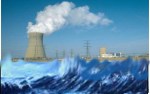
What would be the consequences were a nuclear power plant to flood?
In the case of a natural disaster like a hurricane, the direct impact on a single nuclear power station would likely be exacerbated by a cascade of indirect effects: a range of emergencies and failures unfolding throughout the surrounding area. As during Sandy, transportation would be radically curtailed with roads, bridges, tunnels, trains, and airports shut, as well as some roads blocked by floodwaters, felled trees, and large-scale debris. There could also be widespread power and water outages, fuel shortages, and downed communication lines..
Nuclear power plant flood risk: Sandy was just a warm-up Remapping Debate, By Heather Rogers Dec. 20, 2012 — As Hurricane Sandy approached the East Coast late last October, more than a dozen nuclear power plants from North Carolina stretching up to New England were in its wide-ranging path. On Oct. 29, the night that the eye of the storm made landfall near Atlantic City, New Jersey, five nuclear plants were forced to either reduce power or make emergency shutdowns.
“These facilities need to be hardened more because if they were faced with a Category 2 or a Category 3 [hurricane], it makes me concerned about whether or not they’d be able to safely shut down.” — Michael J. Reilly, National Center for Disaster Preparedness at Columbia University
The most serious event was at the Oyster Creek Generating Station located in Lacey Township, near Barnegat Bay, New Jersey, about 40 miles north of Atlantic City. Amid 75-mile-an-hour winds, power to the region was knocked out, including at the Oyster Creek plant, just before 7 p.m. The plant’s backup diesel generators kicked on to keep its crucial cooling equipment functioning. Nevertheless, by 9 p.m. the plant’s pumps were facing another danger: rising floodwaters. Nuclear Regulatory Commission (NRC) spokesperson Neil Sheehan said that Sandy brought a surge of 7.4 feet to Oyster Creek. The plant is obligated to prepare for the consequences of flooding at 8.5 feet, he said, and, at 9.0 or 9.5 feet — Sheehan wasn’t sure — the plant’s pump motors would begin to be flooded.
The storm surge led the plant to declare an “Alert” — the second step in theNRC’s four-tiered emergency action system.
David Tillman, spokesperson for Exelon, the utility company that owns Oyster Creek, would not answer specific questions about the evening Sandy hit the plant (such as the height to which the water level rose, the height of the pump motors, or the actions taken by the plant in response to the alert). Characteristically for the industry, he insisted that everything worked perfectly and that there were no problems.
The buffer that existed this time may be of little comfort in the future. For all the damage it caused, Sandy was only a Category 1 hurricane — Hurricane Katrina, by comparison, was a Category 3. Given the challenges even Sandy brought to the Northeast’s nuclear power plants, Remapping Debate decided to investigate the extent to which these facilities are prepared to deal with the flood risks widely expected to increase as a result of global warming.
To grasp what a flood at a coastal nuclear power plant such as Oyster Creek would mean, Dave Lochbaum, director of the Nuclear Safety Project at the Union for Concerned Scientists, told Remapping Debate it is worth reflecting on Japan’s Fukushima Dai-Ichi nuclear power plant disaster in 2011. First, the plant — which ran on General Electric Mark I reactors, the same design as at Oyster Creek and 22 other nuclear plants in the U.S.— lost outside power due to the earthquake. Its backup generators switched on, and “the plant weathered [the earthquake] pretty well,” Lochbaum said. But then the floodwaters arrived, exceeding the facility’s sea wall. “That plant wasn’t unaware of the flooding potential, but the magnitude of the challenge they faced was just more than they could handle,” he said. Because the backup generators and pumps were flooded, there was no means by which to keep the reactors and spent fuel pools cooled……….
No comments yet.
1 This Month

of the week – Shut Down Drone Warfare!


Tell the Ukrainian Government to Drop Prosecution of Peace Activist Yurii Sheliazhenko

Petition to revoke the licensing of the Near Surface Nuclear Disposal Facility (NSDF) at Chalk River. https://www.ourcommons.ca/petitions/en/Petition/Details?Petition=e-7247
To see nuclear-related stories in greater depth and intensity – go to https://nuclearinformation.wordpress.com
-
Archives
- April 2026 (91)
- March 2026 (251)
- February 2026 (268)
- January 2026 (308)
- December 2025 (358)
- November 2025 (359)
- October 2025 (376)
- September 2025 (257)
- August 2025 (319)
- July 2025 (230)
- June 2025 (348)
- May 2025 (261)
-
Categories
- 1
- 1 NUCLEAR ISSUES
- business and costs
- climate change
- culture and arts
- ENERGY
- environment
- health
- history
- indigenous issues
- Legal
- marketing of nuclear
- media
- opposition to nuclear
- PERSONAL STORIES
- politics
- politics international
- Religion and ethics
- safety
- secrets,lies and civil liberties
- spinbuster
- technology
- Uranium
- wastes
- weapons and war
- Women
- 2 WORLD
- ACTION
- AFRICA
- Atrocities
- AUSTRALIA
- Christina's notes
- Christina's themes
- culture and arts
- Events
- Fuk 2022
- Fuk 2023
- Fukushima 2017
- Fukushima 2018
- fukushima 2019
- Fukushima 2020
- Fukushima 2021
- general
- global warming
- Humour (God we need it)
- Nuclear
- RARE EARTHS
- Reference
- resources – print
- Resources -audiovicual
- Weekly Newsletter
- World
- World Nuclear
- YouTube
-
RSS
Entries RSS
Comments RSS
 nuclear-news
Leave a comment