VIDEO: USA’s harmful overuse of medical radiation
 http://www.medscape.com/viewarticle/775659 Topol: Runaway Use of Radiation Harming Patients Eric J. Topol, MD Hello. I’m Dr. Eric Topol, Director of the Scripps Translational Science Institute and Editor-in-Chief of Medscape Genomic Medicine and theheart.org. In this series, The Creative Destruction of Medicine, named for the book I wrote, I’m trying to zoom in on critical aspects of how the digital world can create better healthcare.
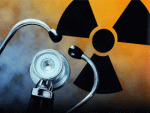 The topic here is radiation and how we’re not doing the right things for patients. We have a serious problem with overcooking radiation in the United States. It’s by far worse here than anywhere else in the world. We have runaway uses of nuclear scans, CT scans, and PET
scanning, and we don’t even warn our patients; we don’t give patients any data on the dangers. In my book, imaging is a really important
topic because there’s so much progress in imaging and use of
nonionizing radiation like ultrasound or MRI, but we continue to rely
heavily on scans. In cardiology, for example, there are more than 10
million nuclear scans being performed each year, mostly CT scans. We
know from all the data we have today that 2%-3% of cancers in this
country are related to use of medical imaging and ionized radiation.
So, why don’t we tell patients when they have a particular imaging
scan exactly how many millisievert (mSv) they’re getting exposed to? A
CT angiogram of the heart is 16 mSv; a lot is being done to try to
reduce that, but that is equivalent to 800 chest x-rays. How about a
typical nuclear scan? A lot of patients who are treated in cardiology
get this done every year. At 41 mSv, it’s equivalent to 2000 chest
x-rays. But patients aren’t told any of this. And not only that, but
we could actually measure exactly how many mSv they got by using the
same type of radiation badges that the medical professionals use when
they work in a cardiac cath lab or in an x-ray suite. But we don’t do
that. This is a serious breach of our responsibility to patients.
We have a very important problem here with this runaway use of
radiation procedures but no accountability with respect to patients’
exposure. This has come to a crisis point in children. Children who
have a diagnosis of a pediatric malignancy, for example, go through
all sorts of radiation imaging, and there have been clear-cut trends
that this is increasing. It’s worrisome and, in fact, it could even
engender additional problems in children burdened with cancer. We
really need to change this.
In a digital world, this information could be collected from birth.
Every individual should have their mSv exposure through medical
imaging recorded cumulatively throughout their life and added to their
electronic health record. Hopefully we’ll see that change come about
in the future. This is something that’s a big hole in the current way
that we work in medicine.
No comments yet.
1 This Month

of the week – Shut Down Drone Warfare!


Tell the Ukrainian Government to Drop Prosecution of Peace Activist Yurii Sheliazhenko

Petition to revoke the licensing of the Near Surface Nuclear Disposal Facility (NSDF) at Chalk River. https://www.ourcommons.ca/petitions/en/Petition/Details?Petition=e-7247
To see nuclear-related stories in greater depth and intensity – go to https://nuclearinformation.wordpress.com
-
Archives
- April 2026 (114)
- March 2026 (251)
- February 2026 (268)
- January 2026 (308)
- December 2025 (358)
- November 2025 (359)
- October 2025 (376)
- September 2025 (257)
- August 2025 (319)
- July 2025 (230)
- June 2025 (348)
- May 2025 (261)
-
Categories
- 1
- 1 NUCLEAR ISSUES
- business and costs
- climate change
- culture and arts
- ENERGY
- environment
- health
- history
- indigenous issues
- Legal
- marketing of nuclear
- media
- opposition to nuclear
- PERSONAL STORIES
- politics
- politics international
- Religion and ethics
- safety
- secrets,lies and civil liberties
- spinbuster
- technology
- Uranium
- wastes
- weapons and war
- Women
- 2 WORLD
- ACTION
- AFRICA
- Atrocities
- AUSTRALIA
- Christina's notes
- Christina's themes
- culture and arts
- Events
- Fuk 2022
- Fuk 2023
- Fukushima 2017
- Fukushima 2018
- fukushima 2019
- Fukushima 2020
- Fukushima 2021
- general
- global warming
- Humour (God we need it)
- Nuclear
- RARE EARTHS
- Reference
- resources – print
- Resources -audiovicual
- Weekly Newsletter
- World
- World Nuclear
- YouTube
-
RSS
Entries RSS
Comments RSS
 nuclear-news
Leave a comment