Health effects of Fukushima radiation were minimised by World Health Organisation
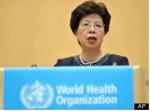 Last month, the German branch of the international physicians’ group sent a letter to WHO Director General Margaret Chan, calling for a substantial expansion of medical research on the health effects of the Fukushima disaster. The branch also sought the early establishment of a comprehensive registry of residents in Fukushima who are estimated to have been exposed to radiation of more than 1 millisievert following the triple meltdowns.
WHO downplayed health effects of nuclear crisis on Fukushima residents : German physician
http://www.japantimes.co.jp/text/nn20121216a4.html?utm source=feedburner&utm_medium=feed&utm_campaign=Feed%3A+japantimes+%28The+Japan+Times%3A+All+Stories%29 Jiji BERLIN — A German doctor and member of a Nobel Peace Prize-winning physicians’ group has criticized a World Health Organization report on the Fukushima nuclear catastrophe for underestimating its impact on human health.
In a research paper, Alex Rosen said the WHO report, published in May this year on estimated radiation doses received by residents near the crippled Fukushima No. 1 nuclear plant, was compiled mainly by officials related to the International Atomic Energy Agency, which promotes the use of atomic energy for peaceful purposes.

Rosen, a member of International Physicians for the Prevention of Nuclear War, called for an independent assessment based on solid scientific methodology that would examine the health impacts from radioactive fallout released after the Fukushima No. 1 complex suffered three core meltdowns in March 2011.
The WHO report put the maximum whole-body radiation dose per person in
the first four months of the crisis at 50 millisieverts, even in two
municipalities very close to the plant, the town of Namie and the
village of Iitate. It also estimated that no area experienced doses in
excess of 100 millisieverts.
The risk of developing cancer is believed to substantially increase if
the annual dose exceeds 100 millisieverts.
Rosen noted that the WHO’s estimate on the amount of radioactive
fallout emitted from the plant’s destroyed reactors was significantly
lower than projections provided by research institutes in many other
countries.
The WHO report also failed to take into account the radiation exposure
of people living within 20 km of the No. 1 plant and who were
evacuated in the first few days of the calamity, after the area was
designated a no-go zone, Rosen said, pointing to the possibility that
these residents may have received high doses before or during their
evacuation.
The report “seems to suggest a certain safety while omitting the
important information that the risk of developing cancer and other
radiation-induced diseases increases proportionally to the amount of
radioactive exposure,” Rosen, a pediatrician, said.
The most flawed aspect of the WHO report is “its apparent lack of
neutrality,” he said.
Rosen further asserted that the report reflects an effort to downplay
the effects of the disaster, as it was compiled chiefly by IAEA staff
and members of nuclear regulatory bodies that were closely colluding
with Japan’s nuclear power industry.
“It is unclear why a report written mainly by the IAEA and
collaborating nuclear institutions would need to be published in the
name of the WHO, if not to provide an unsuspicious cover” for the true
radiation levels Fukushima residents were exposed to, Rosen argued.
Last month, the German branch of the international physicians’ group sent a letter to WHO Director General Margaret Chan, calling for a substantial expansion of medical research on the health effects of the Fukushima disaster. The branch also sought the early establishment of
a comprehensive registry of residents in Fukushima who are estimated to have been exposed to radiation of more than 1 millisievert following the triple meltdowns.
A WHO official said the organization is as yet unable to respond to
Rosen’s research paper or the German branch’s letter because it is
still examining the documents.
International Physicians for the Prevention of Nuclear War,
established in December 1980 and headquartered in Somerville,
Massachusetts, won the Nobel Peace Prize in 1985. The group has
branches in 62 countries and regions worldwide, including Japan.
1 Comment »
Leave a comment
1 This Month

of the week – Shut Down Drone Warfare!


Tell the Ukrainian Government to Drop Prosecution of Peace Activist Yurii Sheliazhenko

Petition to revoke the licensing of the Near Surface Nuclear Disposal Facility (NSDF) at Chalk River. https://www.ourcommons.ca/petitions/en/Petition/Details?Petition=e-7247
To see nuclear-related stories in greater depth and intensity – go to https://nuclearinformation.wordpress.com
-
Archives
- April 2026 (44)
- March 2026 (251)
- February 2026 (268)
- January 2026 (308)
- December 2025 (358)
- November 2025 (359)
- October 2025 (376)
- September 2025 (257)
- August 2025 (319)
- July 2025 (230)
- June 2025 (348)
- May 2025 (261)
-
Categories
- 1
- 1 NUCLEAR ISSUES
- business and costs
- climate change
- culture and arts
- ENERGY
- environment
- health
- history
- indigenous issues
- Legal
- marketing of nuclear
- media
- opposition to nuclear
- PERSONAL STORIES
- politics
- politics international
- Religion and ethics
- safety
- secrets,lies and civil liberties
- spinbuster
- technology
- Uranium
- wastes
- weapons and war
- Women
- 2 WORLD
- ACTION
- AFRICA
- Atrocities
- AUSTRALIA
- Christina's notes
- Christina's themes
- culture and arts
- Events
- Fuk 2022
- Fuk 2023
- Fukushima 2017
- Fukushima 2018
- fukushima 2019
- Fukushima 2020
- Fukushima 2021
- general
- global warming
- Humour (God we need it)
- Nuclear
- RARE EARTHS
- Reference
- resources – print
- Resources -audiovicual
- Weekly Newsletter
- World
- World Nuclear
- YouTube
-
RSS
Entries RSS
Comments RSS
 nuclear-news
[…] Last month, the German branch of the international physicians’ group sent a letter to WHO Director… […]
Pingback by Health effects of Fukushima radiation were minimized by World Health Organisation (WHO) « Operation SAVE the Earth | December 18, 2012 |