Nuclear money makes nuclear addicts of Japan’s towns
 Another example of a local community dependent on money related to nuclear facilities is in Rokkasho, Aomori Prefecture, formerly a poverty-stricken village where most of its 11,000 residents relied on agriculture and fisheries for their livelihood. The village is now called one of Japan’s wealthiest municipalities.
If the government’s plan to phase out nuclear power in Japan is to be implemented, the whole concept of a nuclear fuel cycle in this country would collapse, which in turn would deal a serious blow to Rokkasho’s fiscal foundation.
the system in which money flows from the nuclear community into host municipalities remains intact, and unless
the link is cut off, those municipalities will continue to rely on the nuclear industry.
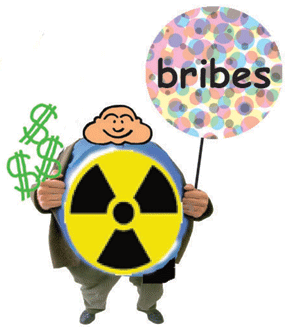 Municipal nuclear addiction, Japan Times, 26 Nov 12 Municipalities hosting nuclear power plants throughout Japan have received large amounts of central government subsidies, donations from utilities and lucrative business contracts Now, 1½ years after the Fukushima nuclear disaste rs, those municipalities realize how much their finances depend on the nuclear power-induced money.
“They’re like drug addicts cut off from supplies,” said a member of the assembly of Niigata Prefecture, which hosts Tokyo Electric Power Co.’s Kashiwazaki-Kariwa nuclear power plant on the Sea of Japan coast. All the  reactors at the plant remain shut down after its No. 5 and 6 reactors went offline earlier this year……
Host prefectures and municipalities receive central government grants based on laws designed to promote development of power generation facilities. ….
While they both host Tepco’s Kashiwazaki-Kariwa plant, nuclear
plant-related subsidies or donations from the utility account for 14
percent of Kashiwazaki’s annual budget and as high as 30 percent of Kariwa’s.
An insider in the construction industry in Kashiwazaki says that local
politicians and contractors continue to hunt for new sources of
nuclear power-related income even after the Fukushima plant disasters.
Even though it is now next to impossible to hope for construction of
new nuclear plants, they are looking into the possibility of building
facilities for temporary storage of spent nuclear fuel from nuclear
power plants around the country, or a storage site for contaminated
materials from Fukushima, he points out.
Another example of a local community dependent on money related to nuclear facilities is in Rokkasho, Aomori Prefecture, formerly a poverty-stricken village where most of its 11,000 residents relied on agriculture and fisheries for their livelihood. The village is now called one of Japan’s wealthiest municipalities.
Nippon Nuclear Fuel Ltd., which plays the central role in the nation’s
nuclear fuel cycle project, has its headquarters in Rokkasho and
accounts for ¥6 billion of the estimated ¥6.8 billion in local tax
revenue for fiscal 2012. Rokkasho’s general account budget for the
year is ¥13 billion — double the amount of a village in Kumamoto
Prefecture with roughly the same population.
f the government’s plan to phase out nuclear power in Japan is to be
implemented, the whole concept of a nuclear fuel cycle in this country
would collapse, which in turn would deal a serious blow to Rokkasho’s
fiscal foundation.
Alarmed by such a prospect, the village assembly in September
unanimously adopted a resolution demanding that if the nuclear fuel
cycle program were to be stopped, all spent fuels that had been
shipped to the reprocessing facility in Rokkasho be moved out of the
village immediately. It was an outright threat to both the central
government and the power companies.
Spent fuel storage pools at nuclear plants throughout the country are
filled almost to capacity, and would overflow if the fuel rods at
Rokkasho were returned to the power plants where they originated. This
would make it impossible to restart any of the nuclear plants in
Japan.
A journalist who covers nuclear power issues for a major newspaper
notes that Rokkasho’s special status among host municipalities gives
it enormous leverage.
“It’s like a drug addict engaging in robbery to get the money to buy
more narcotics,” the journalist said.
The episode shows that the system in which money flows from the
nuclear community into host municipalities remains intact, and unless
the link is cut off, those municipalities will continue to rely on the
nuclear industry. http://www.japantimes.co.jp/text/eo20121126a1.html
No comments yet.
1 This Month

of the week – Shut Down Drone Warfare!


Tell the Ukrainian Government to Drop Prosecution of Peace Activist Yurii Sheliazhenko

Petition to revoke the licensing of the Near Surface Nuclear Disposal Facility (NSDF) at Chalk River. https://www.ourcommons.ca/petitions/en/Petition/Details?Petition=e-7247
To see nuclear-related stories in greater depth and intensity – go to https://nuclearinformation.wordpress.com
-
Archives
- March 2026 (244)
- February 2026 (268)
- January 2026 (308)
- December 2025 (358)
- November 2025 (359)
- October 2025 (376)
- September 2025 (257)
- August 2025 (319)
- July 2025 (230)
- June 2025 (348)
- May 2025 (261)
- April 2025 (305)
-
Categories
- 1
- 1 NUCLEAR ISSUES
- business and costs
- climate change
- culture and arts
- ENERGY
- environment
- health
- history
- indigenous issues
- Legal
- marketing of nuclear
- media
- opposition to nuclear
- PERSONAL STORIES
- politics
- politics international
- Religion and ethics
- safety
- secrets,lies and civil liberties
- spinbuster
- technology
- Uranium
- wastes
- weapons and war
- Women
- 2 WORLD
- ACTION
- AFRICA
- Atrocities
- AUSTRALIA
- Christina's notes
- Christina's themes
- culture and arts
- Events
- Fuk 2022
- Fuk 2023
- Fukushima 2017
- Fukushima 2018
- fukushima 2019
- Fukushima 2020
- Fukushima 2021
- general
- global warming
- Humour (God we need it)
- Nuclear
- RARE EARTHS
- Reference
- resources – print
- Resources -audiovicual
- Weekly Newsletter
- World
- World Nuclear
- YouTube
-
RSS
Entries RSS
Comments RSS
 nuclear-news
Leave a comment