NHK Special “Coexisting With Nature“ -Magnesium steam generation breakthrough
http://www.youtube.com/watch?v=5ZuoeKlqPoA&feature=player_embedded#!
Published on Nov 26, 2012 by MissingSky101
“Coexisting with Nature”
Japanese Canadian science broadcaster and environmentalist David Suzuki meets Japanese environmental and energy researchers who are showing the way to an environmentally sustainable future after the March 2011 natural and nuclear disasters.
TOMORROW beyond 3.11
August 27
David Suzuki
More on Magnesium driven steam generation here..
Researching the Ultimate Fireless Steam Locomotive – Part II
Chemical Thermal Energy Storage
Over the past decade, research was undertaken in Japan into high-temperature chemical thermal energy storage using metallic oxides. This research was aimed at storing thermal energy at thermal power stations during off-peak periods, then using that stored energy to generate extra electric power during peak demand hours. A team of research scientists based at the Tokyo Institute of Technology included Dr Yukitaka Kato, Dr Yamashita and Dr Yoshizawa who undertook research into the thermal reaction of magnesium oxide with steam. Another research team that included Dr Matsuda, Dr Kyaw, Dr Masanobu and Dr Hasatoru at Nagoya University based their investigation on the thermal reaction of calcium oxide and carbon dioxide. Information pertaining to this research can be accessed online at http://www.scej.org/ronbun/JCEJe/e29p0119.html . (LINK dead)
Powerful nuclear interests likely to prevail in Japanese elections
An LDP win would also signal successful lobbying by Japan’s “nuclear village”, a web of vested interests including utilities, bureaucrats and lawmakers that remains powerful despite the world’s worst radiation crisis in a quarter century.

Pro-nuclear party could win power in Japan TVNZ November 27, 2012, Japanese voters look likely to hand victory to a party that favours nuclear power in the first election since the March 2011 Fukushima radiation disaster.
But even if the main opposition Liberal Democratic Party (LDP) wins the December 16 election, it will not reflect any groundswell of popular support for nuclear power.
Instead, it would underline a lack of credible anti-nuclear political standard-bearers in Japan and the ability of the LDP to focus the debate on security matters and the stalled economy. Continue reading
Political turmoil in Japan as election date approaches
Asahi’s public opinion survey of major domestic economic issues showed that 50 percent of interviewees oppose the utilization of nuclear power, which has been a hot-button issue since the nuclear meltdowns
 Japanese voters frustrated over political turmoil 2012-11-27 By
 ZHANG YUNBI (China Daily) Japanese dismay at domestic political turmoil and gloomy economic prospects were two of the top issues in the country’s latest public opinion polls, which outline the landscape leading up to Japan’s election next month.
Experts said the winner of the election will face key economic issues including tax hike bills and a ban on nuclear power. Continue reading
Nuclear free goal brings Japan’s small political parties together
Small parties join push for nuclear-free society The Yomiuri Shimbun, 27 Nov 12 Ichiro Ozawa’s People’s Life First party and a party jointly led by former farm minister Masahiko Yamada and Nagoya Mayor Takashi Kawamura have begun coordinating views to create a new party aimed at uniting smaller political forces advocating a nuclear-free society.
They want the new party to include Kuniko Tanioka, a House of Councillors member and coleader of Midori no Kaze, who supports the zero nuclear option.
The parties also have floated the idea of having Shiga Gov. Yukiko Kada, who has taken a cautious stance on restarting nuclear reactors, become leader of the new party, which according to Kawamura and other officials could be named “Nippon Mirai no To” (Japan Future Party).
Kada is expected to make her position clear on Tuesday….. http://www.yomiuri.co.jp/dy/national/T121126004153.htm
A warning on Mixed-Oxide Fuel (MOX) nuclear fuel plan
 MOX stands for “Mixed-Oxide Fuel.” It is a nuclear power reactor fuel made from plutonium mixed with uranium. The U.S. Department of Energy (DOE) wants to make experimental MOX fuel using plutonium from dismantled nuclear weapons.
Use of MOX fuel fails as a means of getting rid of plutonium. Instead, the plutonium just becomes part of the lethal soup of ingredients termed “high-level nuclear waste”
What is MOX? http://www.nirs.org/factsheets/basicmoxinfo.htm The giant French nuclear firm Cogema, Duke Power and Virginia Power have formed a consortium to create and use plutonium MOX fuel in civilian atomic reactors in North and South Carolina and Virginia.
If their effort is successful, plutonium would be trucked from nuclear weapons depots in the west to the Savannah River Plant on the South Carolina/Georgia border, where new plutonium processing plants would be built. This new MOX fuel would then be trucked to commercial reactors in the Southeast, in order to turn this plutonium into high-level radioactive waste.
The MOX program is dangerous and unnecessary. More than 200 environmental and other organizations across the world have signed an International NIX MOX statement and have pledged to work to stop this program in the U.S. and similar programs in Russia, France and England.
What is MOX? Continue reading
Civil nuclear energy on its last legs
 In the end, the nuclear industry has only itself to be blamed for its decimation. Nobody – except probably its own nuclear village fraternity – will shed any tears on its death.
The Imminent Death of Civil Nuclear Energy http://www.dianuke.org/the-imminent-death-of-civil-nuclear-energy/ Anamika Badal, 26 Nov 12
Some may consider that civilian nuclear energy programs are going great guns and will grow in future. They will not. In fact, its slow death is already on and will only accelerate in future. Let’s understand why.
The nuclear energy industry has had a charmed half century of existence.
What essentially started as military research for the development of weapons of mass destruction (WMD) was subtly packaged into a benign energy source. At heart, the roots of nuclear energy are firmly linked to military use.
The cold war was an occasion which offered the nuclear energy industry the use of massive funds, research facilities, government grants (subsidies) and huge freedom to conduct more and more research into making more and more weapons.
Nuclear Energy was simply a byproduct of this military work.
Companies and governments worked overtime to create a veil of secrecy around atomic energy so that the common person would not be able to link the two. And to their credit, they succeeded for a large part. In the days before the advent of the internet, information was scarce and expensive to procure. People – by and large – tended to believe what the ‘scientists’ and the governments told them.
Essentially, they were sold two stories –
1) Nuclear industry means ‘national security’ and ‘national pride.’ Any opposition to nuclear automatically makes you an anti-national.
2) Nuclear Energy has no alternative because of its “cleanliness” and ability to deliver large amounts of power at cheap cost.
It is said that if a lie is told a thousand times, people start to believe that it is the truth. Continue reading
Nuclear money makes nuclear addicts of Japan’s towns
 Another example of a local community dependent on money related to nuclear facilities is in Rokkasho, Aomori Prefecture, formerly a poverty-stricken village where most of its 11,000 residents relied on agriculture and fisheries for their livelihood. The village is now called one of Japan’s wealthiest municipalities.
If the government’s plan to phase out nuclear power in Japan is to be implemented, the whole concept of a nuclear fuel cycle in this country would collapse, which in turn would deal a serious blow to Rokkasho’s fiscal foundation.
the system in which money flows from the nuclear community into host municipalities remains intact, and unless
the link is cut off, those municipalities will continue to rely on the nuclear industry.
 Municipal nuclear addiction, Japan Times, 26 Nov 12 Municipalities hosting nuclear power plants throughout Japan have received large amounts of central government subsidies, donations from utilities and lucrative business contracts Now, 1½ years after the Fukushima nuclear disaste rs, those municipalities realize how much their finances depend on the nuclear power-induced money.
“They’re like drug addicts cut off from supplies,” said a member of the assembly of Niigata Prefecture, which hosts Tokyo Electric Power Co.’s Kashiwazaki-Kariwa nuclear power plant on the Sea of Japan coast. All the reactors at the plant remain shut down after its No. 5 and 6 reactors went offline earlier this year……
Host prefectures and municipalities receive central government grants based on laws designed to promote development of power generation facilities. …. Continue reading
American justice in question, as USA cracks down on hacker Jeremy Hammond
 The bigger story is what they’ve done in this country to Jeremy Hammond, Bradley Manning, and what they have proposed to do to Julian Assange, and that’s really say that they’re going to come down as heavily as they can on people who expose government secrets, whistleblowers,”
 Anonymous hacker behind Stratfor attack faces life in prison, Rt : 23 November, 2012, A pretrial hearing in the case against accused LulzSec hacker Jeremy Hammond this week ended with the 27-year-old Chicago man being told he could be sentenced to life in prison for compromising the computers of Stratfor.
Judge Loretta Preska told Hammond in a Manhattan courtroom on Tuesday that he could be sentenced to serve anywhere from 360 months-to-life if convicted on all charges relating to last year’s hack of Strategic Forecasting, or Stratfor, a global intelligence company whose servers were infiltrated by an offshoot of the hacktivist collective Anonymous.
Hammond is not likely to take the stand until next year, but so far has been imprisoned for eight months without trial. Continue reading
Angst in USA over who’s to host all that nuclear waste
 Spent fuel is currently stored at the nation’s 104 nuclear power plants, including Plant Vogtle in Burke County. The nationwide inventory of 75,000 tons could expand to 150,000 tons by 2050, not including spent fuel from new reactors.
SRS role in future of spent nuclear fuel disposal unclear
http://chronicle.augusta.com/news/metro/2012-11-26/srs-role-future-spent-nuclear-fuel-disposal-unclear?v=1353950504 By Rob Pavey, Nov. 26, 2012 The U.S. Energy Department is looking for businesses to design a demonstration project for large-scale and long-term storage of spent nuclear fuel. In a notice posted last week by the Office of Nuclear Energy, the department said its intention is simply to identify resources, and that no formal project has been announced or funded.
 The announcement, however, could indicate the government – which is preparing a new spent fuel strategy for Congress – is leaning toward consolidated storage options that could affect South Carolina, said Tom Clements with the Alliance of Nuclear Accountability.
“This solicitation is being put out in advance of DOE delivering the spent fuel strategy report to Congress, which will likely affirm consolidated spent fuel storage,” he said. “Thus, DOE has set the stage for a fight in states that may be targeted for spent fuel dumps,
like South Carolina and Savannah River Site.” Continue reading
Florida Public Service Commission (PSC) sides with nuclear company: ratepayers to pay up
 Florida PSC screws over ratepayers again, approves more rate hikes for new nukes that aren’t being built 26 Nov 12 http://www.cleanenergy.org/index.php?/Press-Update.html?form_id=8&item_id=335#.ULUkZuR9JLv In spite of another year of significant cost increases and scheduling delays, it was business-as-usual at the Florida Public Service Commission (PSC) today with the Commission once again siding with the big power companies over the interests of Florida customers. The PSC approved nearly $300 million in advanced cost recovery charges for new nuclear power generation projects. The PSC accepted all of the PSC staff recommendations issued earlier this month—an unfortunate trend of rubber-stamping that we have seen year after year in spite of major obstacles and pitfalls that have made new reactor proposals in Florida less and less feasible.
Progress Energy Florida (PEF), which recently merged with Duke Energy, was approved to recover over $142 million and Florida Power and Light (FPL) for over $150 million from their customers for new nuclear generation via a “nuclear tax,” including significant costs for four proposed, yet-to-be-licensed, nuclear reactors that neither utility has even committed to actually build and whose estimated combined costs exceed $40 billion.
The Commission granted all the utilities requests on top of the more than $1 billion in cost recovery that was already approved over the past several years. This is an extremely unfortunate situation for utility customers in Florida who are being forced to pay this “nuclear tax” up front for electricity that will very likely never be produced from proposed new reactors.
Today’s vote again underscores the unfairness of the nuclear cost recovery statute that was passed by the Florida legislature back in 2006. Because the Florida State Legislature, the Governor and the PSC have failed to protect Florida’s families and businesses from this “nuclear tax” scheme, Southern Alliance for Clean Energy challenged the statute’s constitutionality before the Florida Supreme Court. Oral argument occurred in early October and we await the Court’s decision. We remain hopeful that the Court will rule in favor of better protections for Florida’s utility ratepayers.
Don’t trust World Health Organisation’s data on Fukushima health effects
 Gundersen on WHO: I don’t trust their data — Garbage in, garbage out — I suspect hot particles and internal emitters are omitted, and radioactive releases underestimated http://enenews.com/gundersen-dont-trust-data-garbage-garbage-suspect-hot-particles-internal-emitters-left-radioactive-releases-underestimated November 25th, 2012
Follow-up to: Asahi: Cancer risk for infants near Fukushima plant has risen, says WHO — More tumors and cysts likely for young people
According to an email from Fairewinds’ chief engineer Arnie Gundersen:
Do you trust the WHO?
I don’t trust this data … my guess is that WHO underestimated the radiological deposition and releases, and thus came up with exposures that are too low. Also, I suspect they have omitted hot particles and internal emitters from their dose assumptions. The same thing happened at TMI. Bad assumptions create low exposures. GIGO!
Watch: Exposed: World Health Organization beholden to nuclear interests — “Like having Dracula guard the blood bank” (VIDEOS)
Japan’s inadequate response to its Fukushima radiation victims
 U.N. envoy: Japan should do more for nuclear victims, Asahi Shimbun November 27, 2012 THE ASSOCIATED PRESS A United Nations rights investigator said Nov. 26 that Japan hasn’tdone enough to protect the health of residents and workers affected by the Fukushima nuclear accident.
Anand Grover, U.N. special rapporteur on the right to health, said the government has adopted overly optimistic views of radiation risks and has conducted only limited health checks after the partial meltdowns at several reactors at the Fukushima No.1 nuclear power plant caused by an earthquake and tsunami in 2011.
Several investigations, including one conducted by a parliament-appointed panel, have criticized the government for alleged cover-ups and delays in disclosing key radiation information, causing evacuees to be unnecessarily exposed to radiation. That has also
caused deep-rooted public distrust of the government and nuclear industry. Continue reading
Wikileaks book warns on Internet surveillance
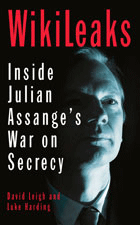 Julian Assange’s book an exercise in dystopian musings WikiLeaks founder’s Cypherpunks warns tool he relies on and used to make his name is ‘global surveillance industry’ target Esther Addley guardian.co.uk, 26 November 2012 Julian Assange‘s new book is not a manifesto, he writes in its introduction – “There is no time for that”. Instead the short volume,entitledCypherpunks: Freedom and the Future of the Internet and published on Monday, is intended to be what the Wikileaks founder calls “a watchman’s shout in the night”, warning of an imminent threat to all civilisation from “the most dangerous facilitator of totalitarianism we have ever seen” – the web……
The Murdoch media octopus to grab more power in USA
 Will the FCC Give Rupert Murdoch the Powerful Gift of Media Consolidation?, 26 November 2012 By Mike Ludwig, Truthout | Just in time for the holidays, the Federal Communications Commission (FCC) is considering changes to media cross-ownership rules that watchdogs say could good give Rupert Murdoch’s massive conglomerate News Corporation the go-ahead to acquire more big media outlets.
The proposal could also keep women and minorities out of the media market, according to civil rights groups.
Reports suggest Murdoch has recovered from the British phone hacking scandal and is ready to jump back into the media consolidation game. Both the Chicago Tribune and the Los Angeles Times are on the list of potential targets. Continue reading
Japan’s displaced people fear to ever return to radiation contaminated areas
In response to a questionnaire sent to Okuma’s evacuees by the town hall in September, only 11 percent of the 3,424 households that responded said they wanted to go back, while 45.6 percent said they had no intention of ever returning, mostly because of radiation fears.
Hopes of Home Fade Among Japan’s Displaced By MARTIN FACKLER NYT, : November 25, 2012 AIZU-WAKAMATSU, Japan — As cold northerly winds sprinkle the first snow on the mountains surrounding this medieval city, those who fled here after last year’s Fukushima nuclear disaster are losing hope that they will ever return to their old homes. Continue reading
1 This Month

of the week – Shut Down Drone Warfare!


Tell the Ukrainian Government to Drop Prosecution of Peace Activist Yurii Sheliazhenko

Petition to revoke the licensing of the Near Surface Nuclear Disposal Facility (NSDF) at Chalk River. https://www.ourcommons.ca/petitions/en/Petition/Details?Petition=e-7247
To see nuclear-related stories in greater depth and intensity – go to https://nuclearinformation.wordpress.com
-
Archives
- March 2026 (244)
- February 2026 (268)
- January 2026 (308)
- December 2025 (358)
- November 2025 (359)
- October 2025 (376)
- September 2025 (257)
- August 2025 (319)
- July 2025 (230)
- June 2025 (348)
- May 2025 (261)
- April 2025 (305)
-
Categories
- 1
- 1 NUCLEAR ISSUES
- business and costs
- climate change
- culture and arts
- ENERGY
- environment
- health
- history
- indigenous issues
- Legal
- marketing of nuclear
- media
- opposition to nuclear
- PERSONAL STORIES
- politics
- politics international
- Religion and ethics
- safety
- secrets,lies and civil liberties
- spinbuster
- technology
- Uranium
- wastes
- weapons and war
- Women
- 2 WORLD
- ACTION
- AFRICA
- Atrocities
- AUSTRALIA
- Christina's notes
- Christina's themes
- culture and arts
- Events
- Fuk 2022
- Fuk 2023
- Fukushima 2017
- Fukushima 2018
- fukushima 2019
- Fukushima 2020
- Fukushima 2021
- general
- global warming
- Humour (God we need it)
- Nuclear
- RARE EARTHS
- Reference
- resources – print
- Resources -audiovicual
- Weekly Newsletter
- World
- World Nuclear
- YouTube
-
RSS
Entries RSS
Comments RSS
 nuclear-news