Lucrative business for nuclear companies in the complex cleanup of UK’s Sellafield site
 multinationals are aligning themselves into strategic relationships to attract the highly lucrative subcontracts coming on stream. Multi-disciplinary consultant Atkins recently formed a joint venture with French-based nuclear specialist Areva to bid for tier two work on decommissioning and fuel management projects in the UK.
Nuclear Legacy, The Construction Index, 23 Nov 12“…….To speed up the process, Sellafield Ltd, the site licence company owned by PBO Nuclear Management Partners (NMP), has started to implement a series of strategic alliances with a combined value of £9bn.
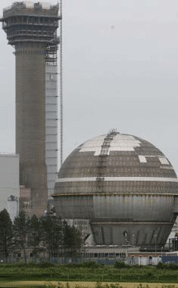 The first framework agreement – The Design Services Alliance – was awarded in February: a £1.5bn contract to The Progressive Alliance (led by Babcock and URS) and AXIOM (a consortium of Amec, Jacobs, Mott McDonald and Assystem). It is expected to extend to 15 years.
A joint venture between Morgan Sindall and Arup has recently been named preferred bidder for the second framework, the £1.1bn Infrastructure Strategic Alliance (ISA). Sellafield Ltd expects to announce the preferred bidder for its Multi Discipline Site Wide Works framework agreement before the end of 2012.
Other collaborative-style initiatives in the pipeline
include a contract for site-wide logistics, appointing a
decommissioning technical programme partner and introducing a major
project delivery strategy. ….
Further down the supply chain, multinationals are aligning themselves into strategic relationships to attract the highly lucrative subcontracts coming on stream. Multi-disciplinary consultant Atkins recently formed a joint venture with French-based nuclear specialist Areva to bid for tier two work on decommissioning and fuel management
projects in the UK.
But nuclear clients are keen to point out that
there are still opportunities for smaller contractors in this busy
sector. Babcock Dounreay Partnership says that around two-thirds of
the site spend is down the supply chain. And commenting on the Morgan
Sindall Arup JV at Sellafield, Nuclear Management Partners deputy
managing director George Beveridge praised the partners for their
“desire to work with our local supply chain to maximise opportunities
through the ISA.“
…… One of the most complex
operations under preparation is the decommissioning
of the 21m-high pile fuel cladding silo, which houses six waste
containers containing more than 3,200m3 of intermediate level
radioactive waste. They also contain high levels of argon gas. While
this is a critical path project, it must be carried out with absolute
precision. The strategy is to drill six 2m x 3m holes into the north
side of the silo. Access doors with gas-tight seals will be bolted to
each aperture. Specially designed waste retrieval modules will then be
bolted to the doors, similar to the way a capsule docks to a space
station. The modules, designed by joint venture Bechtel Babcock
Nuclear Solutions (BBNS) as part of a £150m contract, feature
telescopic booms and grabs that will pick up the waste and rotate 180o
to lower it into a module where it will be photographed and filmed,
and basic radiological measures will be taken. The waste will then be
transferred into 3m3 storage boxes and stored in an interim storage
facility bolted onto the side of the silo. radioactive material, each
posing a unique set of challenges……
At present the project is still in development. After 20,000
man-hours, BBNS has completed the design of the gas-tight doors, and
testing of the doors starts next June. The waste retrieval modules are
still in design phase. Following extensive trials, three diamond-based
cutting machines will be used to drill into the silo. The project team
had considered stitch drilling 76 cores using a 300mm core drill,
however this approach was abandoned because it was too technically
challenging and problematic. “Diamond technology was selected because
it offered the most reliable, powerful, and cost-effective machine
suites suitable for the cutting processes,” says a Sellafield
spokesperson…..
Remotely Controlled Technology
The problem of working in areas that are too hazardous for humans to
enter has long posed challenges for nuclear decommissioning projects.
This has given rise to a range of innovative equipment that would not
be out of place in a James Bond movie. Remotely-operated miniature
submarines have already been deployed at Sellafield and are being
developed to survey fuel storage ponds. Sellafield is also providing
funding for the development of an unmanned aerial vehicle that could
fly into spaces due to be decommissioned, providing detailed scans and
detecting radiation levels. Other emerging technology to receive
financial support from Sellafield is the snake-arm robot, developed by
Bristolbased company OC Robotics. This consists of a self-supporting
robotic arm that can navigate around obstacles like a snake. A camera
is attached to the tip of the arm, which can also accommodate a
selection of tools including a laser cutting head, water jet, gripper
and ultrasound equipment. …..
Buckingham believes that part of the robot’s appeal is that it could
identify and remove the most radioactive elements from confined
spaces, making the area safe for humans to enter. Long term, it could
lead to the more efficient and appropriate disposal of waste, saving
both time and money. Exactly when and how clients such as Sellafield
will start using the Snake Arm on decommissioning projects is not yet
certain. “The nuclear industry moves very slowly. It takes a long time
for new technology to get accepted,” says Buckingham.
http://www.theconstructionindex.co.uk/news/view/nuclear-legacy
No comments yet.
1 This Month

of the week – Shut Down Drone Warfare!


Tell the Ukrainian Government to Drop Prosecution of Peace Activist Yurii Sheliazhenko

Petition to revoke the licensing of the Near Surface Nuclear Disposal Facility (NSDF) at Chalk River. https://www.ourcommons.ca/petitions/en/Petition/Details?Petition=e-7247
To see nuclear-related stories in greater depth and intensity – go to https://nuclearinformation.wordpress.com
-
Archives
- April 2026 (103)
- March 2026 (251)
- February 2026 (268)
- January 2026 (308)
- December 2025 (358)
- November 2025 (359)
- October 2025 (376)
- September 2025 (257)
- August 2025 (319)
- July 2025 (230)
- June 2025 (348)
- May 2025 (261)
-
Categories
- 1
- 1 NUCLEAR ISSUES
- business and costs
- climate change
- culture and arts
- ENERGY
- environment
- health
- history
- indigenous issues
- Legal
- marketing of nuclear
- media
- opposition to nuclear
- PERSONAL STORIES
- politics
- politics international
- Religion and ethics
- safety
- secrets,lies and civil liberties
- spinbuster
- technology
- Uranium
- wastes
- weapons and war
- Women
- 2 WORLD
- ACTION
- AFRICA
- Atrocities
- AUSTRALIA
- Christina's notes
- Christina's themes
- culture and arts
- Events
- Fuk 2022
- Fuk 2023
- Fukushima 2017
- Fukushima 2018
- fukushima 2019
- Fukushima 2020
- Fukushima 2021
- general
- global warming
- Humour (God we need it)
- Nuclear
- RARE EARTHS
- Reference
- resources – print
- Resources -audiovicual
- Weekly Newsletter
- World
- World Nuclear
- YouTube
-
RSS
Entries RSS
Comments RSS
 nuclear-news
Leave a comment