Japan’s solar feed in tariff boosting renewable energy
 The Land of the Rising Sun Goes Solar http://financialconservation.blogspot.com/2012/11/the-land-of-rising-sun-goes-solar.html#ixzz2D4daQDH6 Business Insider, Michael E. Douroux, Financial Conservation | Nov. 22, 2012 “According to a new report from the Japan Photovoltaic Energy Association, domestic shipments of solar cells and modules have risen by 80% in the July-September quarter of this year.
 This is on the heels of the Japanese government enacting an ambitious solar energy incentive initiative, a feed-in tariff (known as net energy metering in California) that aims to help support the adoption of solar energy throughout the country.
The feed-in tariff was introduced in the wake of the Fukushima disaster of 2011, when a powerful earthquake and tsunami triggered a nuclear crisis in Northern Japan. After the disaster, the government made moves to abandon nuclear power. While moving away from nuclear energy has proven to be a slow and laborious process, the country has been keen to aggressively replace nuclear with other forms of alternative energy that are considered safer. Solar energy has, thus
far, become one of the country’s most favored forms of alternative energy for this purpose.”
Brave new nuclear technology has left massive new waste problem
 Nuclear Legacy, The Construction Index, 23 Nov 12 Hazardous, time consuming and expensive: nuclear decommissioning projects pose some of the greatest technical challenges, and opportunities, for contractors. Emma Crates reports.
“….. the toxic legacy of life-expired power stations requires immediate action.The UK was an early pioneer of this brave new technology, opening the world’s first commercial nuclear power station at Calder Hall in Cumbria in1956. At the time, little thought was given to what would happen after the facilities passed their useful working life.
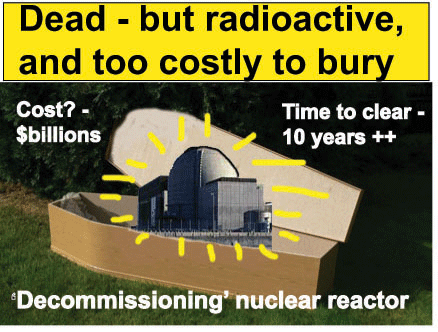
Six decades on, the Nuclear Decommissioning Authority (NDA), the public body responsible for cleaning and decommissioning civil nuclear sites, presides over a complicated legacy. Its portfolio of 19 sites stretches from Dounreay in Scotland to Winfrith in Dorset. Collectively the sites contain hundreds of structures contaminated with radioactive material, each posing a unique set of challenges.
Working in the nuclear sector is not for the faint-hearted: it can take years of planning, preparation and testing before a single structure can be safely defueled, decommissioned and dismantled. The process is hazardous, costly and time consuming. Bespoke solutions are often required….. Continue reading
India: organisations join in protest movement against radioactive waste dumping
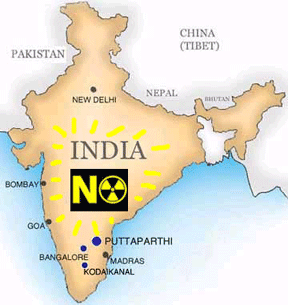 Protests against move to dump nuclear waste in KGF, KOLAR GOLD FIELDS, November 23, 2012 http://www.thehindu.com/news/states/karnataka/protests-against-move-to-dump-nuclear-waste-in-kgf/article4123795.ece?homepage=true
People in Kolar district are concerned over the likelihood of uranium waste generated at the Kudankulam nuclear power plant being dumped in the mine shafts of Kolar Gold Fields (KGF).
Reports that the Union government has filed an affidavit in the Supreme Court saying that nuclear waste from the Kudankulam plant will be stored in the disused shafts of Bharat Gold Mines Ltd. (BGML) in Kolar Gold Fields have stirred a hornet’s nest in the region with
people discussing the safety aspects of such a move.
Taken aback by the prospects of the gold mines turning into a dump yard for hazardous nuclear waste, a number of organisations irrespective of political affiliations staged a series of protests at KGF on Thursday. Continue reading
France’s dilemma: reliance on aging nuclear reactors
State-owned utility EDF, which operates all of France’s reactors, has said it aims to extend their lifespan to 60 years
 France faces twin tasks of ageing nuclear fleet, staff, By Michel Rose and Marion Douet PARIS Nov 22, 2012 (Reuters) – An ageing fleet of nuclear power plants and retirement of
half of EDF’s nuclear staff in the next 5 years are the main challenges the French nuclear safety watchdog is facing and will have to deal with, its new head said on Thursday.
France, the most nuclear-reliant nation in the world, will have to decide in the next few years whether to extend the lifespan of its 58 nuclear reactors to over 40 years, at a time it is trying to cut its reliance on the atom. Continue reading
AUDIO: too costly to maintain nuclear reactors, whether operating or not
 PODCAST: NOVEMBER 21, 2012; THANKSGIVING EDITION: FINANCIAL PRESSURES ARE AFFECTING SAFETY DECISIONS AT THE NATIONS NUCLEAR POWER PLANTS HTTP://WWW.FAIREWINDS.COM/CONTENT/FAIREWINDS-PODCAST November 21, 2012 Arnie explains that Oyster Creek is the only nuclear plant in the US that lacks a modern High Pressure Safety Injection System. This means that the recently discovered pipe crack in a 3 inch pipe at Oyster Creek would create a serious safety threat if it were to completely break. Arnie also discusses the cost of operating nuclear plants, and how many nuclear plants around the country are no longer a low cost electric producer. Finally, Arnie looks at the three nuclear plants with extended shutdowns (Ft. Calhoun, San Onofre and Crystal River) and concludes that the cost of maintaining large staffs when no electricity is being produced is not in the best interests of the ratepayers
Highest ever radiation in wild boar in Iwaki, japan
 33,000 Bq/Kg from wild boar in Iwaki city, “The highest measurement ever” http://fukushima-diary.com/2012/11/33000-bqkg-from-wild-boar-in-iwaki-city-the-highest-measurement-ever/?utm_source=twitterfeed&utm_medium=twitter&utm_campaign=Feed%3A+FukushimaDiary+%28Fukushima+Diary%29
by Mochizuki November 21st, 2012 · On 11/20/2012, Fukushima prefecture announced they measured 33,000 Bq/kg of cesium from wild boar in Iwaki city. It was the highest
measurement ever.
Prefectural government commented they are not sure about the reason.
They measured higher than 100 Bq/Kg from 5 among 16 samples, which were wild boar (Sus scrofa), spot‐billed duck (Anas poecilorhyncha), mallard duck (Anas platyrhynchos) and Japanese deer (Cervus nippon).
Australia’s Aboriginal Mirrar people warn about uranium mining
 Gundjeihmi Aboriginal Corporation November 23rd 2012 Traditional owners directly affected by uranium mining in the Northern Territory, the Mirarr people of Kakadu, have rejected suggestions that the Ranger uranium mine provides a model for Queensland to follow and called on others to heed their experience.
Supporters of the LNP’s decision to open Queensland to uranium mining, including the Australian Uranium Association head Michael Angwin, have made public claims about the ‘excellent’ track record of Ranger uranium mine.
“The suggestion that Ranger provides a blueprint for Queensland must be contested,” said Justin O’Brien, executive officer of Gundjeihmi Aboriginal Corporation, the organisation established and operated by the Mirarr to represent their rights and interests.
The Mirarr, traditional owners of lands in the Kakadu region, including the Ranger and Jabiluka uranium deposits, have the longest lived experience of uranium mining in Australia. The Ranger mine was imposed on Mirarr against their strong opposition and has been operating for 30 years.
“Despite three decades of mining royalties, the socioeconomic standing of local Indigenous people remains below that of the NT average and well below the national standard. It is only in very recent years that income from Ranger has been adequately invested in social and cultural development programs,” Mr O’Brien said.
“The suggestion that Ranger’s track record confirms the high environmental standard of Australia’s uranium mining industry is in stark contrast to the Mirarr experience of mining on their land. Water and tailings management at the mine continue to cause serious concerns and what environmental gains we have secured have been hard fought for over decades.
“In addition, the Mirarr hold grave concerns about the legacy of uranium mining as well as the impact of its products. The fact that Australian uranium was in the failed reactors at Fukushima that have caused so much damage and human misery remains a source of great sadness for the Mirarr.
South Korea’s nuclear regulation, not transparent, not independent
 S.Korea says IEA wants its nuclear sector to be more transparent SEOUL Nov 22, 2012 (Reuters) – The International Energy Agency (IEA) wants South Korea to bring more transparency to its nuclear power sector and strengthen the independence of regulators to increase trust in the safety of its plants, the economy ministry said on Friday.
The agency, which advises industrialized nations and represents 28 oil importing countries, was due later on Friday to unveil a report on South Korea’s energy policies for the first time since 2006…..
The South Korean government has been criticised for a lack of transparency over safety in its nuclear programme and for the dual supervisory and promotion roles of its regulators…..
http://uk.reuters.com/article/2012/11/22/iea-korea-idUKL4N0921O420121122
 The latest government research shows that onshore wind is supported by 66% of the public with 12% opposed, including 4% who are strongly opposed. However, there is evidence that communities become more supportive when they benefit directly from local wind farms. There is much greater public acceptance of renewables in Germany, where two thirds of all turbines and solar panels are owned by individuals, farmers and communities.
Good Energy announces local tariff scheme, Renewable Energy Magazine, Robin Whitlock, 22 November 2012 Local residents near the company’s wind farms will benefit from lower energy bills undera plan to ensure community interest remains at the heat of renewable energy generation in the UK
Good Energy has announced the UK’s first Local Tariff to reward households near its wind farms with lower electricity bills, pioneering a blueprint to put community interest at the heart of renewable energy generation across Britain. Customers who live within two kilometres of the company’s flagship 9.2MW Delabole wind farm in north Cornwall, will qualify for its new Local Tariff, offering a 20% discount on its standard electricity prices. It will currently save an average Good Energy customer in the area around £100 over a year.
The discount will be available to existing and new customers from early 2013. The tariff will also pay out a ‘windfall’ credit of up to £50 per household every year that the turbines exceed their expected performance….. Continue reading
Lucrative business for nuclear companies in the complex cleanup of UK’s Sellafield site
 multinationals are aligning themselves into strategic relationships to attract the highly lucrative subcontracts coming on stream. Multi-disciplinary consultant Atkins recently formed a joint venture with French-based nuclear specialist Areva to bid for tier two work on decommissioning and fuel management projects in the UK.
Nuclear Legacy, The Construction Index, 23 Nov 12“…….To speed up the process, Sellafield Ltd, the site licence company owned by PBO Nuclear Management Partners (NMP), has started to implement a series of strategic alliances with a combined value of £9bn.
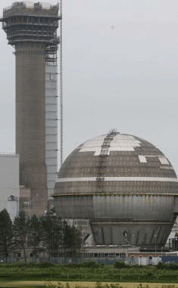 The first framework agreement – The Design Services Alliance – was awarded in February: a £1.5bn contract to The Progressive Alliance (led by Babcock and URS) and AXIOM (a consortium of Amec, Jacobs, Mott McDonald and Assystem). It is expected to extend to 15 years. Continue reading
Gloomy times: Australia’s uranium companies, like Paladin
 Given a downturn in nuclear reactors globally, the oversupply and stockpiling of uranium in Japan and the launch of new uranium mining projects in Canada, there is little evidence to indicate any meaningful revival in the uranium price.
Paladin’s continuing failings a warning for small uranium miners http://ccwa.org.au/blogs/paladin%E2%80%99s-continuing-failings-warning-small-uranium-miners#.UK-2DuR9JLt November 22nd 2012 by Mia.Pepper The Conservation Council of WA has been following the activities of Perth based uranium miner Paladin in collaboration with a number of other environmental NGO’s and social justice groups globally. In consultation with local groups in Malawi and Namibia, where Paladin have operating mines, we have prepared a number of questions that we will be asking at their Annual General Meeting on the 22nd November 2012.
CCWA are concerned that Paladin’s proposed cost cuts will exacerbate existing problems at the company’s mines in Africa. Given the poor economic climate for uranium mining and with some indication from the board that the company is in trouble – we are concerned that the company may abandon projects in the future with no compensation or effective clean up of their existing mine sites.
Background information on Paladin’s operations: Continue reading
India’s Renewable Energy Scheme could still do well
it is vital for the government to ensure that RPO does not remain an
isolated initiative. Given the considerable renewable energy potential within India, a well-designed and workable RPO scheme, with the full support of state and Central policy makers, could result in promoting significant investment in this sector.
Renewed hope for alternative energy The mandate to buy electricity from renewable sources is not as stringent or unworkable as is commonly assumed ,Business Standard Ashwani Srivastava / Nov 23, 2012,
The Central government, in its post-policy-paralysis avatar, has been actively promoting the Renewable Purchase Obligation (RPO) scheme, which obligates electricity supply companies to ensure that a specified fraction of their electricity consumption comes from renewable sources.
The scheme was announced in April 2010, and, according to media reports, is currently facing “major hurdles”. Almost all state-owned electricity distribution companies (discoms),
and obligated entities have failed to meet their RPO obligation for 2011-12. This includes several large entities, including Reliance Industries and Steel Authority of India . Continue reading
AUDIO: Oyster Creek nuclear reactor to shut down permanently?
 Gundersen: California reactor likely shut down forever — At least four other US nuke plants in trouble (AUDIO) http://enenews.com/gundersen-california-nuclear-reactor-shut-down-forever-video Fairewinds Podcast, Nov. 21, 2012:
Nuclear Expert Arnie Gundersen, Fairewinds Energy Education: We had 2 more in the last 2 weeks raise the issue of their not being financially viable. Oyster Creek isn’t the only reactor that’s experiencing financial problems, we’ve got Kewaunee we know about, but 2 others have popped up on the radar this week and they’re surprising because they’re newer reactors.
The Wolf Creek reactor announced it’s looking for a partner to share engineering with […] And Callaway said the same thing. Both of these are new reactors in the Midwest. They’re saying basically that the costs to run a nuclear reactor makes them uncompetitive in today’s environment. So we’ve had 4 reactors in the last month talking about they’re having trouble making economic sense about running. Kewaunee, Oyster Creek, Callaway, and Wolf Creek. And you’ve got to believe that there are others out there too.
Gundersen: San Onofre Unit 3 is likely shut down forever. And Unit 2 is going to be shut down for more than a year and likely never get to 100% power again.
Full report here http://www.fairewinds.com/content/fairewinds-podcast
Role of Fukushima insects in spreading radiation?
 Are radioactive insects spreading Fukushima contamination from lake bottoms across the land? Scientist: They grow underwater then fly out & die everywhere http://enenews.com/are-radioactive-insects-spreading-cesium-from-lake-bottoms-out-across-the-land-scientist-they-grow-underwater-then-fly-out-and-die-everywhere
November 21st, 2012
Title: Fukushima Update: Radioactive Fish, Conflicts of Interest, and Filtered Vents
Source: ScienceBlogs (A National Geographic partner)
Author: Greg Laden
Date: Nov. 21, 2012
Highly Radioactive Fish Have Been Found…
I have a hypothesis that explains many of these observations. Fish like trout, salmon, and char eat, among other things, insects on the surface, gorging on hatches. A hatch is a large number of insects flying around and spending time over water, or often, just falling into the water, after emerging from a body of water where they spent an aquatic phase. I’ve written before about the role that insects such as dragonflies and lake flies serve the role of moving nutrients from their “final” resting place at the bottom of ponds and lakes, out across the landscape. These animals start off as an egg, and then turn into their adult form underwater, accumulating nutrients …. and cesium? …. as they grow. Then they fly out of the water and die everywhere. Or, are eaten by selected species of fish. From clay-rich lake bottom, where radioactive cesium can accumulate in sufficient density to disqualify bottom feeders from human consumption, to the mouths of trout, salmon and char. I don’t know if the Japanese researchers are thinking about it this way, but I hope it is given some thought.
See also: Japan Times: Time bomb in Tokyo metropolitan area — Experts warn of accumulating Fukushima contamination — Potential disaster at Japan’s 2nd largest lake
Algeria’s program; renewable energy at home and for export
Algeria Targets 22,000 MW Of Renewable Energy By 2030 http://cleantechnica.com/2012/11/22/algeria-targets-22000-mw-of-renewable-energy-by-2030/ NOVEMBER 22, 2012 BY ADAM JOHNSTON
North African country Algeria is upping the ante in the renewable energy game. According to a recent PV-Tech article, the country hopes to have 22 gigawatts (GW) of renewable energy online by the year 2030, with a good part being exported on the international market. State-owned utility Sonelgaz, is expected to build 4.2 GW of renewables itself, providing underlying support towards Algeria’s goal.
Next year will see the first phase of the ambitious project, which will eventually include solar photovoltaic energy, concentrated solar power, and wind energy. As noted by PV Tech:
The first phase, which is expected to start in 2013, will include 1,228MW from PV power plants, followed by 2,475MW of concentrated solar (CSP) and 516MW of wind energy by 2022.
Besides Sonelgaz’s commitment to wind and solar, the utility also has a deal with the Desertec CHP project, to look at possibly exporting 1 GW to European countries.
With lots of sun to harness, Algeria, if it succeeds, could be a renewable energy market to watch out for in the years to come.
Clean Technica (http://s.tt/1uuid)
Read more at http://cleantechnica.com/2012/11/22/algeria-targets-22000-mw-of-renewable-energy-by-2030/#rZLuYkJV7RGcRxAr.99
1 This Month

of the week – Shut Down Drone Warfare!


Tell the Ukrainian Government to Drop Prosecution of Peace Activist Yurii Sheliazhenko

Petition to revoke the licensing of the Near Surface Nuclear Disposal Facility (NSDF) at Chalk River. https://www.ourcommons.ca/petitions/en/Petition/Details?Petition=e-7247
To see nuclear-related stories in greater depth and intensity – go to https://nuclearinformation.wordpress.com
-
Archives
- April 2026 (103)
- March 2026 (251)
- February 2026 (268)
- January 2026 (308)
- December 2025 (358)
- November 2025 (359)
- October 2025 (376)
- September 2025 (257)
- August 2025 (319)
- July 2025 (230)
- June 2025 (348)
- May 2025 (261)
-
Categories
- 1
- 1 NUCLEAR ISSUES
- business and costs
- climate change
- culture and arts
- ENERGY
- environment
- health
- history
- indigenous issues
- Legal
- marketing of nuclear
- media
- opposition to nuclear
- PERSONAL STORIES
- politics
- politics international
- Religion and ethics
- safety
- secrets,lies and civil liberties
- spinbuster
- technology
- Uranium
- wastes
- weapons and war
- Women
- 2 WORLD
- ACTION
- AFRICA
- Atrocities
- AUSTRALIA
- Christina's notes
- Christina's themes
- culture and arts
- Events
- Fuk 2022
- Fuk 2023
- Fukushima 2017
- Fukushima 2018
- fukushima 2019
- Fukushima 2020
- Fukushima 2021
- general
- global warming
- Humour (God we need it)
- Nuclear
- RARE EARTHS
- Reference
- resources – print
- Resources -audiovicual
- Weekly Newsletter
- World
- World Nuclear
- YouTube
-
RSS
Entries RSS
Comments RSS
 nuclear-news