Failure of Japan’s new Fukushima clean-up robot
 Japan’s new nuclear-proof robot gets stage fright
  http://ajw.asahi.com/article/economy/technology/AJ201211220024 November 22, 2012 REUTERS YOKOHAMA--A Japanese robot designed to withstand high levels of radiation and extreme heat at damaged nuclear plants such as Fukushima froze on its first public demonstration.
Despite being home to the largest number of industrial robots in the world, Japan did not have a device capable of entering the damaged Fukushima nuclear facility after last year’s devastating earthquake and tsunami.
Instead, Japan brought in U.S. robots to survey the extent of the damage inside the reactor buildings.
Toshiba Corp. unveiled Japan’s own nuclear-proof robot on Oct. 21, a four-legged device able to carry up to 20 kg of equipment and capable of lifting itself up if it falls over on uneven surfaces and amid debris.
During the demonstration, the robot experienced a case of stage fright. The shuffling Tetrapod locked up and suddenly froze after it tried to balance itself, forcing technicians to carry it away. It is the second time such Japanese robotic technology has experienced problems. Last October, a crawling robot developed by the Chiba Institute of Technology lost connection with operators and was abandoned inside Fukushima’s No. 2 reactor building.
Another blow to the Small Modular nuclear reactor (SMR) pipe-dream
“I think they were trying to use cleanup funds, which weren’t intended to be used for nuclear energy projects,” said Tom Clements, the non-proliferation policy director for the Alliance for Nuclear Accountability.
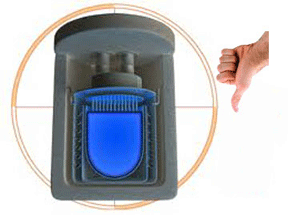 “The whole SMR thing has always appeared very premature and rather half-baked; since these reactors don’t even exist the companies don’t have money to pursue them,” “So it’s all very highly speculative.”
SRS suspends portable reactor development, The Augusta Chronicle, By Rob Pavey, Nov. 10, 2012 Savannah River Site can no longer use its increasingly limited environmental management resources to pursue the development of small, portable nuclear power reactors.
 The ambition to create a “small, modular reactor” farm, where a new generation of SMRs
could be perfected for the commercial market, is a key facet of Enterprise SRS, a futuristic strategy designed to create jobs and future missions for the 310-square-mile site.
Although the U.S. Department of Energy announced agreements in March with three firms that are hoping to use SRS as a home base to study and develop mini reactor technology, site contractor Savannah River Nuclear Solutions received a directive from headquarters to “stand down” and devote no further funds or resources to the effort. Continue reading
Radiation no problem on Mars, but it’ll get you on the way there
 Mars is safe from radiation – but the trip there isn’t New Scientist, 21 November 2012 by Joanna Carver and Victoria Jaggard You needn’t fry on Mars. Readings from NASA’s Curiosity rover suggest radiation levels on the Red Planet are about the same as those in low Earth orbit, where astronauts hang out for months on the International Space Station.
A Mars visit would still be dangerous though, due to the years-long return trip. Continue reading
Thyroid disorders in 42% of Fukushima’s children
German TV: 42% of Fukushima children now with thyroid disorders — Official blames too much seafood? (VIDEO) http://enenews.com/german-tv-42-of-fukushima-children-now-with-thyroid-disorders-official-blames-too-much-seafood-video German TV channel ZDF’s segment on the Fukushima Health Survey translated by SimplyInfo:
November 19th, 2012 More than 42% of 57,000 tested children have nodules or cyst, reports Dr. Suzuki who leads the examinations. In Chernobyl they found only 0.1 – 1%. nobody of the experts asks for the reasons. […] He explains the results mainly by improved diagnosis methods, but people don’t believe him. […] There are no refererence [sic] studies, Dr. Suzuki tells us, and maybe the children simply took too much iodine or seafood. He doesn’t know if this has something to do with radiation. “We are mainly here to inform the parents of the results of our study.” But what do such results mean to parents without proper explanations? The official handling of the disaster is more than questionable. Many people have completely lost trust in government and believe that the disaster is played down to protect the mighty nuclear industry of Japan.
Close to Tokyo, an increasingly radioactive lake
 Japan Times: Time bomb in Tokyo metropolitan area — Experts warn of accumulating Fukushima contamination http://enenews.com/japan-times-time-bomb-tokyo-metropolitan-area-experts-warn-accumulating-fukushima-contamination
Title: The muddy issue of cesium in a lake
Source: Japan Times
Author: By TOMOKO OTAKE
Date: Nov 18, 2012
Lake Kasumigaura in Ibaraki Prefecture is facing an environmental threat that has essentially turned it into a time bomb ticking away 60 km northeast of Tokyo.
Experts warn that Japan’s second largest lake with a surface area of 220 sq. km is quietly but steadfastly accumulating radioactive cesium […]
[It] is not only rich with fishery resources but whose water is used for irrigation, industrial purposes, and even for consumption as drinking water for 960,000 people in Ibaraki Prefecture. Furthermore, no one knows how and by how much the problem has worsened over the months, except for one obvious thing: it hasn’t gone away. […]
[Atsunobu Hamada, former director of the government-affiliated Ibaraki Freshwater Fisheries Research Institute maintains] that the inevitable solution would be to release Kasumigaura’s cesium into the Pacific Ocean via the Tone River […]
“We have a potential disaster waiting to happen,” [Hiroshi Iijima, director general of the nonprofit organization Asaza Fund in Ushiku, Ibaraki Prefecture] said. “This is a lake in the Tokyo metropolitan area and the second-largest lake in Japan, and we are sitting idly by, letting it get contaminated.”
Katsuhiko Sato, official at the Environment Ministry’s water environment section: The current levels of contamination pose no health risk for the area’s residents, because radiation in the lake and the rivers is shielded by water – (Shielding? See above: “Water is used for irrigation, industrial purposes, and even for consumption as drinking water for 960,000 people in Ibaraki Prefecture”)
Asahi Source: Locations in Chiba came under heavy nuclear fallout; Borders Tokyo — Contamination has potential to affect ecosystems
16 years in prison, perhaps, for anti nuclear nun?
 Rice, an 82-year old vowed sister of the Society of the Holy Child of Jesus, was much calmer than the average person facing up to 16 years in federal prison for pulling off what has been dubbed by some legal experts as the biggest security breach in the history of the nation’s atomic complex.
A decision on both the dismissal and the admission of evidence will be made by Judge Shirley within the next 30 days. A trial in the U.S. District Court is scheduled for late February 2013.
82 year old nun ready to go to prison for nuclear breach (uncludes video) By Jo Piazza / current.com , 22 Nov 12, With her fingers pointed in a steeple supporting her chin, Sister Megan Rice made a small but formidable presence in the East Tennessee District Court this week.
Clad in a lavender hoodie and navy sweatpants, her steel-colored hair cut into a sturdy pixie, the diminutive Catholic nun was nearly dwarfed by the large wooden defendant’s table. Rice, an 82-year old vowed sister of the Society of the Holy Child of Jesus, was much calmer than the average person facing up to 16 years in federal prison for pulling off what has been dubbed by some legal experts as the biggest security breach in the history of the nation’s atomic complex. Continue reading
Portable solar power generator saving the day still in New York
 VIDEO: A Solar Thanksgiving for Battered Rockaways http://www.motherjones.com/blue-marble/2012/11/video-solar-thanksgiving-battered-rockaways?utm_source=twitterfeed&utm_medium=twitter&utm_campaign=Feed%3A+motherjones%2FTheBlueMarble+%28Mother+Jones+%7C+The+Blue+Marble%29
—By Tim McDonnell and James West, Nov. 21, Since Hurricane Sandy, the historic Belle Harbor Yacht Club in the Rockaways—one of New York City’s hardest-hit neighborhoods—has become an indispensable hub for supplies, volunteers, and a much-needed round of drinks. Three weeks after the storm, the oft-maligned Long Island Power Authority still hasn’t re-connected this building, not to mention its neighbors, back to the grid, leaving locals to face the prospect of a cold, dark Thanksgiving.
But outside, the sun is shining, and a trio of local solar power companies have seen an opportunity to bridge the gap left open by the electric utility. The yacht club, among several area buildings, is now plugged into a portable solar power generator, which frees volunteers from the endless gas lines that plague those dependent on traditional generators and leaves them ready to dish out hot plates of turkey and stuffing to the beleaguered community.
US Dept of Energy losing enthusiasm for Small Modular Nuclear reactors (SMRs)
ultimately, the decision may have come down to the commercial prospects for the technologies. The fact remains that the economics of all of these designs remains murky.
Based on economies of scale, small reactors will produce more expensive electricity than large reactors, all other factors being equal.
Does DOE’s Funding Announcement Mark the End of its Irrational Exuberance for SMRs? http://allthingsnuclear.org/does-does-funding-announcement-mark-the-end-of-its-irrational-exuberance-for-smrs/?utm_source=twitterfeed&utm_medium=twitter&utm_campaign=Feed%3A+AllThingsNuclear+%28All+Things+Nuclear%29 Ed Lyman, senior scientist
November 21, 2012
On November 20 DOE finally announced that the Babcock and Wilcox Company (B&W) and its “mPower” reactor were the lucky winners of its Funding Opportunity Announcement (FOA) for a cost-sharing program with industry for the design and licensing of “small modular reactors,” or SMRs. Although DOE had originally said the announcement would come in July or August, it decided instead to bury it on Thanksgiving week – not usually a time the agency releases news of which it is particularly proud.
And in fact, the real news is not that a grant was awarded to B&W – this was a near-certainty – but that there was only one winner instead of two. Continue reading
The renewable energy revolution to take off, with energy storage
 Energy storage systems signal arrival of ‘baseload’ renewables REneweconomy, By Giles Parkinson 21 November 2012 It has been widely thought that the arrival of cost-competitive rooftop solar PV systems would be the biggest game changer in the electricity market. But it may be that the emergence of affordable energy storage systems will have an even more profound impact.
There are predictions that the energy storage market is going to boom. One survey suggested that $30 billion will be spent on energy storage in the next decade in Australia alone. In the US, where $1 trillion is expected to be spent on electricity network infrastructure in the next 10 years, at least one fifth of that – or $200 billion – will be spent on energy storage.

The big question is who is going to benefit most from that investment – the customer, or the utility that delivers or sells the electricity. Or maybe even both. Most people are still trying to figure that out. Continue reading
Cesium levels in mushrooms have risen in several Japanese prefectures
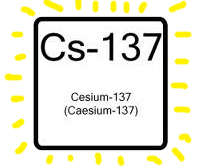 [Asahi] Cesium levels in mushroom have also risen in
  various areas compared with last year http://fukushima-diary.com/2012/11/asahi-cesium-levels-in-mushroom-have-also-risen-in-various-areas-compared-with-last-year/
by Mochizuki on November 21st, 2012 ·
<Quote> [Asahi]
・・・
As of Nov. 16, officials said 93 municipalities in 10 prefectures, including Fukushima, had a shipment restriction in place. For five prefectures–Aomori, Saitama, Yamanashi, Nagano and Shizuoka–wild mushrooms constitute the only produce for which a shipment ban is in effect.
Cesium levels have also risen in various areas compared with last year.
According to tests requested by the central government, the highest levels recorded this year were 120 becquerels in Aomori Prefecture, up from only 60 becquerels last year; 2,100 becquerels in Nagano Prefecture (1,320 becquerels last year); and 3,000 becquerels in Tochigi Prefecture (134 becquerels last year).
Yasuyuki Muramatsu, a chemistry professor at Gakushuin University who specializes in radiation effects on ecology, said, “While the detailed mechanism is still unclear, mushrooms can more easily absorb cesium in comparison to plants because they are fungi.” As for why cesium levels are higher this autumn, Muramatsu said, “There is the possibility that radioactive materials that were attached to the trunks and leaves of trees last year were washed away by the rain and entered the soil into which mushrooms extend their fungal filament.”
Muramatsu cautioned that some types of wild mushroom may have high cesium levels next year as well, which will require continued testing.
seawater off Fukushima containing plutonium
Pu-239/240 was measured in sea water from 15km offshore Fukushima plant
by Mochizuki on November 21st, 2012 ·
(4.7±1.5)E-6 Bq/L of Pu-239/240 was measured from the upper layer of
15km offshore from Fukushima plant….
http://fukushima-diary.com/2012/11/pu-239240-was-measured-in-sea-water-from-15km-offshore-fukushima-plant/
Solar System Backs Up Generator, Keeps Power On in Face of Sandy’s Fury
Phoenix Rising: Renewable Energy Good News Comes to Light After Hurricane Sandy By Jennifer Runyon, Managing Editor, RenewableEnergyWorld.com November 20, 2012
“…..When Sandy slammed into Bayonne, NJ, a one-of-a-kind solar electric system developed byAdvanced Solar Products of Flemington, NJ helped keep the power on at Midtown Community School, where 50 to 75 residents of this historic Hudson Riverfront city spent the night sleeping on cots in the warm, dry and well-lit community room.
Power from the grid was lost to all of Bayonne, including Midtown Community School (left), which also serves as a community emergency evacuation center, at about 9:00 on the evening of October 29. The lights at the school stayed on, however, because of its backup system. The large commercial-scale solar system, at the time part of the largest solar power project on the east coast, was designed and built with assistance from Advanced Solar Products (ASP) and installed in 2004.
The 272-kW PV array was designed to operate in conjunction with an uninterruptible power supply. The one at the school is a diesel generator according to Lyle Rawlings who has served as president of ASP since 1991. The generator is large enough to meet the electricity needs of the school during a power failure, but uses huge quantities of diesel fuel, which must be delivered by truck if supplies can be located at all during and after an emergency such as Sandy.
“Without our solar system on the roof of the school, we would have needed even more fuel, which would have been difficult to find because it was needed for all the repair trucks operating around the state,” said Rawlings.
In order to provide this capability, the school’s solar power system was specially modified with new controls, sensors and innovative software to enable it to automatically detect a power outage. When it does, it immediately shifts its output from circuitry powering the school’s ordinary heating, cooling and lighting systems to the building’s emergency circuits. “Storms such as Sandy will become more frequent if we do not stem greenhouse gas induced climate change,” says Rawlings. “Widespread adoption of solar power is an economically beneficial way to reduce greenhouse gases from burning fossil fuels.” …. http://www.renewableenergyworld.com/rea/news/article/2012/11/phoenix-rising-renewable-energy-good-news-comes-to-light-after-hurricane-sandy?cmpid=WNL-Wednesday-November21-2012
Caribbean and Southeastern Coastal Wind Turbines Fare Well During Sandy Phoenix Rising
Renewable Energy Good News Comes to Light After Hurricane Sandy By Jennifer Runyon, Managing Editor, RenewableEnergyWorld.com November 20, 2012
“……Just about a week after Hurricane Sandy,Northern Power Systems announced that 74 of its wind turbines, including three in the Caribbean, had been in the path of Hurricane Sandy and were undamaged by the high winds. Following Irene, a category 3 hurricane that hit in 2011, Sandy was the second powerful Atlantic storm to hit Northern Power turbines within a year and all turbines that were impacted performed safely as expected.
“The losses experienced from Hurricane Sandy are a tragic reminder of how powerful nature can be,” said Troy Patton, Northern Power Systems President and CEO. “Many of our turbines, from the Caribbean to the eastern seaboard of the U.S., were directly in the path of Hurricane Sandy, but none were damaged by the high winds. At Northern Power Systems, we have the experience and commitment to continue to make products that are safe and reliable.”
As a testament to the design of Northern Power’s turbines, as soon as each turbine detected Sandy’s hurricane force winds, it automatically entered safe mode. Once conditions returned to normal, each turbine started generating electricity again, said the company. http://www.renewableenergyworld.com/rea/news/article/2012/11/phoenix-rising-renewable-energy-good-news-comes-to-light-after-hurricane-sandy?cmpid=WNL-Wednesday-November21-2012
Youtube: Carl Sagan’s vision for our time
 https://www.youtube.com/watch?v=hLkC7ralR30 One of Carl Sagan’s most pertinent messages for humanity…… our small planet, at this moment, here we face a critical branch-point in the history. What we do with our world, right now, will propagate down through the centuries and powerfully affect the destiny of our descendants.
It is well within our power to destroy our civilization, and perhaps our species as well. If we capitulate to superstition, or greed, or stupidity we can plunge our world into a darkness deeper than time between the collapse of classical civilization and the Italian Renaissaince.
But, we are also capable of using our compassion and our intelligence, our technology and our wealth, to make an abundant and meaningful life for every inhabitant of this planet. To enhance enormously our understanding of the Universe, and to carry us to the
stars.” Carl Sagan explains the immensity of space and time. This clip
is from Carl Sagan’s Cosmos episode 8, “Journeys in Space and Time.”
USA Dept of Energy organising radioactive waste storage, before congress discusses it
Outrageous! DOE quietly prepares for “consolidated interim storage” of radwaste before Congress even considers it. #mobilechernobylhttp://1.usa.gov/XBxlTt
 A–High Burnup Fuel Cask Demonstration Project – Federal Business Opportunities: Opportunities
1 This Month

of the week – Shut Down Drone Warfare!


Tell the Ukrainian Government to Drop Prosecution of Peace Activist Yurii Sheliazhenko

Petition to revoke the licensing of the Near Surface Nuclear Disposal Facility (NSDF) at Chalk River. https://www.ourcommons.ca/petitions/en/Petition/Details?Petition=e-7247
To see nuclear-related stories in greater depth and intensity – go to https://nuclearinformation.wordpress.com
-
Archives
- April 2026 (103)
- March 2026 (251)
- February 2026 (268)
- January 2026 (308)
- December 2025 (358)
- November 2025 (359)
- October 2025 (376)
- September 2025 (257)
- August 2025 (319)
- July 2025 (230)
- June 2025 (348)
- May 2025 (261)
-
Categories
- 1
- 1 NUCLEAR ISSUES
- business and costs
- climate change
- culture and arts
- ENERGY
- environment
- health
- history
- indigenous issues
- Legal
- marketing of nuclear
- media
- opposition to nuclear
- PERSONAL STORIES
- politics
- politics international
- Religion and ethics
- safety
- secrets,lies and civil liberties
- spinbuster
- technology
- Uranium
- wastes
- weapons and war
- Women
- 2 WORLD
- ACTION
- AFRICA
- Atrocities
- AUSTRALIA
- Christina's notes
- Christina's themes
- culture and arts
- Events
- Fuk 2022
- Fuk 2023
- Fukushima 2017
- Fukushima 2018
- fukushima 2019
- Fukushima 2020
- Fukushima 2021
- general
- global warming
- Humour (God we need it)
- Nuclear
- RARE EARTHS
- Reference
- resources – print
- Resources -audiovicual
- Weekly Newsletter
- World
- World Nuclear
- YouTube
-
RSS
Entries RSS
Comments RSS
 nuclear-news
