India’s Kudankulam nuclear power plant founded on illegalities
Kudankulam on shaky legal ground http://www.thehindu.com/opinion/op-ed/kudankulam-on-shaky-legal-ground/article4064951.ece D. NAGASAILA
V. SURESH 5 Nov Violations of Coastal Regulation Zone and Environmental Impact Assessment notifications make official claims questionable
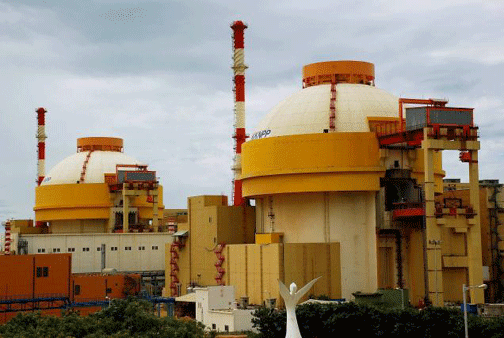
The debate over nuclear energy will go on, but the issue with the Kudankulam Nuclear Power Plant (KKNPP) is one of the several illegalities on which it is founded.
In 1988, India inked the Koodankulam Nuclear Power Plant deal with the
former Soviet Union. Two key elements in it were: the highly dangerous
and toxic “Spent Nuclear Fuel” (SNF) would be shipped back to the
Soviet Union; and the massive volumes of fresh water required to cool
the plant would be supplied from Pechiparai dam, in Kanyakumari
district, Tamil Nadu. The Ministry of Environment and Forests (MoEF)
formally granted approval on May 9, 1989 on this basis. But there was
no further progress until 1997.
In 1997, India signed another agreement, this time with Russia, to
revive the KKNPP.
UNTENABLE
Between 1989 and 1997, the Coastal Regulation Zone (CRZ) and
Environment Impact Assessment (EIA) Notifications were issued in 1991
and 1994 mandating compulsory clearances by environmental regulators
before any new plant could be set up. The CRZ prohibited all
industrial activity within 500 metres of the high tide line. The only
exception to this was industries and projects of the Department of
Atomic Energy (DAE) directly requiring waterfront or foreshore
facilities. The KKNPP today claims exemption from CRZ notification.
This is untenable. The Nuclear Power Corporation of India Ltd.
(NPCIL), which set up the KKNPP, is registered under the Companies Act
as a commercial venture to engage in the business of power projects
and “… to enter into partnerships with any person, including private
entity or any foreign investing entity.” The NPCIL-KKNPP is thus,
under law, only a “Company” and not a project of the DAE. The Supreme
Court has consistently held that government departments are distinct
from government companies. Further, merely because it draws seawater,
it does not become an industry requiring waterfront facilities as per
the decision of the Supreme Court in the shrimp farming case. Thus the
KKNPP is not exempted from CRZ and the plant has been built in
violation of the CRZ notification.
The EIA notification stipulated that for notified industries,
environmental clearance is mandatory for new projects or expansion or
modernisation of existing ones. Nuclear power is a notified industry
and as per EIA notification, an EIA report must be prepared and made
public. A public hearing should be conducted to record objections. The
entire record would be considered by an independent “Expert Appraisal
Committee” before environmental clearance is granted. Clearances are
valid for five years. If the project does not commence within the
five-year period, then fresh clearances will have to be obtained after
fresh public hearings.
The NPCIL, the Atomic Energy Regulatory Board (AERB) and the MoEF all
claim that the EIA notification is not applicable to KKNPP as it has
obtained clearance in 1989. Is this claim valid? An explanatory note
to the EIA notification says that in respect of existing projects as
of 1994 (the year when the EIA notification was promulgated) only
those which have completed the land acquisition process and which have
obtained the “Consent to Establish” from the State Pollution Control
Boards are exempt. The KKNPP has not even applied for “Consent to
Establish” from the Tamil Nadu Pollution Control Board; nor was the
land acquisition process completed.
Hence the repeated assertions of exemption from environmental
regulations are untenable and seriously compromise environmental
safety. The NPCIL started construction work only in 2001. More than 12
years had gone by since the grant of approval in 1989.
TWO SIGNIFICANT CHANGES
There were two significant changes to the project. The first was that,
contrary to the original proposal to ship out the SNF to Russia, the
highly radioactive SNF from the nuclear power plant was to be stored,
transported and reprocessed within India.
The second change was equally major: the freshwater requirement was
now to be met by the construction of six desalination plants instead
of sending piped water from Pechiparai dam. The environmental impact
of the desalination plant on coastal ecology and marine life are
serious concerns with implications for the livelihoods of the fishing
community.
The environmental impact of storage, transportation and reprocessing
of spent fuel as well as the impact of six desalination plants on
marine ecology were not assessed at the time of initial clearance, and
not since.
After launch of construction, the National Environmental Engineering
Research Institute (NEERI) prepared an EIA report in 2003. Even in
this report the environmental impact of spent fuel and desalination
plants was not assessed. It is important to note that generally for
all EIAs the baseline data on air, water, flora and fauna in and
around the proposed plant are vital to assess the likely impact of the
plant on them.
In the EIA for plants three to six, NEERI used baseline data from the
Coast of Travancore on the west coast though the KKNPP is located in
the east. The NEERI concluded that the heat from the coolant water
from the KKNPP on the east will not affect marine life on the west
coast, although it doesn’t require scientific expertise to arrive at
such a conclusion.
The NPCIL and the AERB (the MoEF also agrees) put forward the
erroneous proposition that spent fuel is no issue at all; it is
actually an asset; it can be safely stored at the plant site for five
years, then safely transported and reprocessed safely in a facility at
a location which is yet to be decided. What is the supporting material
for this assertion? Nothing.
IN THE U.S., JAPAN
No country has ever been able to reprocess more than a third of spent
fuel. Even that involves significant quantities of High Level Waste
which is equally radioactive and has to be stored.
In the United States, licences for nuclear power plants have been
subject to the Nuclear Regulatory Commission’s (NRC) assurance in 1984
that a permanent storage by way of a geological repository would be
available for all SNF by 2007-09 and spent fuel can be safely stored
on site at the plants until then. In 1990 the deadline was extended to
2025. In December 2010, it was revised to conclude that a suitable
repository will be available “when necessary” and in the meantime the
spent fuel can be stored safely on site. This ruling was challenged
before the U.S. Court of Appeals for the District of Columbia Circuit.
In “State of New York, et. al., vs Nuclear Regulatory Commission and
USA” the court ruled that spent nuclear fuel “poses a dangerous,
long-term health and environmental risk.” It will remain dangerous
“for time spans seemingly beyond human comprehension.” The court
struck down the NRC’s ruling on two grounds. First, in concluding that
permanent storage will be available “when necessary,” the commission
did not calculate the environmental effects of failing to secure
permanent storage — a possibility that cannot be ignored. Second, in
determining that spent fuel can be safely stored on site at nuclear
plants for 60 years after the expiration of a plant’s licence, the
commission failed to properly examine future dangers and key
consequences. In other words, no EIA was done by the NRC before coming
to such a conclusion.
The real lesson from Fukushima is not merely on improved technical
safeguards at plants from tsunamis and earthquakes. The “Fukushima
Nuclear Accident Independent Investigation Commission” appointed by
the Japanese Parliament warned that the disaster was man-made. The
commission found that it was the government of Japan’s single-minded
pursuit of nuclear power which resulted in collusion between the
government, the regulators and the plant operator, TEPCO — leading to
the practice of resisting regulatory measures and covering up
violations.
(The writers are advocates. V. Suresh is also National General
Secretary, PUCL. Email: rightstn@gmail.com)
No comments yet.
1 This Month

of the week – Shut Down Drone Warfare!


Tell the Ukrainian Government to Drop Prosecution of Peace Activist Yurii Sheliazhenko

Petition to revoke the licensing of the Near Surface Nuclear Disposal Facility (NSDF) at Chalk River. https://www.ourcommons.ca/petitions/en/Petition/Details?Petition=e-7247
To see nuclear-related stories in greater depth and intensity – go to https://nuclearinformation.wordpress.com
-
Archives
- April 2026 (103)
- March 2026 (251)
- February 2026 (268)
- January 2026 (308)
- December 2025 (358)
- November 2025 (359)
- October 2025 (376)
- September 2025 (257)
- August 2025 (319)
- July 2025 (230)
- June 2025 (348)
- May 2025 (261)
-
Categories
- 1
- 1 NUCLEAR ISSUES
- business and costs
- climate change
- culture and arts
- ENERGY
- environment
- health
- history
- indigenous issues
- Legal
- marketing of nuclear
- media
- opposition to nuclear
- PERSONAL STORIES
- politics
- politics international
- Religion and ethics
- safety
- secrets,lies and civil liberties
- spinbuster
- technology
- Uranium
- wastes
- weapons and war
- Women
- 2 WORLD
- ACTION
- AFRICA
- Atrocities
- AUSTRALIA
- Christina's notes
- Christina's themes
- culture and arts
- Events
- Fuk 2022
- Fuk 2023
- Fukushima 2017
- Fukushima 2018
- fukushima 2019
- Fukushima 2020
- Fukushima 2021
- general
- global warming
- Humour (God we need it)
- Nuclear
- RARE EARTHS
- Reference
- resources – print
- Resources -audiovicual
- Weekly Newsletter
- World
- World Nuclear
- YouTube
-
RSS
Entries RSS
Comments RSS
 nuclear-news
Leave a comment