USA nuclear reactors not prepared for very high storm surges
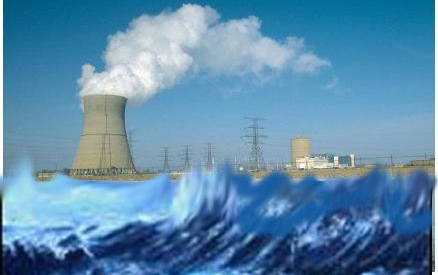 When the nuclear industry says that it can withstand conditions “beyond that historically reported,” we should want to know a lot more
United States came in second, behind Japan, as the country with the largest number of inadequately protected nuclear power plants. The 1938 New England hurricane triggered a storm surge as high as 25 to 30 feet, considerably higher than waves generated this week by Sandy. A wave that tall would easily overtake many nuclear plants on the East Coast, which on average lie about 20 feet above sea level, with minimal sea wall protection.
SANDY, FUKUSHIMA, AND THE NUCLEAR INDUSTRY New Yorker by Evan Osnos, November 2, 2012 When Hurricane Sandy hit the East Coast, it forced three nuclear reactors to shut down, including the Indian Point 3 plant along the banks of the Hudson, about twenty-five miles north of New York City. Three more reduced their output as a precaution. At
the nation’s oldest nuclear plant, the Oyster Creek facility, about thirty-three miles north of Atlantic City, operators faced an unusual event: wind, a rising tide, and the storm surge sent more water than normal into the plant’s water-intake system.
At the same time, the plant, which was already down for maintenance, lost its electrical
power from the grid. Operators called an “alert” that escalated the plant a step up from the lowest emergency level, and they turned to backup generators to keep cooling the reactor.
Nobody was ever in danger, and, all in all, America’s hundred-and-four
nuclear reactors handled the storm with far less trouble than other
parts of the power grid.
Nobody was quicker to applaud the nuclear industry than the nuclear industry. “Hurricane Sandy once again demonstrates the robust construction of nuclear energy facilities, which are built to withstand extreme flooding and hurricane-force winds that are beyond that historically reported for each area,” said Marvin Fertel, president of the industry lobbying group, the Nuclear Energy Institute.
The enthusiasm was not unanimous. Arnie Gundersen, an industry critic
who is the chief engineer of the non-profit Fairewinds Energy
Education Corp, told Bloomberg that if Oyster Creek had been
operating, flood waters just six inches higher could have knocked out
pumps and caused a disaster—a claim that a spokesman for the plant’s
operator, Exelon, called “unequivocally false.” Who’s right? I asked
David Lochbaum, a former nuclear-plant engineer who directs the
nuclear-safety project at the Union of Concerned Scientists. He said,
“I disagree with Exelon’s statement that Arnie was ‘unequivocally
false.’ It’s precisely that kind of closed or narrow mindedness that
allowed Fukushima to happen.”
Fukushima, of course, was the site of the triple meltdown in Japan, in
March of 2011, which was triggered by an earthquake and tsunami beyond
anything that Japanese nuclear officials had planned for. It became
the world’s largest nuclear disaster since Chernobyl. And one of the
clearest lessons from Fukushima was that the vagaries of the future
have a way of confounding the comforts of the past. When the nuclear industry says that it can withstand conditions “beyond that historically reported,” we should want to know a lot more, according to three researchers at the Shorenstein Asia-Pacific Research Center
at Stanford. Phillip Lipscy, Kenji Kushida, and Trevor Incerti
measured the vulnerability of nuclear plants built near water, by
comparing their defenses to historical data on earthquakes,
landslides, and hurricanes. In the Washington Post this week, they
assessed the effects of Sandy and said their data “suggested that
several U.S. nuclear power plants are unprepared for high waves.”
In our database, the United States came in second, behind Japan, as the country with the largest number of inadequately protected nuclear power plants. The 1938 New England hurricane triggered a storm surge as high as 25 to 30 feet, considerably higher than waves generated this week by Sandy. A wave that tall would easily overtake many nuclear plants on the East Coast, which on average lie about 20 feet above sea level, with minimal sea wall protection.
They found vulnerable plants on the New Jersey/Delaware border, in
Connecticut, and in New Hampshire—each less than fifty miles from a
big city. (During the Fukushima disaster, the United States urged its
citizens to stay at least fifty miles from the plant.) Part of the
problem is that the United States is simply too young to know much
about its physical past. In Japan, seismologists had warned that the
Fukushima Daiichi plant was acutely vulnerable to tsunamis based on
records of a wave in the year 869 that historians, at the time,
described as so large that it left “no time to get into boats or climb
the mountains.” The plant ignored the advice, and the rest, as they
say, is history. As for the United States, the Stanford team wrote,
“the risk to plants in this country is probably understated” because
American records go back only about three hundred and fifty years, so
in “the United States, we don’t even know what a
once-in-a-thousand-years wave looks like.” One of the curious things
about disasters is how short our memory is for them. After years of
warnings about New York’s growing vulnerability, a flood wreaked havoc
on New York subways for a few hours in 2007, and transit officials
spent thirty-four million dollars on flood protections. But that was
the end of it. “No additional state money has been forthcoming for an
overhaul,” the Times reported this week, quoting a former transit
official who said: “We’ve just been lucky. We need hardening for the
risk we’ve always faced. Until things happen, people aren’t willing to
pay for it.”….
No comments yet.
1 This Month

of the week – Shut Down Drone Warfare!


Tell the Ukrainian Government to Drop Prosecution of Peace Activist Yurii Sheliazhenko

Petition to revoke the licensing of the Near Surface Nuclear Disposal Facility (NSDF) at Chalk River. https://www.ourcommons.ca/petitions/en/Petition/Details?Petition=e-7247
To see nuclear-related stories in greater depth and intensity – go to https://nuclearinformation.wordpress.com
-
Archives
- April 2026 (103)
- March 2026 (251)
- February 2026 (268)
- January 2026 (308)
- December 2025 (358)
- November 2025 (359)
- October 2025 (376)
- September 2025 (257)
- August 2025 (319)
- July 2025 (230)
- June 2025 (348)
- May 2025 (261)
-
Categories
- 1
- 1 NUCLEAR ISSUES
- business and costs
- climate change
- culture and arts
- ENERGY
- environment
- health
- history
- indigenous issues
- Legal
- marketing of nuclear
- media
- opposition to nuclear
- PERSONAL STORIES
- politics
- politics international
- Religion and ethics
- safety
- secrets,lies and civil liberties
- spinbuster
- technology
- Uranium
- wastes
- weapons and war
- Women
- 2 WORLD
- ACTION
- AFRICA
- Atrocities
- AUSTRALIA
- Christina's notes
- Christina's themes
- culture and arts
- Events
- Fuk 2022
- Fuk 2023
- Fukushima 2017
- Fukushima 2018
- fukushima 2019
- Fukushima 2020
- Fukushima 2021
- general
- global warming
- Humour (God we need it)
- Nuclear
- RARE EARTHS
- Reference
- resources – print
- Resources -audiovicual
- Weekly Newsletter
- World
- World Nuclear
- YouTube
-
RSS
Entries RSS
Comments RSS
 nuclear-news
Leave a comment