American nuclear reactors similar to Fukushima ones do not have emergency filtered vents

 A Hard Look at U.S. Reactor Hardware After Fukushima NYT, By MATTHEW L. WALD, 2 Nov 12 Over the objections of the nuclear industry, the staff of the Nuclear Regulatory Commission is planning to recommend the adoption of a new rule requiring American reactors similar to the ones at Fukushima Daiichi to install emergency vents with filters on them.
The filtered vents would be required on two of the oldest reactor designs sold by General Electric. The idea is that their containments could be opened early in an accident to vent a puff of slightly radioactive gas and explosive hydrogen and thus prevent a buildup in pressure or explosions as an accident unfolds. The reactors did not have such vents originally, but most of the oldest models, equipped with Mark I containments, added vents in the early 1990’s.
After the Fukushima accident of March 2011, the commission ordered that vents be added to Mark II reactors as well but told its staff to quickly study whether filtered ones were necessary.
The United States has 23 Mark I reactors, all of which now have vents, and eight Mark II reactors, none of which have vents. None have filtered vents….. Continue reading
USA nuclear reactors not prepared for very high storm surges
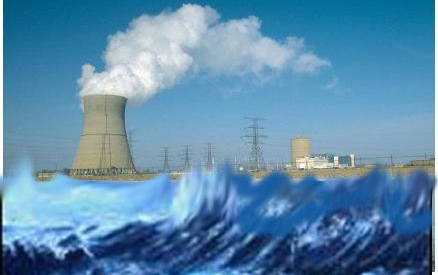 When the nuclear industry says that it can withstand conditions “beyond that historically reported,” we should want to know a lot more
United States came in second, behind Japan, as the country with the largest number of inadequately protected nuclear power plants. The 1938 New England hurricane triggered a storm surge as high as 25 to 30 feet, considerably higher than waves generated this week by Sandy. A wave that tall would easily overtake many nuclear plants on the East Coast, which on average lie about 20 feet above sea level, with minimal sea wall protection.
SANDY, FUKUSHIMA, AND THE NUCLEAR INDUSTRY New Yorker by Evan Osnos, November 2, 2012 When Hurricane Sandy hit the East Coast, it forced three nuclear reactors to shut down, including the Indian Point 3 plant along the banks of the Hudson, about twenty-five miles north of New York City. Three more reduced their output as a precaution. At
the nation’s oldest nuclear plant, the Oyster Creek facility, about thirty-three miles north of Atlantic City, operators faced an unusual event: wind, a rising tide, and the storm surge sent more water than normal into the plant’s water-intake system.
At the same time, the plant, which was already down for maintenance, lost its electrical
power from the grid. Operators called an “alert” that escalated the plant a step up from the lowest emergency level, and they turned to backup generators to keep cooling the reactor. Continue reading
Urgent! A message from Jill Stein at the pipeline protest -Green Party USA
Green Party Jill Stein arrested while assisting protesters prior to her arrest (Video)
NRC raises concerns about Dresden nuclear plant flood plan via the Chicago Tribune
By norma field – 2012/11/02
The Nuclear Regulatory Commission said Friday that it has asked Exelon Generation to address concerns over how the company would handle a catastrophic flood at the Dresden Nuclear Station in northern Illinois, after recent inspections indicated potential problems.
Among the concerns is how the company would refuel diesel pumps that circulate water to cool the reactor and how it would keep equipment from becoming clogged with flood debris, NRC spokeswoman Viktoria Mitlyng said. The commission sent a letter to the company Thursday, and Exelon has 30 days to respond.
“We’re not saying their plan won’t work, but we have raised questions,” and Exelon must demonstrate that it would work, Mitlyng said.
She said there is no immediate safety risk, but the goal is to keep the site’s two reactors safe in the event of a worst-case flood, like the one that swamped the Fukushima Daiichi plant in Japan last year.
Although that is highly improbable, the company must be prepared, Mitlyng said.
Continue reading at NRC raises concerns about Dresden nuclear plant flood plan
4 out of 6 experts in nuclear safety panel got grants from utilities
TOKYO, Nov. 3, Kyodo (Subsciption)
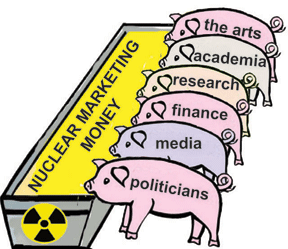
Four out of the six members of a government team drafting new safety standards for nuclear reactors have received between around 3 million yen and 27 million yen each in grants, donations and compensation from utilities in the past three to four years, according to data disclosed by the Nuclear Regulation Authority on Friday.
The regulatory body’s secretariat said the members “have been selected in line with rules, and there should be no problem.” Critics, however, say the members’ judgments might be swayed by the wishes of donors, exposing safety regulations to the risk of being watered down.
The NRA requires experts involved in drafting safety standards for nuclear power plants and other matters to disclose remuneration and donations, but has no provision for disqualifying them in light of such information.
Breaking – TEPCO’s Efforts towards Nuclear Reform on Facebook too!
TEPCO strongly wishes to be a nuclear power plant operator which has the world’s highest level of safety awareness, engineering capabilities and risk communication ability with society.
Thus, we established the “Nuclear Reform Special Task Force” led by our president in order to reform TEPCO’s safety culture, safety measures, disaster prevention measures, risk/crisis control protocol, information disclosure, and risk communication methods.
At the same time, we established “Nuclear Reform Monitoring Committee” which is comprised of domestic and overseas experts and monitors our reform implementation and progress from a purely external point of view as an advisory organization.
We will implement management and safety culture reforms under this new organizational framework.
TEPCO’s Goals


Basic Policies of Nuclear Reform


Continue reading
San Onofre Nuclear Plant Costs $300 Million
Friday, November 02, 2012
The blackout at the San Onofre nuclear power plant in California has cost close to $317 million, according to the operator of the plant, Southern California Edison. Edison International is the parent company and it said in court records that as of September 30, the bill for inspections and repairs has cost the company $96 million, according to the Associated Press. The plant has not been in service since January, causing power costs to hit $221 million. That is an increase from $117 million from the end of June.
Ted Craver, the Chairman of Edison International, conducted a conference call with Wall Street analysts recently. He said, “It’s not clear at this time if the units can be repaired, and it appears complete replacement of the steam generators would take some years.”
[…]
When four steam generators were overhauled in 2009 and 2010 for a cost of $670 million, damage to alloy tubing occurred. On January 31, the Unit 3 reactor was shut down following a tube break as a safety precaution. Officials at the plant said no danger was imminent for neighbors or workers even though traces of radiation were leaked.
[…]
An investigation by the California Public Utilities Commission was launched recently to determine if ratepayers should shoulder the cost for a plant that has been offline for the better part of a year.
More here
http://www.jdjournal.com/2012/11/02/san-onofre-nuclear-plant-costs-300-million/
1 This Month

of the week – Shut Down Drone Warfare!


Tell the Ukrainian Government to Drop Prosecution of Peace Activist Yurii Sheliazhenko

Petition to revoke the licensing of the Near Surface Nuclear Disposal Facility (NSDF) at Chalk River. https://www.ourcommons.ca/petitions/en/Petition/Details?Petition=e-7247
To see nuclear-related stories in greater depth and intensity – go to https://nuclearinformation.wordpress.com
-
Archives
- April 2026 (103)
- March 2026 (251)
- February 2026 (268)
- January 2026 (308)
- December 2025 (358)
- November 2025 (359)
- October 2025 (376)
- September 2025 (257)
- August 2025 (319)
- July 2025 (230)
- June 2025 (348)
- May 2025 (261)
-
Categories
- 1
- 1 NUCLEAR ISSUES
- business and costs
- climate change
- culture and arts
- ENERGY
- environment
- health
- history
- indigenous issues
- Legal
- marketing of nuclear
- media
- opposition to nuclear
- PERSONAL STORIES
- politics
- politics international
- Religion and ethics
- safety
- secrets,lies and civil liberties
- spinbuster
- technology
- Uranium
- wastes
- weapons and war
- Women
- 2 WORLD
- ACTION
- AFRICA
- Atrocities
- AUSTRALIA
- Christina's notes
- Christina's themes
- culture and arts
- Events
- Fuk 2022
- Fuk 2023
- Fukushima 2017
- Fukushima 2018
- fukushima 2019
- Fukushima 2020
- Fukushima 2021
- general
- global warming
- Humour (God we need it)
- Nuclear
- RARE EARTHS
- Reference
- resources – print
- Resources -audiovicual
- Weekly Newsletter
- World
- World Nuclear
- YouTube
-
RSS
Entries RSS
Comments RSS
 nuclear-news