In this climate challenged world, nuclear lobbyists have nothing to crow about
Having a grid that simply survives a category 1 hurricane without a Fukushima-sized nuclear disaster is nothing to crow about.
The astronomical cost of restoring power to millions of consumers is real, as is the potential danger still posed by a number of crippled nuclear power plants.
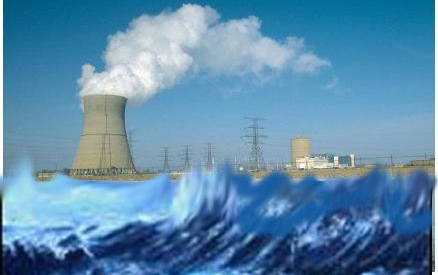 Oyster Creek Nuclear Alert: As Floodwaters Fall, More Questions Arise TruthOut , 01 November 2012 Gregg Levine, capitoilette | News Analysis“……If you thought all of these problems would cause nuclear industry representatives to lay low for a while, well, you’d be wrong: “Our facilities’ ability to weather the strongest Atlantic tropical storm on record is due to rigorous precautions taken in advance of the storm,” Marvin Fertel, chief executive officer of the Nuclear Energy Institute, a Washington-based industry group, said yesterday in a statement.
Fertel went on to brag that of the 34 reactors it said were in Sandy’s path, 24 survived the storm without incident.
Or, to look at it another way, during a single day, the heavily populated eastern coast of the Unite States saw multiple nuclear reactors experience problems. And that’s in the estimation of the nuclear industry’s top lobbyist.
Or, should we say, the underestimation? Of the ten reactors not in Fertel’s group of 24, seven were already offline, and the industry is not counting them. So, by Fertel’s math, Oyster Creek does not figure against what he considers success. Power reductions and failed emergency warning systems are also not factored in, it appears.
This storm–and the trouble it caused for America’s nuclear fleet–comes in the context of an 18-month battle to improve nuclear plant safety in the wake of the multiple meltdowns and continuing crisis at Japan’s Fukushima Daiichi nuclear facility. Many of the rules andsafety upgrades proposed by a US post-Fukushima taskforce are directly applicable to problems resulting from Superstorm Sandy. Improvements to flood preparation, backup power regimes, spent fuel storage and emergency notification were all part of the taskforce report–all of which were theoretically accepted by the Nuclear Regulatory Commission. But nuclear industry pushback, and stonewalling, politicking and outright defiance by pro-industry commissioners has severely slowed the execution of post-Fukushima lessons learned.
The acolytes of atom-splitting will no doubt point to the unprecedented nature of this massive hybrid storm, echoing the “who could have predicted” language heard from so many after the earthquake and tsunami that started the Fukushima disaster. Indeed, such language has already been used–though, granted, in a non-nuclear context–by Con Edison officials discussing massive power outages still afflicting New York City:
At a Consolidated Edison substation in Manhattan’s East Village, a gigantic wall of water defied elaborate planning and expectations, swamped underground electrical equipment, and left about 250,000 lower Manhattan customers without power.
Last year, the surge from Hurricane Irene reached 9.5 feet at the substation. ConEd figured it had that covered.
The utility also figured the infrastructure could handle a repeat of the highest surge on record for the area — 11 feet during a hurricane in 1821, according to the National Weather Service. After all, the substation was designed to withstand a surge of 12.5 feet.
With all the planning, and all the predictions, planning big was not big enough. Sandy went bigger — a surge of 14 feet. “Nobody predicted it would be that high,” said ConEd spokesman Allan Drury.
In a decade that has seen most of the warmest years on record and some of the era’s worst storms, there needs to be some limit on such excuses. Nearly a million New York City residents (including this reporter) are expected to be without electricity through the end of the week. Residents in the outer boroughs and millions in New Jersey could be in the dark for far longer. Having a grid that simply survives a category 1 hurricane without a Fukushima-sized nuclear disaster is nothing to crow about.
The astronomical cost of restoring power to millions of consumers is real, as is the potential danger still posed by a number of crippled nuclear power plants. The price of preventing the current storm-related emergencies from getting worse is also not a trivial matter, nor are the radioactive isotopes vented with every emergency reactor scram. All of that should be part of the nuclear industry’s report card; all of that should raise eyebrows and questions the next time nuclear is touted as a clean, safe, affordable energy source for a climate change-challenged world.
No comments yet.
1 This Month

of the week – Shut Down Drone Warfare!


Tell the Ukrainian Government to Drop Prosecution of Peace Activist Yurii Sheliazhenko

Petition to revoke the licensing of the Near Surface Nuclear Disposal Facility (NSDF) at Chalk River. https://www.ourcommons.ca/petitions/en/Petition/Details?Petition=e-7247
To see nuclear-related stories in greater depth and intensity – go to https://nuclearinformation.wordpress.com
-
Archives
- April 2026 (114)
- March 2026 (251)
- February 2026 (268)
- January 2026 (308)
- December 2025 (358)
- November 2025 (359)
- October 2025 (376)
- September 2025 (257)
- August 2025 (319)
- July 2025 (230)
- June 2025 (348)
- May 2025 (261)
-
Categories
- 1
- 1 NUCLEAR ISSUES
- business and costs
- climate change
- culture and arts
- ENERGY
- environment
- health
- history
- indigenous issues
- Legal
- marketing of nuclear
- media
- opposition to nuclear
- PERSONAL STORIES
- politics
- politics international
- Religion and ethics
- safety
- secrets,lies and civil liberties
- spinbuster
- technology
- Uranium
- wastes
- weapons and war
- Women
- 2 WORLD
- ACTION
- AFRICA
- Atrocities
- AUSTRALIA
- Christina's notes
- Christina's themes
- culture and arts
- Events
- Fuk 2022
- Fuk 2023
- Fukushima 2017
- Fukushima 2018
- fukushima 2019
- Fukushima 2020
- Fukushima 2021
- general
- global warming
- Humour (God we need it)
- Nuclear
- RARE EARTHS
- Reference
- resources – print
- Resources -audiovicual
- Weekly Newsletter
- World
- World Nuclear
- YouTube
-
RSS
Entries RSS
Comments RSS
 nuclear-news
Leave a comment