“Fresh Currents” – a must-read book for Japan and the world
Even if you don’t live in Japan, “Fresh Currents” has something profound to offer. As the Kyoto Journal’s Einarsen notes, “The writings in ‘Fresh Currents’ explore Japan’s path forward from Fukushima to a renewable energy future — and why this is important, wherever you live.”
“Fresh Currents” can be downloaded free. It is also available from good bookstores, priced ¥2,000. For more details, including news updates, visit:www.freshcurrents.org. Stephen Hesse is a professor in the Law Faculty of Chuo University. He can be reached at stevehesse@hotmail.com.
‘Fresh Currents’ charts the way to, and from, Fukushima, Japan Times, 28 Oct 12, By STEPHEN HESSE This month’s column is about a book that is very much more than just a book: It is a work of art, a labor of love and a realizable dream of a better future for Japan…..
Japan has limited options regarding its energy future: To accept the status quo and the cronyism that taints its government-industry relations, leaving energy policy in the hands of those who prioritize political gain; or to pursue national energy security that puts a priority on safety and on sharing the costs and benefits, financial and technological, across all of the nation’s regions and residents.
In a nutshell, Japan can either remain nuclear, with all the dangers that portends for these islands perched on the Pacific Rim of Fire — or it can pursue policies that foster and reward dramatic increases in energy conservation and efficiency and the development of alternative energies that are safe and widely decentralized.
Japan’s feed-in tariff (FIT) system for renewable energy sources adopted in July is a step in the right direction, at last offering competitive compensation to those who invest in and develop alternative-energy sources. But it needs to be buttressed with a comprehensive framework of incentives that stimulate research and long-term investment……
if Japan can manage to muster the political will to act, this nation already has the options and ideas it needs, many of them laid out in that new book to which I so fulsomely referred, which is both a compilation of policy insights and suggested viable solutions to the energy fix Japan is in.
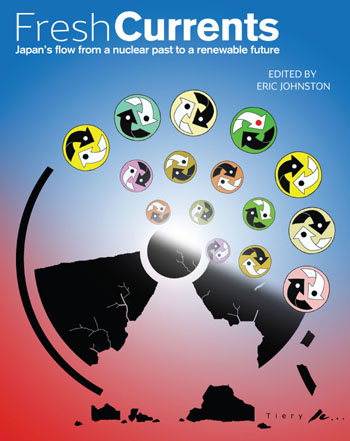
“Fresh Currents: Japan’s Flow From a Nuclear Past to a Renewable Future” is a visual and intellectual smorgasbord, a compilation of eye-opening articles, insightful interviews, useful charts and graphs — and stunning artwork and photographs.
The book is a Kyoto Journal team effort by more than a dozen volunteer contributors, mostly foreigners, under the similarly voluntary editorial eye of long-standing JT writer and reporter Eric Johnston. I call it a labor of love because both the writing and the wonderful visuals make it clear that those involved care as much about this nation as anyone…….
“Fresh Currents” began taking shape soon after 3/11 and has been financed with donations collected via an indiegogo.com fundraising campaign last summer.
As Kyoto Journal Editor John Einarsen explains, “The myth that nuclear power can deliver us from the long-term hazards of fossil fuels has been shattered. Renewable energy, long dismissed as impractical, is being given serious reconsideration. Japan can and must take advantage of this opportunity to rethink and refocus its energy strategies. Doing so, Japan will set an example for the world to follow.”
Following an introduction by Johnston, “Fresh Currents” is divided into two sections: “How We Got Here” and “The Way Forward.”…..
“Fresh Currents” is a captivating work because it tells the story of Japan’s energy journey — past, present and future — through the eyes of some of Japan’s most observant writers, thinkers and activists.
Each section of the book opens with several pages titled “Facts & Figures” that offer pause for thought. Here are some examples:
• Amount of plutonium Japan has in storage internationally: more than 35 tons.
• Number of simple nuclear warheads 35 tons of plutonium could arm: 5,000.
• Japan’s current installed nuclear-generation capacity: 46.15 gigawatts (GW).
• Japan’s potential offshore wind-energy capacity: 1,600 GW.
The first essay in the collection, also by Johnston, looks back at the history of nuclear power in Japan, from Hiroshima to Fukushima. This, however, is not the version you will find in ministry-approved textbooks………
Even if you don’t live in Japan, “Fresh Currents” has something profound to offer. As the Kyoto Journal’s Einarsen notes, “The writings in ‘Fresh Currents’ explore Japan’s path forward from Fukushima to a renewable energy future — and why this is important, wherever you live.”
In short, “Fresh Currents” is more than a book: It is a piece of living history that crystallizes the threshold upon which we stand today.
No comments yet.
1 This Month

of the week – Shut Down Drone Warfare!


Tell the Ukrainian Government to Drop Prosecution of Peace Activist Yurii Sheliazhenko

Petition to revoke the licensing of the Near Surface Nuclear Disposal Facility (NSDF) at Chalk River. https://www.ourcommons.ca/petitions/en/Petition/Details?Petition=e-7247
To see nuclear-related stories in greater depth and intensity – go to https://nuclearinformation.wordpress.com
-
Archives
- April 2026 (114)
- March 2026 (251)
- February 2026 (268)
- January 2026 (308)
- December 2025 (358)
- November 2025 (359)
- October 2025 (376)
- September 2025 (257)
- August 2025 (319)
- July 2025 (230)
- June 2025 (348)
- May 2025 (261)
-
Categories
- 1
- 1 NUCLEAR ISSUES
- business and costs
- climate change
- culture and arts
- ENERGY
- environment
- health
- history
- indigenous issues
- Legal
- marketing of nuclear
- media
- opposition to nuclear
- PERSONAL STORIES
- politics
- politics international
- Religion and ethics
- safety
- secrets,lies and civil liberties
- spinbuster
- technology
- Uranium
- wastes
- weapons and war
- Women
- 2 WORLD
- ACTION
- AFRICA
- Atrocities
- AUSTRALIA
- Christina's notes
- Christina's themes
- culture and arts
- Events
- Fuk 2022
- Fuk 2023
- Fukushima 2017
- Fukushima 2018
- fukushima 2019
- Fukushima 2020
- Fukushima 2021
- general
- global warming
- Humour (God we need it)
- Nuclear
- RARE EARTHS
- Reference
- resources – print
- Resources -audiovicual
- Weekly Newsletter
- World
- World Nuclear
- YouTube
-
RSS
Entries RSS
Comments RSS
 nuclear-news
Leave a comment