No future for nuclear-powered container ship -Barents Observer
The world’s only nuclear-powered container ship, the Murmansk-based “Sevmorput”, faces a future as scrap metal, two decades before its original service life expires.
The vessel, which has been lying idle in the Atomflot base outside Murmansk for years, was on 31 July this year taken out of the Russian Ship Register. The unique ship will end up a scrap metal, experts in Murmansk confirm.

The “Sevmorput”, which in the 1990s experienced major problems in international shipping following port restrictions, was used mainly on the route between Murmansk and Dudinka, the main port on the Yenisey River. In a bid to get the ship back in active service, the Murmansk Shipping Company in 2007 proposed to rebuild it into an oil drilling vessel. That initiative, however, stranded as the federal nuclear power company Rosatom took over the responsibility of the icebreaker fleet in 2008.
In 2009, Atomflot General Director Vyacheslav Ruksha himself admitted that the “Sevmorput” has no work, and that the fate of the ship is sealed. “If the situation lasts into 2010, the ship will be turned into needles”, he told B-port.ru.
The vessel, built at the Zaliv yard in Kerch, Ukraine, was a unique contribution to the Soviet fleet of civilian nuclear vessels when entering service in 1988. Until then, the world had seen only three other nuclear powered civilian merchant ships, all of which ended up as failed experimental vessels. The 260 meter long and 61.000 ton deadweight “Sevmorput” was to show that the Soviet Union could extend its nuclear power capacities also into merchant shipping. The ship was built in a period of booming shipping in Soviet Arctic waters.
The “Sevmorput”, which also has powerful icebreaking capacities, for several years shipped in both international and Russian domestic waters. However, shipping along the Russian Northern Sea Route declined dramatically in the 1990s and the ship was soon blocked access to most international ports.
http://barentsobserver.com/en/business/no-future-nuclear-powered-container-ship-24-10
Fukushima radioactive water could fill 50 Olympic sized swimming pools
To deal with the excess tainted water, the utility has channeled it to more than 300 huge storage tanks placed around the plant.
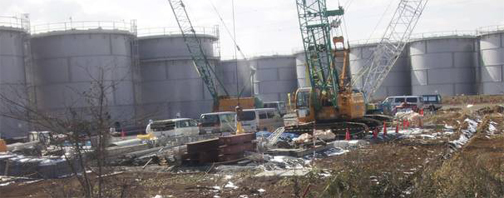
 Fukushima Nuclear Disaster: Plant’s Contaminated Water Storage Running Out Of Space HUFFINGTON POST, By MARI YAMAGUCHI 10/25/12 TOKYO — Japan’s crippled nuclear power plant is struggling to find space to store tens of thousands of tons of highly contaminated water used to cool the broken reactors, the manager of the water treatment team said.
About 200,000 tons of radioactive water – enough to fill more than 50 Olympic-sized swimming pools – are being stored in hundreds of gigantic tanks built around the Fukushima Dai-ichi plant. Operator Tokyo Electric Power Co. has already chopped down trees to make room for more tanks and predicts the volume of water will more than triple within three years. Continue reading
Harvey Wasserman lists America’s rust bucket nuclear reactors
 The Rust-Bucket Reactors Start to Fall http://www.nukefree.org/editorsblog/rust-bucket-reactors-start-fall , Harvey Wassermann, 26 Oct 12, The US fleet of 104 deteriorating atomic reactors is starting to fall. The much-hyped “nuclear renaissance” is now definitively headed in reverse.
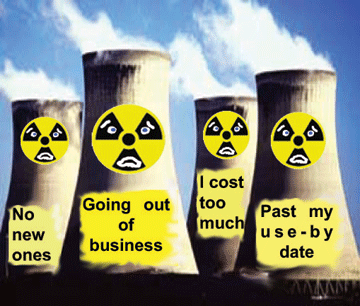
The announcement that Wisconsin’s Kewaunee will shut next year will be remembered as a critical dam break. Opened in 1974, Kewaunee has fallen victim to low gas prices, declining performance, unsolved technical problems and escalating public resistance.
Many old US reactors are still profitable only because their capital costs were forced down the public throat during deregulation, through other manipulations of the public treasury, and because lax regulation lets them operate cheaply while threatening the public health.
Plight of Fukushima’s heroic emergency workers
Nuclear workers in Japan Heroism and humility Meet the “Fukushima 50”, the men on the front line of the nuclear disaster The Economist Oct 27th 2012 | TOKYO | ACCORDING to his friends, the man in charge of the Fukushima Dai-ichi nuclear-power plant during the 2011 disaster, Masao Yoshida, says it felt like being on Iwo Jima. That is the North Pacific island heroically defended by the Japanese in 1945 but doomed to fall to the Americans.
His two underlings, Atsufumi Yoshizawa and Masatoshi Fukura, do not portray the struggle quite so graphically. In their first interviews since the disaster, they spoke of the sense of responsibility of the so-called Fukushima 50, those who risked their lives to fight the soaring levels of radiation coming out of the plant in the hours and days after the earthquake and tsunami on March 11th last year. They were driven, especially, by a desire to protect the local communities in which many of their families lived.
Yet the Fukushima 50, despite heroic efforts, still suffer from the complex of emotions that soldiers might experience when returning from a losing battle. A sense of shame and stigmatisation lingers. Continue reading
India stops Australian film maker entering Kudankulam anti nuclear protest area
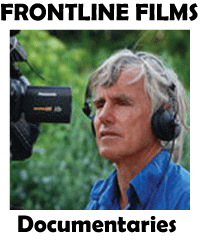 Australian filmmaker prevented from entering Kudankulam 25 Oct
  12http://www.dnaindia.com/india/report_australian-filmmaker-prevented-from-entering-kudankulam_1756187 , Oct 25, 2012, Three persons from Australia were today prevented from entering Idinthakarai, the epicentre of protests by People’s Movement Against Nuclear Energy leading the stir against Kudankulam Nuclear Power Plant in Tirunelveli district, police said.
Filmmaker David Bradbury along with his wife and son arrived in India on tourist visas and were about to enter Idinthankarai from Kanyakumari district this morning when police stopped them near Radhapuram police station, they said.
“After interrogations, the three were made to go back, since prohibitory orders were in place,” an officer said.
The PMANE has been leading protests against the plant for over a year citing safety concerns.
Commissioning of the first unit of the Indo-Russian project was originally scheduled for December last year, but has been delayed due to the protest.
Nuclear power obstacle in Japan: new evacuation plans
under the new radiation forecast, many more local governments will have to compile disaster management plans for areas that could require evacuation.
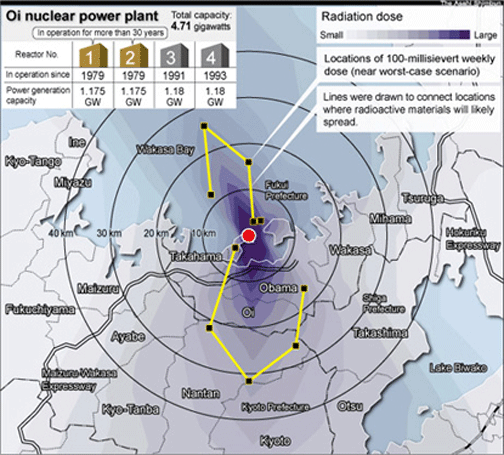
Radiation forecast creates hurdle in resuming nuclear plant operations UPDATE: Forecast predicts wider evacuations needed if nuclear disaster repeated October 25, 2012 THE ASAHI SHIMBUN Municipalities are demanding a greater say in whether utilities can restart their reactors after the new industry watchdog placed more communities in the danger zone of possible nuclear accidents. Continue reading
Inedible for years to come – fish near Fukushima coast

 Fukushima fish ‘may be inedible for a decade’ Fiona Harvey, environment correspondent guardian.co.uk 25 October 2012 Marine scientist finds levels of radioactivity in fish near stricken Fukushima nuclear plant are higher than expected
Fish from the waters around the Fukushima nuclear plant in Japan could be too radioactive to eat for a decade to come, as samples show that radioactivity levels remain elevated and show little sign of coming down, a marine scientist has warned.
According to a paper published in the journal Science on Thursday, large and bottom-dwelling species carry most risk, which means cod, flounder, halibut, pollock, skate and sole from the waters in question could be off limits for years, .
Sample fish caught in waters near the stricken reactors suggest there is still a source of caesium either on the seafloor or still being discharged into the sea, perhaps from what is left of the cooling waters. As the levels of radioactive isotopes in the fish are not declining as fast as they should have, the outlook for fishing in the area is likely to be poor for the next 10 years, the paper’s author told the Guardian.
“These fish could have to be banned for a long time. The most surprising thing for me was that the levels [of radioactivity] in the fish were not going down. There should have been much lower numbers,” said Ken Buesseler, senior scientist at the Woods Hole Oceanographic Institution in the US, who wrote the paper titled Fishing For Answers Off Fukushima.
He said his findings – taken in part from Japanese research and sampling of fish in the area – showed how difficult it was to predict the outcome of a nuclear incident such as that at Fukushima. ….. http://apps.facebook.com/theguardian/environment/2012/oct/25/fukushima-fish-inedible-decade-radioactivity
China puts the brakes on nuclear power
 China Slows Development of Nuclear Power Plants, NYT By KEITH BRADSHER, October 24, 2012 HONG KONG — Still responding to the partial meltdowns last year at nuclear reactors in Fukushima, Japan, the Chinese government has lowered its target for the construction of nuclear power plants by 2015, notably by not building more nuclear reactors at inland locations.
A white paper on energy policy released after a cabinet meeting on Wednesday said that the government planned to have 40 gigawatts of nuclear power capacity installed by 2015, and pledged strict safety standards. While the white paper and state-controlled media did not
describe this as a reduction in the target, the country’s current Five-Year Plan sets a target of 50 gigawatts….. Nuclear power generates only 1.8 percent of China’s electricity, far below the global average of 14 percent. http://www.nytimes.com/2012/10/25/business/global/china-reduces-target-for-construction-nuclear-power-plants.html?_r=2&
Israel’s secrecy on its nuclear weapons is getting ridiculous

 Netanyahu’s ‘Crazy’ Talk Seen Threatening Israel’s Nuclear Ambiguity International Herald Tribune, By HARVEY MORRIS, OCTOBER 25, 2012, LONDON — Israel will face mounting pressure to acknowledge the existence of its nuclear weapons arsenal as an unintended consequence of its government’s belligerent stance towards Iran, according to a former Israeli intelligence chief.
Ami Ayalon, former head of the Shin Bet domestic security agency, says, “The world won’t let you have nuclear ambiguity if you act crazy.” In an interview with Rendezvous during a visit to London, Mr. Ayalon said Israel’s special status was at risk as a result of Prime Minister Benjamin Netanyahu’s threats of military action against Iran’s nuclear plants if sanctions failed to persuade Tehran to abandon its alleged ambition to build a bomb.
Mr. Ayalon is among a number of serving and former defense and intelligence chiefs who have challenged the wisdom of threatening Iran with a unilateral strike.
His latest warning came as Finland prepared to host an international conference soon to debate turning the Middle East into a nuclear weapons-free region. The Israeli government has said it is against such a meeting, at which the issue of Israel’s own unacknowledged nuclear arsenal is certain to be raised.
“Mr. Netanyahu has been playing the role of irresponsible player in the region,” with his threats against Iran, according to Mr. Ayalon. “That raises the questions: Does he mean it? And what is the price?”…. http://rendezvous.blogs.nytimes.com/2012/10/25/netanyahus-crazy-talk-seen-threatening-israels-nuclear-ambiguity/
A horrible combination – fracking and nuclear reactor

 Fracking and nuclear side by side in Pennsylvania: A match made in hell? RT.com 25 October, 2012, Plans are afoot to drill a well that will use fracking technology only a mile from a nuclear power plant in Pennsylvania. The parties involved say they are unconcerned, despite evidence showing fracking increases incidence of earthquake….. http://rt.com/usa/news/fracking-nuclear-earthquake-safety-243/
Fish caught off Japan’s coast becoming MORE radioactive
the most contaminated fish found yet off Fukushima were caught in August, some 17 months after the disaster. The two greenlings, which are bottom-feeders, had cesium levels of more than 25,000 becquerels per kilogram, 250 times the level the government considers safe.
Radiation levels in fish off Japan not declining since nuclear disaster Anchorage Daily News, October 25, 2012 By MALCOLM FOSTER — Associated Press TOKYO — Radioactive cesium levels in most kinds of fish caught off the coast of Fukushima haven’t declined in the year following Japan’s nuclear disaster, a signal that the seafloor or leakage from the damaged reactors must be continuing to contaminate the waters – possibly threatening fisheries for decades, a researcher says. Continue reading
The case for closing Vermont Yankee nuclear plant heard in court
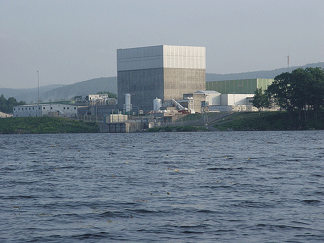
 Vermont Yankee Debate Heats Up On Two Fronts http://www.vpr.net/news_detail/96334/vermont-yankee-debate-heats-up-on-two-fronts/ , 10/24/12 The legal debate over the future of the Vermont Yankee nuclear plant is heating up at federal appeals court and at the state Public Service Board.
The state this week laid out a detailed case for why the plant should not get a new 20 year state permit to operate. Continue reading
Petition to Kitakyushu City to stop burning of radioactive wastes
Petitioning The Mayor of Kitakyushu City This petition will be delivered to: Kenji KITAHASHI The Mayor of Kitakyushu City TO STOP BURNING OF RADIOACTIVE DISASTER DEBRIS IN KITAKYUSHU https://www.change. org/petitions/to-stop-burning-of-radioactive-disaster-debris-in-kitakyushu?utm_campaign=twitter_link&utm_medium=twitter&utm_source=share_petition
by Horiwaki Kosaku Brooklyn, NY ACT NOW TO PROTECT the safe and clean air, water and soil of the Japanese city of Kitakyushu and the island of Kyushu from further radioactive contamination.
GO TO THIS SITE To SIGN TO STOP BURNING OF RADIOACTIVE DISASTER DEBRIS. Tell Kitakyushu Mayor Kenji Kitahashi to stop spreading radioactive particles into the Kitakyushu and Kyushu air, land and water. Continue reading
Will ratepayers foot the big bill for restarting San Onofre nuclear power plant?
 California Regulators Examining Troubled Nuclear Plant’s Costs Fox Business, October 25, 2012 California regulators said Thursday they would decide whether utility customers should pay to fix and restart the troubled San Onofre nuclear power plant in a ruling likely to determine the plant’s future.
The nuclear plant, located on the Pacific Coast between Los Angeles and San Diego, has been shut since Jan. 31, when a pipe ruptured and released radioactive steam…
.. The company plans to restart part of the plant for a limited period, but needs approval from the U.S. Nuclear Regulatory Commission before it can proceed. The NRC has said a decision on that plan, filed earlier this month, will likely take several months.
Asked whether the company might delay its plans for the plant pending the CPUC’s decision on whether customers would foot the bill, a SoCal Edison spokeswoman declined to comment….. http://www.foxbusiness.com/news/2012/10/25/california-regulators-examining-troubled-nuclear-plant-costs/#ixzz2AR7GkP3a
Solar energy catching on with friends and neighbours
Solar Power Adoption is Contagious, Dani Thé, ENN , October 22, 2012
Apparently doing something good can be contagious. Or at least this seems to be the case with solar power adoption. According to a study by Yale and New York University, published though Marketing Science, individuals are most likely to install solar panels on their home if one of their neighbors has also done so. The study, “Peer Effects in Diffusion of Photovoltaic Panels“, took a close look at solar installation clusters between January 2001 and December 2011 throughout the state of California. They found that a resident was most likely to install solar panels if solar panels had already been installed within that resident’s same zip code…… However, without governmental policy measures to create a market for which solar panel installations are desirable, initial installations by a household in a zip code area remains the principal challenge. Without it, a likelihood of adoption domino effect is minimal.
An example of such policy required to kick-start solar technology adoption rates is the “California Solar Initiative”. Established in 2006 by the California Public Commission, it played an integral role of encouraging solar infrastructure installations. Ten years since its establishment, the 3.3 billion dollar, 10-year rebate program encouraged the installation of over 3,000 megawatts of solar infrastructure. This study provides insight into the diffusion process of solar technology infrastructure, and also encourages policy makers to take action. It will require both governmental guidance and business strategy to take full advantage of these findings, so that solar technology adoption rates can quickly grow. The hope is that future studies will discover that the diffusion of other environmentally friendly technologies are just as contagious as solar is. http://www.enn.com/top_stories/article/45120
1 This Month

Protect Sazan Island from the Trump family! https://secure.avaaz.org/campaign/en/protect_sazan_island_from_the_trump_family_loc/?bqFCVab&v=174511&cl=22707147157&_checksum=5e9dde668860e8231c33699735e16a1fbf22ab2cb01da50c999fe8732b9775ef&utm_source=email&utm_medium=blast_email&utm_campaign=174511

Cuba Is Not a Failed State – It Is a Besieged State
PETITION: “Global Appeal to Endorse Palestinian Right of Return of Refugees”
To see nuclear-related stories in greater depth and intensity – go to https://nuclearinformation.wordpress.com
-
Archives
- June 2026 (129)
- May 2026 (306)
- April 2026 (356)
- March 2026 (251)
- February 2026 (268)
- January 2026 (308)
- December 2025 (358)
- November 2025 (359)
- October 2025 (376)
- September 2025 (257)
- August 2025 (319)
- July 2025 (230)
-
Categories
- 1
- 1 NUCLEAR ISSUES
- business and costs
- climate change
- culture and arts
- ENERGY
- environment
- health
- history
- indigenous issues
- Legal
- marketing of nuclear
- media
- opposition to nuclear
- PERSONAL STORIES
- politics
- politics international
- Religion and ethics
- safety
- secrets,lies and civil liberties
- spinbuster
- technology
- Uranium
- wastes
- weapons and war
- Women
- 2 WORLD
- ACTION
- AFRICA
- Atrocities
- AUSTRALIA
- Christina's notes
- Christina's themes
- culture and arts
- Events
- Fuk 2022
- Fuk 2023
- Fukushima 2017
- Fukushima 2018
- fukushima 2019
- Fukushima 2020
- Fukushima 2021
- general
- global warming
- Humour (God we need it)
- Nuclear
- RARE EARTHS
- Reference
- resources – print
- Resources -audiovicual
- Weekly Newsletter
- World
- World Nuclear
- YouTube
-
RSS
Entries RSS
Comments RSS
 nuclear-news