Japan’s Indistry Minister calls for a quick phaseout of nuclear energy
 The most serious problem is spent fuel buildup at each plant as well as an additional storage at a fuel reprocessing plant in Aomori prefecture, northern Japan. The country lacks plans about what to do with the highly radioactive waste.
 Minister: Japan Must Quickly Phase out Nuke Energy abc news, By MARI YAMAGUCHI Associated Press TOKYO September 29, 2012 Japan’s industry minister said the country must give up nuclear power plants as soon as possible because they pose too much risk in one of the world’s most earthquake-prone countries.
Yukio Edano said last year’s meltdowns after a tsunami hit the Fukushima Dai-ichi plant showed that nuclear power’s cost is too high. He expressed the opinion in his new book of policy views that hit stores Saturday.
Edano, who served top government spokesman during the height of the nuclear crisis last year, said he came to the conclusion after seeing “what was believed to be masterpiece of modern technology succumb to natural disaster so easily.”
“Now I want to eliminate nuclear power plants as soon as possible,” he wrote in the book, “Even if I get a beating, I must say this.”…. Continue reading
In spite of govt repression, India’s anti nuclear movement fighting on
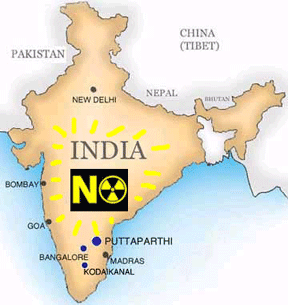 Centre, TN govt suppressing anti-nuke protests in Kudankulam’ http://www.dnaindia.com/india/report_centre-tn-govt-suppressing-anti-nuke-protests-in-kudankulam_1747176 , Sep 30, 2012, The leader of anti-nuclear protests in Kudankulam today charged the Centre and the Tamil Nadu government with suppressing the struggle “only to support foreign countries” which want to sell nuclear reactors.
At a day-long All-India Left Coordination Convention activist SP Udaykumar demanded through video message the closure of the project. ”The central and state governments are ignoring our pleas … to support the American, Russian and French nuclear projects in the country. We strongly demand the closure of Kudankulam Nuclear Power Plant project and the government should scrap all nuclear power projects,” he said.

“We do need development but not at the cost of putting the lives of millions of people at stake and destroying our natural resources,” he said. He accused the CPI and CPI(M) of supporting the Kudankulam project on one hand and opposing Jaitapur Nuclear Power Plant on the other.
At the convention, several leaders of various Left parties accused the UPA government of being “pro-corporate”.
“The state is brazenly becoming pro-corporate and authoritarian,” CPI National Secretary D Raja said.
Encouraging Left and democratic forces to work together keeping differences aside, Raja said, …..
The AILC gave a call for Punjab Bandh on October 5, Parivartan Rally in Patna on November 9 and a two-day strike by central trade unions in February next year.
Nuclear power plants can’t cope with increasing heat, with climate change

 Climate change Millstone shutdown is a sign of broader power problem caused by climate change CT Mirror, September 24, 2012 By Jan Ellen Spiegel Waterford — Last month’s unprecedented 12-day shutdown of part of the Millstone Nuclear Power Station sent a shudder through the nuclear energy world.
Caused when the seawater used to cool the plant’s generating Unit 2 became too warm, it was the first time any U.S. nuclear plant was shut down because of intake water temperature problems.
Nuclear energy officials were concerned, but “I don’t know if we would say ‘surprised,'” said Richard MacManus, Millstone’s director of nuclear safety and licensing. He spoke as he stood alongside Niantic Bay, taking in the panoramic view of the massive Millstone facility and Long Island Sound, its source of water.
The shutdown capped a season of power reductions and other difficulties at several of the nation’s power plants — including non-nuclear ones — caused when summer heat and drought compromised the vast amounts of water needed to cool them. It has also set in motion a cascade of other potentially debilitating effects, all of which point to the likelihood that climate change has placed part of the U.S. power grid at risk.
Curiously, the industry and its watchers had seen it coming — for decades……… http://www.ctmirror.org/story/17512/millstone-shutdown-sign-broader-water-power-conflicts-climate-change
Global warming causing rapid decline in Arctic sea ice
Norwegian Arctic Summers Warmest in 1,800 Years
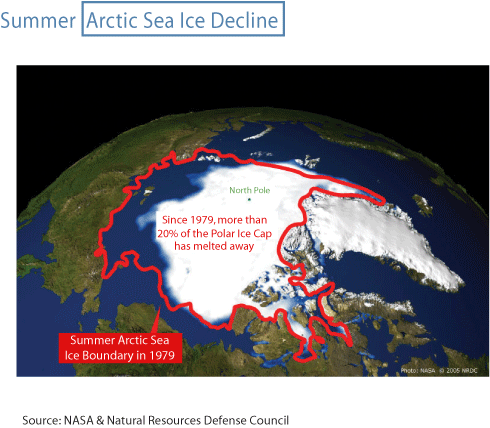
Summer temperatures on the Norwegian archipelago of Svalbard in the High Arctic are now higher than during any time over the last 1,800 years, including a period of higher temperatures in the northern hemisphere known as the Medieval Warm Period, according to a new study. In an analysis of algae buried in deep lake sediments, a team of scientists calculated that summer temperatures in Svalbard since 1987 have been 2 to 2.5 degrees Celsius (3.6 to 4.5 degrees F) warmer than during the Medieval Warm Period, which lasted from roughly 950 to 1250 AD. Scientists say this year’s record declines in Arctic sea ice extent and volume are powerful evidence that the giant cap of ice at the top of the planet is on a trajectory to largely disappear in summer within a decade or two, with profound global consequences. http://www.enn.com/wildlife/article/45024
USA wants to sell nuclear missile defense technology to Gulf countries
 US pushing Gulf nations to develop missile defense, Daily Star, Lebanon News September 29, 2012 The United States is pushing Gulf countries to develop missile defense plans, amid what they see is a rising threat from Iran, US officials said Friday.
The US official said Washington has already expressions of interest from some of the Gulf nations in developing missile defense capabilities and they hoped to have some announcements of contracts in the coming months.
http://www.dailystar.com.lb/News/Middle-East/2012/Sep-29/189613-us-pushing-gulf-nations-to-develop-missile-defense.ashx#ixzz284XJwdli
Nuclear weapons do not make a country safe.
 Mr. Umarov said that Kazakhstan fully supports a proposal by Secretary-General Ban Ki-moon to adopt a nuclear weapons convention, noting the suggestion of his country’s president that, as an important step in that direction, the United Nations should adopt a Universal Declaration of a Nuclear Weapon-Free World.
Africa: Nuclear Weapons Are No ‘Guarantee of Security,’ Kazakh Foreign Ministers Tells UN Debate AllAfrica.com 30 Sept 12, The inability of nuclear weapons to guarantee a country’s security or independence was highlighted in the speech of Kazakhstan’s Acting Minister of Foreign Affairs, Kairat Umarov, to the United Nations General Assembly today. Continue reading
Fukushima’s new hospital equipment can NOT measure internal radiation
 Technohill, the Japanese distributer of this equipment commented on their website that this equipement cannot measure internal exposure unlike the hospital explained on their press conference.
Fukushima hospital imported new WBC equipment, distributer “It can’t measure internal exposure” http://fukushima-diary.com/2012/09/fukushima-hospital-imported-new-wbc-equipment-distributer-it-cant-measure-internal-exposure/ by Mochizuki September 29th, 2012 Kuwano kyoritsu hospital in Koriyama city held a press conference on 9/24/2012. Continue reading
Australian Government set up a Renewable Energy Package- a good model for USA
 What America Can Learn from Australia’s New Clean Energy Future Package http://thinkprogress.org/climate/2012/09/29/929441/what-america-can-learn-from-australias-new-clean-energy-future-package/ Sep 29, 2012 by Jennifer Morgan, via WRI Insights Australia, one of world’s most carbon-intensive countries, recently began implementing a comprehensive national policy to address climate change and transition to a clean-energy economy. Yesterday, WRI had the pleasure of hosting Mark Dreyfus , Australian Parliamentary Secretary for Climate Change and Energy Efficiency, who outlined his country’s plans to a group of business, congressional, and NGO representatives.
One point that came through at the event is that Australia’s recent energy and climate choices can be very instructive to the United States. This post provides a quick look at Australia’s new policy and explores how it can inform and inspire U.S. efforts to move toward a low-carbon future.
Why Did Australia Adopt a National Climate and Energy Policy? Continue reading
Water use by nuclear power plants – another climate change problem
 Millstone shutdown is a sign of broader power problem caused by climate change, CT Mirror, September 24, 2012, By Jan Ellen Spiegel ….. Water consumption – some view raising the plant’s operating temperature as a Band-Aid for the real problem — the amount of water the nation’s 19,000 power generating units, including 104 nuclear ones, use. They consume 100 billion gallons a day — three times what cascades over Niagara Falls in the same time frame.
“U.S. power plants are at risk from not enough water due to situations like drought, too much water because of sea level rise and flooding, or water that is simply too warm,” said Steve Fleischli, acting director of the Natural Resources Defense Council‘s water and climate program. “From our perspective, what power plants can do to protect the grid is not rely so much on water.”
Most of the cooling water is returned to its source and then re-used, according to the U.S. Geological Survey, which documents fresh- and saltwater use every five years. Since 1965 most water withdrawals have gone for thermo-electric power generation. In 2005 (2010 data is not available yet), that figure was 40 percent nationally.
But in Connecticut it’s 82 percent. Among freshwater withdrawals, 24 percent goes to power plants. Of the saltwater withdrawals here, 99 percent goes to power plants.
At Millstone, Unit 2 uses 450,000 gallons of water per minute, and Unit 3 uses twice that amount. Coal plants like that in Bridgeport, which also takes its water from Long Island Sound, withdraw nearly the same amount of water as nuclear plants per megawatt hour. Gas and oil plants — similar in their water needs — require less than nuclear and coal. Conventional plants, however, generally can use warmer water than nuclear plants because without radiation concerns, their safety systems are less critical…… http://www.ctmirror.org/story/17512/millstone-shutdown-sign-broader-water-power-conflicts-climate-change
India’s nuclear energy program just not happening
 India’s ticking nuclear crisis: Part I Charu Sudan Kasturi, Hindustan Times New Delhi, September 30, 2012 India has missed its five-yearly nuclear power generation target by 74%, its plans crippled by the protests at Kudankulam and other nuclear plant sites that have left the country’s energy security roadmap under a cloud of uncertainty. The government had set an already modest target of adding 3380 MW of additional nuclear power by 2012 to the country’s 3900 MW capacity at the start of the 11th Five Year Plan in 2007.
But failure to convince local people and activists at almost every site handpicked for a nuclear plant has left the Nuclear Power Corporation of India Limited (NPCIL) with only 880 MW to show as nuclear power added over the past five years.
Similar protests over the coming few years could seriously jeopardize India’s current energy security strategy, energy economists, government experts and NPCIL officials have cautioned.
Mushrooms containing radioactive cesium sold in Western Japan
 Cesium from mushroom made in Kyushu, sold in west coast of Japan
http://fukushima-diary.com/2012/09/cesium-from-mushroom-made-in-kyushu-sold-in-west-coast-of-japan/ by Mochizuki on September 30th, 2012 · According to the report of Ministry of Health, Labour and Welfare, cesium was measured from mushroom made in Ohita prefecture, in Kyushu of western Japan. It was sold in Niigata prefecture, west coast of Japan.
Also, cesium was measured from mushroom made in Shizuoka prefecture, in central Japan. It was also sold in Niigata prefecture, west coast of Japan.
Sample 1
Product : Dried mushroom
Date : 9/24/2012
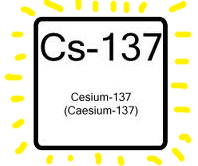
Cs137 : 5.9 Bq/Kg
Production : Ohita
Sample 2
Product : Dried mushroom
Date : 9/24/2012
Cs137 : 6.3 Bq/Kg
Production : Shizuoka
Punjab goes all out for solar power
 Punjab to set up solar photo-voltaic power packs across state: http://www.hindustantimes.com/Punjab/Chandigarh/Punjab-to-set-up-solar-photo-voltaic-power-packs-across-state/SP-Article1-937965.aspx Majithia Punjab is all set to set up solar photo-voltaic power packs in households across the state in a major move to encourage use of solar energy for basic electricity needs, Non-Conventional Energy
Minister Bikramjit Singh Majithia said on Sunday. He said the government was making all
efforts to fulfill the gap in demand and supply of electricity by installing more generating capacity in the renewable energy sector as well as conventional sector.
Majithia said Punjab has considerable sun light available for more than 330 days in a year and this abundant energy could be utilised for generation of power during the day time through solar photo-voltaic power plants.
He said the state is endowed with vast potential of solar energy estimated at 4-7 KWH per one sq mt of solar insulation level and added that Punjab government was committed to tap this resource.
He also said the Punjab Energy Development Agency (PEDA) has planned installation of Solar Power Packs at households in the state of capacity 500Wp to 1000Wp.
Majithia said the Ministry of New & Renewable Energy has sanctioned the Central Financial Assistance of Rs. 3.03 crore as first installment and with total project cost of Rs. 10 crore.
He said that besides generating power, Solar Photo-voltaic Power Packs were environment friendly and carbon neutral and were easily produced and consumed.
The Punjab government has set up Akshey Urja shops in all districts of the state, where people can buy these at 30 % subsidy.
Climate change brings storm, wave, threats to nuclear power plants
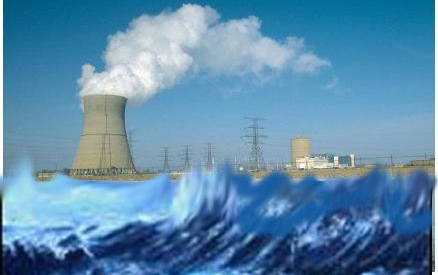 Millstone shutdown is a sign of broader power problem caused by climate change, CT Mirror, September 24, 2012, By Jan Ellen Spiegel “……As if warm water and lack of water haven’t produced enough hand-wringing at power plants this summer, scientists also are mindful that climate change includes sea level rise and increasingly violent storms. Millstone, literally at the water’s edge, has suffered storm-related power reductions over the years. MacManus said waves came over the seawall during Tropical Storm Irene, but water did not enter any buildings.
The NRC’s new chairwoman, Allison Macfarlane, has asked her staff to examine the effects of climate change on nuclear power plant operation.
But the industry bristles at the notion that it has ignored water issues. “It would be wrong to think that this is a sudden thing no one has ever thought about, no one has ever talked about,” said William Skaff, director of policy analysis at the Nuclear Energy Institute, the industry’s policy organization.
But others like John Rogers, co-manager of the energy and water project for the Union of Concerned Scientists, saw the Millstone shutdown and other incidents as wake-up calls.
“It’s clear that past energy choices in numerous instances are colliding with available water resources,” he said. “What this summer did was really underscore the potential for collision. In a lot of cases power plants got the water they needed. What we don’t know is who didn’t get the water.” http://www.ctmirror.org/story/17512/millstone-shutdown-sign-broader-water-power-conflicts-climate-change
Never mind the radioactive waste under the Arctic sea: Shell is keen to drill there
Shell still optimistic about Arctic drilling
http://www.heraldsun.com.au/business/breaking-news/shell-still-optimistic-about-arctic-drilling/story-e6frf7ko-1226485643427 AP October 01, 2012 THE stars lined up – almost – for Shell Oil to drill exploratory wells this year in waters off Alaska’s north coast.
The Arctic Ocean was on record pace for low sea ice. The Obama administration gave a qualified green light to drilling. Two drill ships and a flotilla of support vessels were staged off prospects.
But as the open water season wound down, Shell announced last week it would limit drilling to time-consuming preparation for an offshore well. The final straw for the decision: damage during testing September 15 to an undersea containment dome, a key to the company’s spill response system.
Environmentalists cheered the setback. Shell Oil President Marvin Odum says he considers it a temporary impediment in the long-term quest to open a petroleum frontier.
More nuclear accidents are probable. Solar Power is the best solution
Nuclear Power Part III: Safety and Conclusion by Jeff Danner – Common Science Sep 30 2012 “…….Given that the world currently hosts a fleet of a little over 400 nuclear power plants, how frequently should we expect reactor core meltdowns to occur in the future?
Organizations ranging from the Massachusetts Institute of Technology and the Max Planck Institute in Germany have estimated that we can expect a serious nuclear accident every 8 to 20 years. As the average age of nuclear plants around the world grows, I would expect the rate of incidents to increase…….
The only practical and ethical pathway to a sustainable future that I consider to be plausible is a massive national effort to construct solar electric plants and corresponding upgrades to the power grid.
The efforts and expenses on this monumental project need to be on the equivalent scale of what we have invested in the military over the last several generations. The growth of solar power capacity must be tied to firm targets to reduce per capita electricity use and an
enforceable schedule for decommissioning both fossil fuel and nuclear power plants. I plan a future series of columns on how this transition to solar power can take place.
Unfortunately, as I have bemoaned before, our current social and political culture is not at all prepared to grapple with issues of with import and complexity of nuclear power. Discussions of energy resources and long-term sustainability during the current presidential election campaign have been shallow and inconsequential at best. So for now, we’ll just have to hope the next melt down is far away.
http://chapelboro.com/Nuclear-Power-Part-III–Safety-and-Conclusion/9686450?pid=268649
1 This Month

Protect Sazan Island from the Trump family! https://secure.avaaz.org/campaign/en/protect_sazan_island_from_the_trump_family_loc/?bqFCVab&v=174511&cl=22707147157&_checksum=5e9dde668860e8231c33699735e16a1fbf22ab2cb01da50c999fe8732b9775ef&utm_source=email&utm_medium=blast_email&utm_campaign=174511
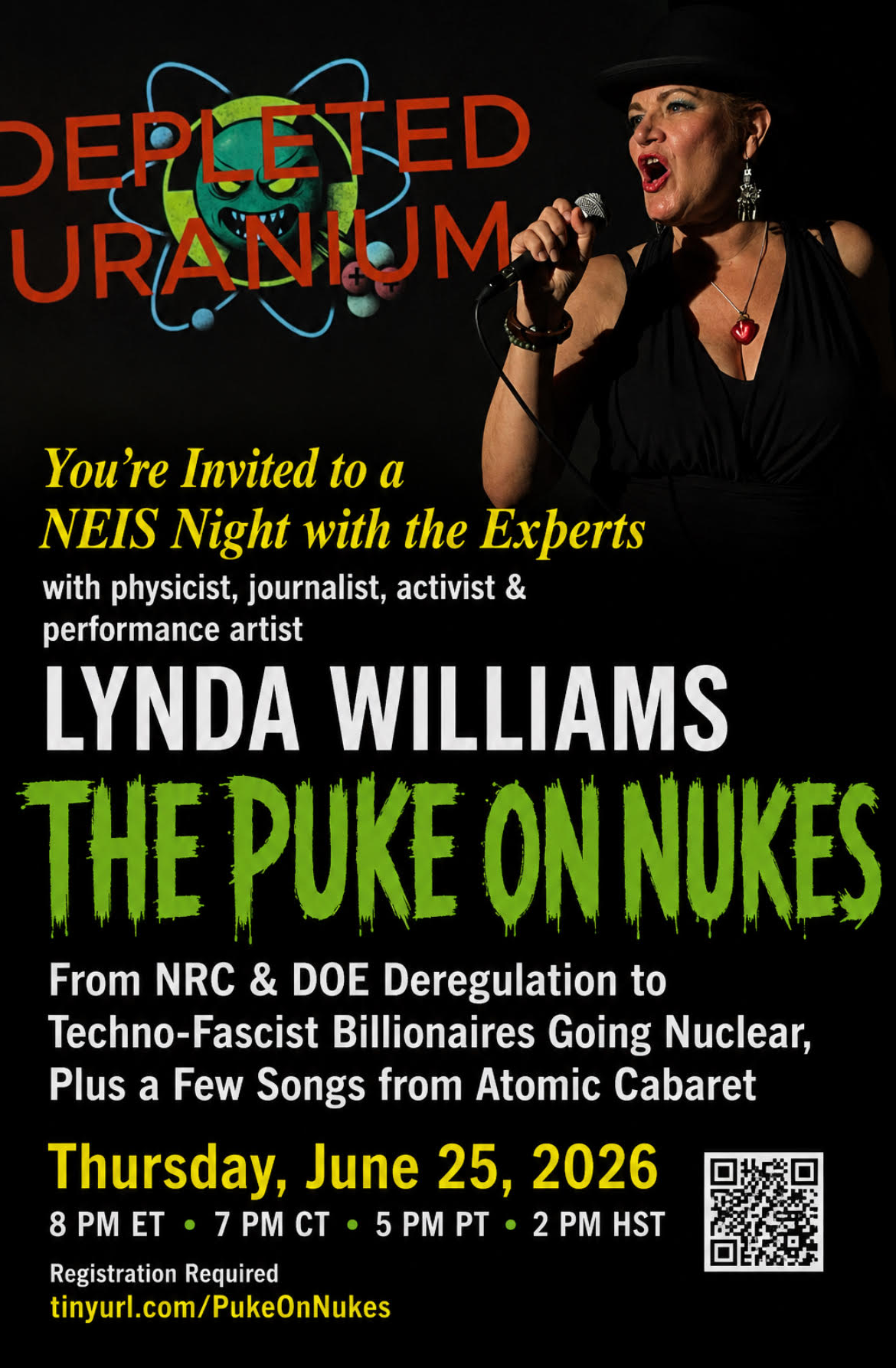
25 June- THE PUKE ON NUKES
Thursday, June 25, 2026
7pm Central Time (8pm ET, 6pm MT, 5pm PT) UTC – 5
From NRC & DOE Deregulation to Techno-Fascist Billionaires Going Nuclear, Plus a Few Songs from Atomic Cabaret REGISTER
26 June – Radiation Trainwreck at the NRC / Join the Protect Better Campaign – https://us02web.zoom.us/meeting/register/4ZlZ5_qLSHGiLSCg8FF6Bg#/registration

Cuba Is Not a Failed State – It Is a Besieged State
PETITION: “Global Appeal to Endorse Palestinian Right of Return of Refugees”
To see nuclear-related stories in greater depth and intensity – go to https://nuclearinformation.wordpress.com
-
Archives
- June 2026 (142)
- May 2026 (306)
- April 2026 (356)
- March 2026 (251)
- February 2026 (268)
- January 2026 (308)
- December 2025 (358)
- November 2025 (359)
- October 2025 (376)
- September 2025 (257)
- August 2025 (319)
- July 2025 (230)
-
Categories
- 1
- 1 NUCLEAR ISSUES
- business and costs
- climate change
- culture and arts
- ENERGY
- environment
- health
- history
- indigenous issues
- Legal
- marketing of nuclear
- media
- opposition to nuclear
- PERSONAL STORIES
- politics
- politics international
- Religion and ethics
- safety
- secrets,lies and civil liberties
- spinbuster
- technology
- Uranium
- wastes
- weapons and war
- Women
- 2 WORLD
- ACTION
- AFRICA
- Atrocities
- AUSTRALIA
- Christina's notes
- Christina's themes
- culture and arts
- Events
- Fuk 2022
- Fuk 2023
- Fukushima 2017
- Fukushima 2018
- fukushima 2019
- Fukushima 2020
- Fukushima 2021
- general
- global warming
- Humour (God we need it)
- Nuclear
- RARE EARTHS
- Reference
- resources – print
- Resources -audiovicual
- Weekly Newsletter
- World
- World Nuclear
- YouTube
-
RSS
Entries RSS
Comments RSS
 nuclear-news