Fukushima information website
http://fukushimaappeal.blogspot.com.au/2012/10/new-nuclear-regulation-agency-lined.htm We are Japanese people living in the UK. We are not activists or scientists, just normal citizens who want peace in the world and to protect our environment in a way that serves everybody. We are aware that there isn’t enough information in the main stream media in the UK about what’s going on in Fukushima, and we would like to share with you what we’ve found from Japanese web sites: information and news from scientists and doctors who are extremely worried about the safety of citizens, and from concerned freelance journalists and ordinary people. Since the magnitude-9 earthquake and tsunami, followed by the Fukushima nuclear disaster, we have been feeling a huge sense of loss… and have learned that nothing stays the same. Also we think that the Fukushima disaster was actually the result of many years of global political and economic corruption going on behind the scenes, and that the Japanese government was taken in by the worldwide drive for nuclear power, without learning the lessons of the Nagasaki and Hiroshima bombings. (NB: English is not our native language, so please take this into account when reading this blog.)
Japan’s Science Ministry may have “doctored” Fukushima radiation readings
Group: Ministry may have manipulated Fukushima radiation readings October 06, 2012 THE ASAHI SHIMBUN Citizens and scientists have raised concerns that the science ministry manipulated its measurement of radiation levels in Fukushima Prefecture to show figures lower than they really were.
The Association for Citizens and Scientists Concerned About Internal Radiation Exposures said on Oct. 5 that its survey this year of airborne dose levels found an average 10-30 percent higher than the ministry’s numbers, and in certain areas, the discrepancy was even
greater….. http://ajw.asahi.com/article/0311disaster/fukushima/AJ201210060041
Renewable energy resulting in cheaper baseload power
German baseload power cheaper than French 12 months running, Renewables International, 7 Oct 12 Yesterday, the European Energy Exchange (AEX) released figures for September, revealing that the price of baseload power in Germany has fallen by nearly 0.8 cents per kilowatt-hour over the past year – and has been cheaper than baseload power in France for 12 consecutive months.
The EEX published the trading results for September yesterday, but unfortunately the press release is currently only available in German.
What it shows is that day-ahead prices in Germany & Austria are lower than in France or Switzerland both in terms of base load and peak load. Indeed, though the press release explains that prices on the German and French markets “converge 75% of the time” (during periods of low consumption, such as during the night and on weekends), the difference in prices has become considerable, with the difference in base load prices being 4% on the average for September…..
day-ahead prices have been lower in Germany than in France for 12 consecutive months. The average German baseload price in September was slightly below the price in August, so the downward pressure on prices continues. The drop over the past 12 months in Germany has indeed been quite dramatic at around 18% – from 5.264 cents per kilowatt-hour in
September 2011 to the current 4.467 cents last month.
The news is especially important because nuclear power, which provides slightly more than 75% of France’s power supply, is often held to be an especially inexpensive source of baseload power. Furthermore, opponents of renewables repeatedly voice their concern about the cost impact of green power scaring away industry. …..
http://www.renewablesinternational.net/german-baseload-power-cheaper-than-french-12-months-running/150/537/57302/
Renewable energy taking over in European regions
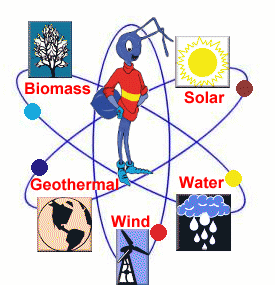 100 % RENEWABLE ENERGY IS ALREADY REALITY World Future Council, 8 Oct 12, Anna Leidreiter Europe is showing the world that we can move to a sustainable energy future based on cost-effective, clean and stable supplies. Renewable energies (RE) accounted for more than 71% of total electric capacity additions in 2011, bringing renewable energy’s share of total electric capacity to 31.1%. A number of European cities, regions and countries have committed to and even already achieved 100% renewable energy-sourced electricity, heating, and transport.
A network of 100% RE regions in Germany has 74 regions and municipalities that have already reached 100% renewable energy. One of these is Jühnde, the first bioenergy village in Germany. Through its 712kW biogas plant Jühnde produces twice the amount of electricity demanded by the local area and provides heat for 70% of the inhabitants through the co-operative, with 80% of the revenue remaining in the region. The initiative began with a public meeting in 2001 and citizen participation continues to be emphasised.
The municipality of Skellefteå, Sweden, is another good example of ambitious RE targets being set and met through community-owned power. Skellefteå Kraft is Sweden’s fifth largest electricity producer and 100% municipality-owned. The company, therefore, has a social mandate over and above its commercial pursuits. With renewables accounting for nearly 90% of its energy production it is in a good position to contribute to reaching the national targets of 50% share of renewable energy in the energy mix and 10% in transport by 2020, targets that will increase to 100% by 2050 and 2030, respectively.
This is reality not only in small towns: Denmark makes the case that 100% RE targets are set and can be met at a national level in one of the world’s wealthiest countries. As with Germany’s approach to achieving the 100% renewable energy target, the Danish experience has been one of bottom-up, participatory community power. On the Thy peninsula, where the World Future Council‘s workshop on 100% Renewable Energy in European Regions is taking place this wekeend at the Folkecenter, renewable energy – the bulk of which coming from wind – account for 100% of electricity consumption and 85% of space heating. The ‘Fossil-Free Thy’ project initiated by the Folkecenter aims to reach 100% renewable energy heating in the region in several years, and Thy is but one European example already demonstrating the feasibility of a fully renewable energy supply….. http://power-to-the-people.net/2012/10/100-renewable-energy-is-already-reality/
Boss of International Atomic Energy Agency (IAEA) at Japan’s Nuclear-Free Forum
Japan forum to discuss nuclear-free energy future, 06 October 2012  Muhammad Iqbal TOKYO: Japanese and European officials are to discuss future energy solutions at a forum in Kyoto this weekend in the wake of Japan’s plans to eliminate atomic power from the country’s energy mix by 2040.
Officials at the annual Science and Technology in Society (STS) forum Sunday will discuss the experience of removing nuclear power from a country’s energy mix, and what independent institutions can advise on the process.
Prime Minister Yoshihiko Noda’s administration in September declared its aim to eliminate atomic power over the next 30 years, as the cabinet declared a three-pronged strategy leading up to the halt, with tougher safety standards, the shuttering of reactors 40-years-old and a ban on the building of new units.
Since the tsunami-sparked meltdowns at the Fukushima plant last year there has been a grounds well of public opposition to nuclear power, which once provided a third of energy-hungry Japan’s electricity.
Genevieve Fioraso, France’s minister of higher education and research, told reporters Saturday ahead of the forum that Japan fared well despite its energy problems but said development of renewable energy solutions was “difficult”.
Among officials attending the forum Sunday are Yukiya Amano, director general of the International Atomic Energy Agency (IAEA), UK government chief scientific adviser John Beddington, and members of the Fukushima inquiry commission…..http://www.brecorder.com/world/southeast-asia/84115-japan-forum-to-discuss-nuclear-free-energy-future.html
Independent Scotland would ban nuclear weapons but join Nato Telegraph 7 Oct 12 Alex Salmond has promised SNP members a separate Scotland will have a written constitution banning nuclear weapons if they reverse their decades-long opposition to Nato.By Simon Johnson, Scottish Political Editor 07 Oct 2012161 The First Minister said the document would include a clause declaring weapons of mass destruction illegal, meaning the UK’s Trident submarine fleet would have to be moved from its base on the Clyde.
He made the pledge to placate his party members ahead of their conference later this month, at which they will vote to reverse SNP policy on an independent Scotland being part of Nato. The Nationalists have opposed membership for years because the
alliance is based on nuclear weapons, but this stance has severely undermined the credibility of their defence policy in the debate over separation.
Mr Salmond and Angus Robertson, his defence spokesman, are aiming to convince the SNP rank-and-file they can safely back Nato without compromising their anti-nuclear credentials or their determination to remove Trident…
… Patrick Harvie, the Scottish Greens’ co-leader, said: “The idea that we sign up to a nuclear alliance, the implication of which is to ask other countries to deploy nuclear weapons on our behalf, and then have a debate about whether they should be moved from the Clyde is a nonsense.” http://www.telegraph.co.uk/news/politics/SNP/9592522/Independent-Scotland-would-ban-nuclear-weapons-but-join-Nato.html
15 Nuclear Reactors on New Madrid Fault Line Before It’s News , 16 Mar 2011 Bob Nations, Jr., the Director of Shelby County Office of Preparedness, says that since the lack of preparation exposed by Hurricane Katrina, he is “preparing for the catastrophic event” in his six-county jurisdiction.
Nations admitted that after a major quake, Tennessee’s infrastructure and response capabilities “would get overwhelmed fairly quickly.”
There are 15 nuclear power plants in the New Madrid fault zone — three reactors in Alabama — that are of the same or similar design as the site in Japan experiencing problems.
The USGS report predicts that a major quake would create horrific
scenes like something out of a science fiction movie, potentially
cutting the Eastern part of the country off from the West in terms of
vehicular traffic and road commerce. …..
http://www.sott.net/article/225939-15-Nuclear-Reactors-on-New-Madrid-Fault-Line
Nuclear engineer slams industry safety standards: speech given at anti-nuclear protest rally UK
Commenting on EDF Energy’s bid to build a new EPR reactor at Hinkley, Smith added, “The nuclear industry suffers from the delusion that nuclear power is safe. They said that after Three Mile Island, they said it after Chernobyl and they said it after Fukushima. Do we really want Hinkley Point to be the next major disaster?”
06.10.12
A specialist engineer who worked at Hinkley Point nuclear power station for almost 30 years yesterday slammed the nuclear industry’s approach to safety and predicted that a Fukushima-type disaster in the UK was ‘almost inevitable’.
Speaking at a rally organised to oppose the construction of a new mega-reactor at the Somerset power station, Peter Smith said he become increasingly disillusioned with the nuclear industry during his career. “Over the years, I became more and more aware of the dangers and dark side of nuclear power,” he said.
“The industry denies that it ever puts profit before safety but this is a lie. I have seen corner-cutting from the design stage onwards. At Hinkley, major safety systems were omitted and others only implemented after major incidents.”
Nuclear Lead poisoning cover-up UK, serious wildlife contamination found!
In a recent wildlife report it was shown that birds tested in the period winter 2010 to winter 2011 were found that elevated levels of lead (i.e. >20.0 μg/dL) were found in the blood of 34 % (n = 285) of waterbirds tested at four sites in Britain during the 2010/2011 winter this happening during some of the largest radioactive releases from nuclear power plants and medical reactors.
In this study, we examined data on current and historical trends in lead poisoning in British waterbirds and related these to the introduction of legislation restricting the use of lead. Our results indicate that lead poisoning has continued to affect a wide range of British waterbirds long after legal restrictions were introduced.
Of course, it could be argued that existing lead weights might be the cause of this anomaly but the main effected bird species prone to lead weight poisoning was the swans.
significant change in lead-related mortality in mute swans found during the same time period, 25 % (n = 12) between 1971 and 1987, 4.6 % (n = 65) between 1988 and 1999 and 2 % (n = 100) between 2000 and 2010
The annual breakdown of radioactive materials in the UK Water Standards report due 2012 for the period 2011 to 2012 (May) to date has not been published. But I was able to snag a Google cached copy of the USA military base UK Annual water report for that period. It clearly shows the lead pollution getting to, or above the safety levels for humans. Depending on the varying safety level. The US military had to go back the following month (October 2011) and redo the test for it to pass. Here is some evidence of that and also, where the contamination was likely from. the Budapest Medical Isotopes Institute in Hungary.
Getting to “Yes” at International Conference on Nuclear Waste -Canada
but the tough questions during Tuesday’s sessions about transparency in some of the siting process and the independence of the nuclear regulators came from outside Canada, or not at all.
[…]
“You don’t want a “yes” crowd because a “yes” crowd incites a “no” crowd and the “no” crowd always has a lot of energy”, explained Saida Laarouchi Engstrom, from the Swedish Nuclear Fuel and Waste Management Company.
[…]
Asked to comment on what constitutes community support, Kramer replied that “Fifty (percent) plus one is not enough” and suggested that the ballot box was a way to measure support. Kramer said that those who support the nuclear waste burial project were elected, and those did not support it lost in the municipal elections.
Friday, October 05, 2012 by: BayToday.ca Staff
Story Brennain Lloyd/Special to BayToday.ca.
A parade of country representatives took to the stage Tuesday in downtown Toronto at an international conference on nuclear waste burial, outlining programs and plans for what the nuclear industry calls “geological repositories”. The two-day international conference was the most recent in a series of gatherings convened every four years.
In an opening panel of “implementers” from Sweden, Finland, Japan, the U.K. and Switzerland, presenters flashed image after image of tunnels, shafts and caverns carved out of rock, all generated as part of national planning processes which would ultimately result in country stockpiles of high level nuclear fuel waste being placed deep below the surface, as a “final solution” to the to-date intractable problem of how to contain the radioactive wastes that are generated by nuclear power plants and will remain hazardous – and harmful – for hundreds of thousands of years.
Thirty Five Minutes To Meltdown -EU nuclear stress tests update
“In the end, there always remains a degree of risk
that you can reduce through retrofitting and investments.
But you can never completely eliminate it.”
Günther Oettinger European Commissioner for Energy
in interview with Der Spiegel, April 2011
BY ADONAI
OCTOBER 6, 2012
POSTED IN: EDITORS’ PICKS, ENERGY
European activists are joining their voices and worries after European Commision released this week their “stress tests” report of nuclear power plants (NPP) in Europe. By the report there are currently 145 nuclear reactors in 15 European states, EC states that safety record is such that although incidents have occurred andcontinue to occur, no major accidents have ever taken place. Activists said the report dodges the real issues.
The results don’t say that any nuclear reactor in Europe is too unsafe to operate. But they identify concerns across Europe, including a lack of seismic measuring instruments, insufficient safety and rescue equipment, and inadequate emergency plans. The largest number of concerns was found in France, the leader in number of nuclear reactors in EU.
Anti-nuclear campaigners criticised the report, which they said glosses over more serious concerns. “The final report of the EU nuclear stress tests charade looks set to dodge all the tough questions, as expected,” said German Green MEP Rebecca Harms (europeanvoice.com).
In introduction to released “stress tests” EC states that the challenges which nuclear safety and its governance face were highlighted in the accident at the Fukushima reactors in Japan following the earthquake and the tsunami in March 2011. This event demonstrated that nuclear reactors must be protected even against accidents which have been assessed as highly improbable. Events at Fukushima revealed well-known and recurring issues: faulty design, insufficient backup systems, human error, inadequate contingency plans, and poor communications. The EU must learn the lessons of Fukushima to further reduce the risk of nuclear incidents in Europe.
The Fukushima accident resulted in unprecedented efforts to review the safety of nuclear installations in Europe and worldwide. Initiatives were taken at national, regional and international level. In the EU, the European Council, in March 2011 concluded that “the safety of all EU nuclear plants should be reviewed, on the basis of a comprehensive and transparent risk and safety assessment (“stress tests”).
Definition of a “terrorist” -USA (Audio)
http://www.youtube.com/watch?v=rp8SeGGnUfE&feature=player_embedded
Published on Sep 28, 2012 by EndtheLie
Duration 2.00 hrs
Tonight on End the Lie Radio, Madison Ruppert and guest Brandon Turbeville of Activist Post discuss the definition of a “terrorist” and how almost everyone in America today could absurdly be considered suspicious per the DHS’s ever-expanding definition, as well as who are the local Councils of Governments (COGs) and how are they supporting the Agenda 21 initiative across small-town America in this information-packed, educational episode. End the Lie Radio is live from 10:00 PM – 12:00 AM EST/7:00 PM – 9:00 PM PST every Monday evening at http://EndtheLie.com/Radio.
Brandon Turbeville is an author out of Mullins, South Carolina. He has a Bachelor’s Degree from Francis Marion University and is the author of three books, Codex Alimentarius — The End of Health Freedom, 7 Real Conspiracies, and Five Sense Solutions. Turbeville has published over one hundred articles dealing with a wide variety of subjects including health, economics, government corruption, and civil liberties.
Review -Peace activists close nuclear facility, cause historic security breach -Ploughshares USA

The Transform Now Three with their signs, via http://transformnowplowshares.wordpress.com.
In the early morning on Saturday, July 28, three gray-haired trespassers made their way into a nuclear weapons facility in Tennessee. They were armed with human blood, hammers, candles, flowers, crime-scene tape and a Bible. In the process of their break-in and after, they managed to close down operations at the facility for days on end and raise searching questions about how secure — and how justified — the United States’ vast nuclear stockpiles really are.
Bahrain Shiite activist Rajab on hunger strike
“According to Amnesty International, since the protests first began in February 2011, at least 60 people have been killed.”
06 OCTOBER 2012
AFP – Bahraini Shiite rights activist Nabeel Rajab has gone on hunger strike, a local rights group said Saturday, just two days after he was briefly released from jail to attend his mother’s funeral.
Rajab, 48, who is serving a three-year sentence for participating in illegal demonstrations, was allowed out of jail for one day to bury his mother.
After the funeral, Rajab was taken back into custody and barred from attending the three-day condolence gathering where friends and relatives pay their respects.
“In protest against this unjustified punishment, (Rajab) started a full hunger strike (on Friday),” said the Bahrain Centre for Human Rights (BCHR).
In a comment posted on Twitter, Bahraini rights lawyerMohammed al-Jishi said “Rajab’s hunger strike is an expected reaction since he’s being denied his lawful and humane right to attend his mum’s funeral.”
Bahrain authorities say Rajab was barred from attending the condolence gathering because he “committed violations” at the funeral.
“Rajab was released briefly to attend his mother’s funeral on humanitarian grounds,” the authorities said in a statement, but he “violated the terms of his release and delivered a speech inciting mourners to stage illegal protests”.
“Because of his actions, Rajab has had the privilege to attend further mourning gatherings revoked,” the authorities said.
The BCHR said that Rajab called on mourners to “continue their struggle for rights and democracy,” and argued his speech was a “peaceful expression of opinion.”
India: ‘Nuclear energy is not a national issue – it is a global issue’ — anti-nuclear movement gains momentum
“The people protesting in Koodankulam are not only fighting for their health and livelihoods; they are not only fighting for the peoples’ of India; they are fighting for the right to life of the peoples’ of the entire world, and for the healthy lives of our unborn generations. It is the duty of all conscious human beings, wherever they are, to join the struggle against nuclear energy.”
Neeraj Jain interviewed by B. Skanthakumar
October 5, 2012 – Links International Journal of Socialist Renewal — The anti-nuclear peoples’ movement in India has been gathering momentum in recent years. The courageous struggle of women, men and children of Idinthakarai village in South India, who are resisting the Koodankulam Nuclear Power Plant, and are under siege by state security forces – with more than 56,000 of whom have been falsely charged, including 6000 for the offence of “sedition”, and 53 imprisoned – has highlighted the people’s movement against nuclear energy.
Neeraj Jain is the convenor of Lokayat, a social activist group in Pune, Maharashtra, that is part of the all-India National Alliance of Anti-Nuclear Movements (NAAM). Jain, who trained in electrical engineering, is the author of Nuclear Energy: Technology from Hell (Aakar Books, Delhi 2012). He was interviewed by B. Skanthakumar in Bangkok on September 5, 2012, before the confrontation a few days later during fuel-loading of the Koodankulam nuclear reactor, in which one fisher was shot dead and dozens were injured, sparking strikes and agitations across Tamil Nadu, including in Chennai, Coimbatore, Erode and Thootukudi.
* * *
What is the background to the upsurge of peoples’ movements against nuclear energy in India today?
The Indian National Congress-led government is going for nuclear energy in a big way, claiming that it is cheap, clean and safe, and the solution to the country’s energy needs.
This expansion of nuclear energy is a follow-up to the Indo-US nuclear deal [in 2008]. The Indian government agreed to buy US$150 billion worth of nuclear reactors, equipment and other materials from the United States of America in return for the US inking the agreement. Indian Prime Minister Manmohan Singh’s special envoy, Shyam Saran, also promised that US companies would benefit for decades from Indian orders for military equipment. The quid pro quowas for the US to modify its laws and allow India to engage in nuclear commerce, from which it had been blocked after its nuclear tests in 1974.
The US also lobbied with the Nuclear Suppliers Group (NSG) – which is an association of 45 countries that export uranium and nuclear technology – to grant India the waiver to engage in civilian nuclear trade, despite not having signed the Nuclear Non-Proliferation Treaty (NPT). In return, the Indian government promised the NSG countries that their companies would receive lucrative contracts in India. This was candidly admitted in an article in a leading newspaper of Maharashtra by the former chief of India’s Department of Atomic Energy, Anil Kakodkar.
This is the real reason behind the Indian government opening its doors to Western nuclear energy companies. After putting the country on sale, it is now strutting about claiming that it has become a “nuclear superpower”, in addition to its claim to having become an “economic superpower”.
The government of India is setting up two kinds of nuclear plants.
1 This Month

Protect Sazan Island from the Trump family! https://secure.avaaz.org/campaign/en/protect_sazan_island_from_the_trump_family_loc/?bqFCVab&v=174511&cl=22707147157&_checksum=5e9dde668860e8231c33699735e16a1fbf22ab2cb01da50c999fe8732b9775ef&utm_source=email&utm_medium=blast_email&utm_campaign=174511
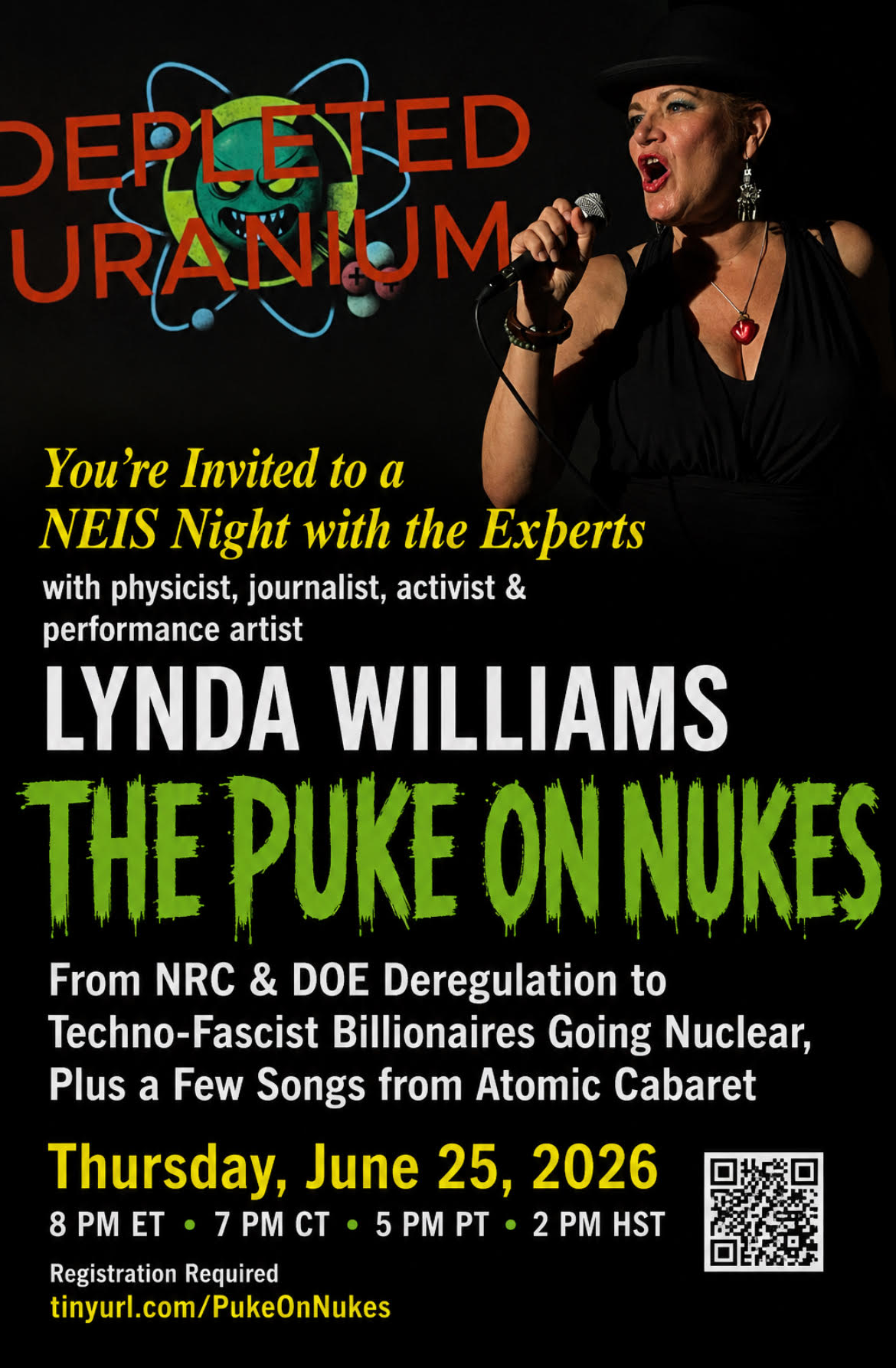
25 June- THE PUKE ON NUKES
Thursday, June 25, 2026
7pm Central Time (8pm ET, 6pm MT, 5pm PT) UTC – 5
From NRC & DOE Deregulation to Techno-Fascist Billionaires Going Nuclear, Plus a Few Songs from Atomic Cabaret REGISTER
26 June – Radiation Trainwreck at the NRC / Join the Protect Better Campaign – https://us02web.zoom.us/meeting/register/4ZlZ5_qLSHGiLSCg8FF6Bg#/registration

Cuba Is Not a Failed State – It Is a Besieged State
PETITION: “Global Appeal to Endorse Palestinian Right of Return of Refugees”
To see nuclear-related stories in greater depth and intensity – go to https://nuclearinformation.wordpress.com
-
Archives
- June 2026 (142)
- May 2026 (306)
- April 2026 (356)
- March 2026 (251)
- February 2026 (268)
- January 2026 (308)
- December 2025 (358)
- November 2025 (359)
- October 2025 (376)
- September 2025 (257)
- August 2025 (319)
- July 2025 (230)
-
Categories
- 1
- 1 NUCLEAR ISSUES
- business and costs
- climate change
- culture and arts
- ENERGY
- environment
- health
- history
- indigenous issues
- Legal
- marketing of nuclear
- media
- opposition to nuclear
- PERSONAL STORIES
- politics
- politics international
- Religion and ethics
- safety
- secrets,lies and civil liberties
- spinbuster
- technology
- Uranium
- wastes
- weapons and war
- Women
- 2 WORLD
- ACTION
- AFRICA
- Atrocities
- AUSTRALIA
- Christina's notes
- Christina's themes
- culture and arts
- Events
- Fuk 2022
- Fuk 2023
- Fukushima 2017
- Fukushima 2018
- fukushima 2019
- Fukushima 2020
- Fukushima 2021
- general
- global warming
- Humour (God we need it)
- Nuclear
- RARE EARTHS
- Reference
- resources – print
- Resources -audiovicual
- Weekly Newsletter
- World
- World Nuclear
- YouTube
-
RSS
Entries RSS
Comments RSS
 nuclear-news