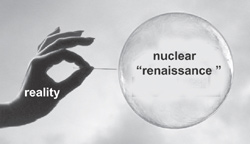
 There is a rash of misinformation on the net about the supposed merits of the ‘new’ nuclear energy source on the block, thorium. I am sure that in a perfect world where nobody lies, thorium would be the perfect answer to the world’s energy needs as is claimed. This is unfortunately not the case.
Apparently, every time there is a new nuclear catastrophe, the thorium ‘miracle’ is promoted again as the ‘savior’ for the world. The Fukushima nuclear radiation catastrophe was not unique and the thorium misinformation artists have come out in droves. It’s the nuclear industry’s defense mechanism – create a new ‘safety myth’ that regular people can latch onto.
In reality, the thorium nuclear fuel cycle has been under development since the very early days of the nuclear industry. India, for example, has spent decades trying to commercialize it, and has failed. The US, Russia, Germany, and many others tried and failed as well. At best, thorium based nuclear power generation may be commercialized in a few decades.
I doubt it.
Fortunately, there are a number of independent trustworthy and expert sources of information on the internet regarding thorium nuclear. Here they are: Continue reading →
October 19, 2012
Posted by Christina Macpherson |
2 WORLD, spinbuster, Uranium |
1 Comment
If we really want to assist Indian communities who currently lack access to electricity – and we should – it would be far more effective to prioritise exporting Australian expertise in regional renewable energy systems.
the admission this week from India’s own auditor that the country’s nuclear industry is “dangerously unsafe, disorganised and, in many cases, completely unregulated” – only compounds concerns.
When Australian uranium leaves our waters it effectively disappears from the radar. This is a profound concern for a fuel that can power either nuclear reactors or nuclear weapons. High-level Indian officials have stated that they need to source uranium from overseas in order to free up their own uranium for military purposes

No smooth passage to India for Australian uranium http://www.abc.net.au/environment/articles/2012/10/18/3612800.htm DAVE SWEENEY, ABC 18 OCT 2012 PRIME MINISTER JULIA GILLARD is in India this week and amid the staged handshakes and solemn exchanges of signed papers. The uranium sales plan is being heavily promoted. But there is growing concern both here and in India about the implications of the move and the fast-tracking of nuclear-armed India into the global atomic club.
No doubt Julia Gillard will be employing the age-old tactic of highlighting a problem that no reasonable person could ignore and then seeking to ‘own’ the solution. Proponents of the sales deal point to the estimated 200 million Indians who do not have reliable access to electricity as a rationale for the sales deal. But to link Australian yellowcake with lights and cookers in remote Indian villages is to draw a very long bow. Continue reading →
October 19, 2012
Posted by Christina Macpherson |
AUSTRALIA, India, politics international |
Leave a comment
India’s much trumpeted nuclear reactor construction binge has fizzled out… in the next five years we should not expect any shipments from Australia.
The India-US nuclear deal had one aspect of tacit proliferation built into its structure – the horizontal proliferation of knowledge from the civilian to the military
As a result while all kinds of water-tight restrictions were placed on the transfer of materials and power, none was placed on the movement of scientists. This of course was well known, the point was to acquire French reprocessing technology – ostensibly for civilian purposes but then to duplicate the same to improve India’s reportedly dismal weapons material reprocessing.
The scary state of Indian reactors, their safety and security has long been whispered about – but was blown apart by the CAG’s indictment a few months back.
Julia’s Nuclear Tango – Analysis http://www.eurasiareview.com/18102012-julias-nuclear-tango-analysis/
IPCS October 18, 2012 By Abhijit Iyer‐Mitra As expected, nuclear negotiations took centre stage during Australian
Prime Minister Julia Gillard’s visit to Delhi. Much talk of cultural links owing to the English language, cricket, a Westminster style parliament was bandied about. While Australia insists on a multifaceted engagement to build deep interdependencies, India sees only its one point agenda in all of this and has held ties hostage to the supply of Uranium. While opinions in Delhi seem optimistic many factors point to need for a hard reality check. Continue reading →
October 19, 2012
Posted by Christina Macpherson |
India, politics international, Uranium |
Leave a comment
 U.K. Energy Rules to Include Measures Spurring Nuclear By Alex Morales Bloomberg News October 18, 2012 U.K. Energy Secretary Ed Davey promised to give industry more clarity about power market reforms due next month, seeking to allay the concerns of renewable and nuclear power developers that ministers are bogged down in analysis of the problem….. Cameron’s Plan Prime Minister David Cameron said yesterday the government will put
into the legislation a measure forcing energy suppliers to charge each customer at the lowest available rate. The surprise proposal was not included in the May 22 draft, which focused on energy supply rather than demand.
Cameron’s statement caused “chaos in the energy industry,” Caroline Flint, the shadow energy minister for the opposition Labour Party, said in Parliament today. Neil Bentley, deputy director general of the Confederation of British Industry, said the pace of reform is
“frustrating” and risks falling victim to “paralysis by analysis.”….
http://www.businessweek.com/news/2012-10-18/u-dot-k-dot-energy-law-will-include-measures-spurring-nuclear-power
October 19, 2012
Posted by Christina Macpherson |
politics, UK |
Leave a comment
Cricketism has brought India closer to Australia and nuclear grey deals brought them still closer and the announcement by a silly Australian PM to offer the nation’s prestigious awards to foreigners, especially in cricketism exercises. India needs Australian uranium for nuclear terror purposes
Mutual exchange of honorary degrees and awards are very common, like street robberies, in international politics for the promotion of trade in arms and nukes stuff.
Russians supply India nuclear stuff and Australians offer awards.
Why should the Indian regime of corporates and mafias kill people in Kudankulam?
India’s Archons bribes Australia for awards — Cricketism, The Canadian 18 OCTOBER 2012 BY DR. ABDUL RUFF ” …….Madam Gillard arrived in India after a surprise trip to Afghanistan had meetings with business leaders and their protector Singh in Delhi. Indian nuclear mafia abroad is doing well.
Australia’s ruling centre-left Labor party voted to overturn its ban on uranium sales to India last year after a long debate about nuclear weapons and reactor safety following Japan’s atomic crisis. Continue reading →
October 19, 2012
Posted by Christina Macpherson |
AUSTRALIA, India, politics international |
Leave a comment
The Belene nuclear project, Bulgaria’s radioactive political issue The Sofia Globe, OCT 19 2012 by CLIVE LEVIEV-SAWYER The farce into which Bulgaria’s planned national referendum on whether to proceed with the Belene nuclear power station has rapidly descended is an illustration of just how radioactive the issue has proved for every government and political party that has touched it. Continue reading →
October 19, 2012
Posted by Christina Macpherson |
EUROPE, politics |
Leave a comment
Power line linked to nuclear plant upgrade would cost at least $193 million Journal Sentinel 18 Oct 12 A high-voltage power line in Sheboygan, Manitowoc and possibly Calumet counties will cost $193 million to $262 million, depending on the route selected.
American Transmission Co. this week filed an application with state regulators to build the line, which is needed to help accommodate the increased power output from the Point Beach Nuclear Plant…. http://www.jsonline.com/blogs/business/174789691.html
October 19, 2012
Posted by Christina Macpherson |
business and costs, USA |
Leave a comment
Marines learn how to detect invisible threat during course DVIDS 18 Oct 12 CAMP LEJEUNE, N.C. – Deadly radiation kills if it goes undetected, so it falls upon specially trained Marines to alert units of the unseen danger.
More than 30 Marines from various units within the 2nd Marine Logistics Group learned how to counter radiation by using the AN/PDR-77 during the Monitor Survey Reconnaissance Course here, from Oct. 15 to 18.
“Every unit is responsible for having a select number of Marines who are certified with this equipment,” said Sgt. Steven D. Potts, a chemical, biological, radiological and nuclear defense specialist with Combat Logistics Regiment 27, 2nd MLG.
It could possibly save the lives of many servicemembers, he added.
CBRN defense specialists trained the Marines to use the AN/PDR-77, a small, box-shaped sensor that detects alpha, beta, gamma and X-ray radiation.
“This [course] provides a tool for the commanding officer if we ever face a CBRN attack,” said Sgt. Jason L. Stacy, a CBRN defense specialist with CLR-27, 2nd MLG. “These reconnaissance teams can find the extent of the contamination or radiation, what type of chemical is present or how much radiation is present, and we can use the area or find a clean route through or around it.” http://www.dvidshub.net/news/96383/marines-learn-detect-invisible-threat-during-course#.UIG0yW_A9dM#ixzz29mIcEJOX
October 19, 2012
Posted by Christina Macpherson |
health, USA |
Leave a comment
Centre justifies waiver of nuclear civil liability pact with Russia THE HINDU, 19 Oct 12 J. VENKATESAN The Centre on Thursday justified in the Supreme Court waiver of the nuclear liability agreement with Russia for the Kudankulam plant in Tamil Nadu and said it was a policy decision taken at a time when no other country came forward to sustain India’s nuclear capabilities.
Making this submission before a Bench of Justices K.S. Radhakrishnan and Dipak Misra, Solicitor General Rohinton Nariman denied the allegation of Prashant Bhushan, counsel for petitioners, that the Government had signed the agreement to appease Russia…..
http://www.thehindu.com/news/national/centre-justifies-waiver-of-nuclear-civil-liability-pact-with-russia/article4010279.ece?homepage=true
October 19, 2012
Posted by Christina Macpherson |
India, Legal |
Leave a comment
Solar panels often steal the limelight when it comes to solar power systems, so it’s good to see developments in inverter technology getting a little more press attention.
In a grid connected solar power system, a solar inverter converts the DC electricity generated by solar panels into AC electricity suitable for use by home appliances and for exporting to the mains grid. Continue reading →
October 19, 2012
Posted by Christina Macpherson |
ENERGY, technology, USA |
Leave a comment
What you need to know about Darlington’s reactors Greenpeace – August 31, 2012 These are the frequently asked questions about Darlington Ontario’s nuclear reactors. If this information leaves you concerned and you want the government to re-consider their plan, sign up below. Why “Stop Darlington”?
The biggest threat to building a green energy sector in Ontario is the $36 billion earmarked to build two new, and re-build four outdated, risky nuclear reactors at Darlington, 60 kilometers east of Toronto.
Spending billions to rebuild old reactors and to build new ones at Darlington comes with unnecessary accident risks, damages Lake Ontario, and burdens future generations with stockpiles of radioactive waste. Continue reading →
October 19, 2012
Posted by Christina Macpherson |
general |
Leave a comment
Critics on all sides as Australia leads way on Antarctic protection BY: MATTHEW DENHOLM, TASMANIA CORRESPONDENT The Australian October 18, 2012 AUSTRALIA and France have developed a plan to protect 1.9 million square kilometres of east Antarctica as new marine parks, although a report today will call for an even larger reserve.
The Australia-France proposal, backed by the EU, covers seven coastal zones in east Antarctica…. (subscribers only)
http://www.theaustralian.com.au/national-affairs/foreign-affairs/critics-on-all-sides-as-australia-leads-way-on-antarctic-protection/story-fn59nm2j-1226498135791
October 19, 2012
Posted by Christina Macpherson |
ANTARCTICA, oceans |
Leave a comment
Overexposure of a radiographer
Thursday, October 18, 2012
A radiographer went in a bunker where industrial radiography operations were made. The ionising source was a X-ray machine (225kV – 4mA). The radiographer thought that the irradiation was finished but this was not the case and he was exposed.
According to the biological dosimetry, the radiographer received a whole body dose below 200mSv.
At the moment, the licencee is making a reconstitution of the incident to better determine the dose
Location:
Stork Technical Service
Event date:
Wed, 2012-09-19
Event sender:
Gilles.Hermans@fanc.fgov.be
October 19, 2012
Posted by arclight2011 |
Uncategorized |
Leave a comment
“It’s such an odd situation because private companies just don’t have this material,” Miles Pomper, a senior research associate at the Center for Nonproliferation Studies in Washington, D.C., told the Democrat and Chronicle.
No kidding. A spokesman for the Nuclear Regulatory Commission told the Los Angeles Times that the company had enriched 1,582 grams of uranium-235 up to 93.4%, a level considered weapons-grade. Good thing Kodak isn’t in Iran; that’s the kind of thing Israel’s been threatening to go to war over.
For Kodak, nuclear reactor and weapons-grade uranium proved useful
Posted on October 18, 2012
From
An Eastman Kodak facility had a small nuclear reactor and 3½ pounds of weapons-grade uranium for more than 30 years. (Associated Press / May 14, 2012)
By Matt PearceMay 14, 2012, 3:01 p.m.
Kodak has the bomb.
… OK, not really. But according to a report from the Rochester, N.Y., Democrat and Chronicle, an EastmanKodak facility had a small nuclear reactor and 3 ½ pounds of weapons-grade uranium for more than 30 years.

Kodak. The company that makes cameras and printers.
“It’s such an odd situation because private companies just don’t have this material,” Miles Pomper, a senior research associate at the Center for Nonproliferation Studies in Washington, D.C., told the Democrat and Chronicle.
No kidding. A spokesman for the Nuclear Regulatory Commission told the Los Angeles Times that the company had enriched 1,582 grams of uranium-235 up to 93.4%, a level considered weapons-grade. Good thing Kodak isn’t in Iran; that’s the kind of thing Israel’s been threatening to go to war over.
The company was using the reactor to check its chemicals and perform radiography tests, the commission said, and had upgraded to its in-house system after using one at Cornell University, according to the Democrat and Chronicle. It was reportedly guarded and monitored carefully.
Kodak, not known as one of the world’s nuclear powers, filed for bankruptcy protection in January and has been shedding some of its holdings.
Continue reading →
October 19, 2012
Posted by arclight2011 |
Uncategorized |
1 Comment
“General Douglas MacArthur agreed
MacArthur’s views about the decision to drop the atomic bomb on Hiroshima and Nagasaki were starkly different from what the general public supposed …. When I asked General MacArthur about the decision to drop the bomb, I was surprised to learn he had not even been consulted. What, I asked, would his advice have been? He replied that he saw no military justification for the dropping of the bomb. The war might have ended weeks earlier, he said, if the United States had agreed, as it later did anyway, to the retention of the institution of the emperor.”
http://www.washingtonsblog.com/2012/10/the-real-reason-america-used-nuclear-weapons-against-japan-to-contain-russian-ambitions.html
The REAL Reason America Used Nuclear Weapons Against Japan (It Was Not To End the War Or Save Lives)
Posted on October 14, 2012 by WashingtonsBlog
Atomic Weapons Were Not Needed to End the War or Save Lives
Like all Americans, I was taught that the U.S. dropped nuclear bombs on Hiroshima and Nagasaki in order to end WWII and save both American and Japanese lives.
But most of the top American military officials at the time said otherwise.
The U.S. Strategic Bombing Survey group, assigned by President Truman to study the air attacks on Japan, produced a report in July of 1946 that concluded (52-56):
Based on a detailed investigation of all the facts and supported by the testimony of the surviving Japanese leaders involved, it is the Survey’s opinion that certainly prior to 31 December 1945 and in all probability prior to 1 November 1945, Japan would have surrendered even if the atomic bombs had not been dropped, even if Russia had not entered the war, and even if no invasion had been planned or contemplated.
General (and later president) Dwight Eisenhower – then Supreme Commander of all Allied Forces, and the officer who created most of America’s WWII military plans for Europe and Japan – said:
The Japanese were ready to surrender and it wasn’t necessary to hit them with that awful thing.
Newsweek, 11/11/63, Ike on Ike
Eisenhower also noted (pg. 380):
In [July] 1945… Secretary of War Stimson, visiting my headquarters in Germany, informed me that our government was preparing to drop an atomic bomb on Japan. I was one of those who felt that there were a number of cogent reasons to question the wisdom of such an act. …the Secretary, upon giving me the news of the successful bomb test in New Mexico, and of the plan for using it, asked for my reaction, apparently expecting a vigorous assent.
During his recitation of the relevant facts, I had been conscious of a feeling of depression and so I voiced to him my grave misgivings, first on the basis of my belief that Japan was already defeated and that dropping the bomb was completely unnecessary, and secondly because I thought that our country should avoid shocking world opinion by the use of a weapon whoseemployment was, I thought, no longer mandatory as a measure to save American lives. It was my belief that Japan was, at that very moment, seeking some way to surrender with a minimum loss of ‘face’. The Secretary was deeply perturbed by my attitude….
Admiral William Leahy – the highest ranking member of the U.S. military from 1942 until retiring in 1949, who was the first de facto Chairman of the Joint Chiefs of Staff, and who was at the center of all major American military decisions in World War II – wrote (pg. 441):
It is my opinion that the use of this barbarous weapon at Hiroshima and Nagasaki was of no material assistance in our war against Japan. The Japanese were already defeated and ready to surrender because of the effective sea blockade and the successful bombing with conventional weapons.
Continue reading →
October 19, 2012
Posted by arclight2011 |
Uncategorized |
Leave a comment






 nuclear-news