Europe’s Extreme light Infrastructure Nuclear Laser project still being hyped. To good to be true?
“..Dr Goldsworthy hopes that in 20 years the laser technology could be enriching a third of the world’s power station uranium, returning “handsome royalty streams” to Australia…”
“ELI will have a large societal benefit in medicine with new radiography and hadron therapy methods. It will also considerably contribute to material science with the possibility to unravel and slow down the aging process in nuclear reactors and in the environment by offering new ways to treat nuclear wastes.”
“…Similarly, the final amplification stage takes multiple lines and one needs to coherently superpose them, as many as 10 or so at the highest power. This is a challenge that the world has never encountered nor has been carried out at this level…”

Zapping Nuclear Waste With Laser Beams Could Actually Be A Great Idea
by MARK MEMMOTT
“World’s Most Powerful Laser Beams To Zap Nuclear Waste.”
That Bloomberg Businessweek headline got our attention. We were imagining the explosion that might result.
But as it turns out, the zapping “could destroy nuclear waste and provide new cancer treatments,” according to the story.
Japanese Legal Expert: “Even residents of Tokyo are evacuating” — More and more people fleeing Fukushima (VIDEO)
“…more and more people evacuate Fukushima…”
http://enenews.com/even-residents-of-tokyo-are-evacuating
Published: October 26th, 2012 at 9:16 am ET
By ENENews
Title: Japanese Attorney Masaki Kito on Fukushima and real estate
Published by: A4NR
Published on: Oct 26, 2012
And this press release from Brunei concerning contaminated food from Japan
THURSDAY, 11 OCTOBER 2012 08:50ROKIAH MAHMUD
-Importation Of Some Food Items From Japan Suspended -Lack of trust? -Brunei Darussalam
“In this regard, importers and the public have been informed that the importation of certain food categories has been suspended.
The importation of any meat, seafood, milk and milk products, fruits and vegetables (fresh and processed), tubers including potato and sweet Potato, seaweed and green tea products from Fukushima, Ibaraki, Tochigi, Gunma, Saitama, Kanagawa, Tokyo and Chiba Prefectures are temporarily suspended.”
Urgent petition to save the children of Fukushima -Evacuate now!
UK -Horizon nuclear to be sold to the Chinese and Japanese?
By David Coates
Published on Friday 28 September 2012 09:20
A battle between China and Japan’s financial heavyweights will decide the future of a huge contract to build new nuclear power stations.
The bidding war to buy Horizon Nuclear Power, a group which owns two sites earmarked for a pair of reactors in North Wales and Gloucestershire, has stepped up with Japanese giant Hitachi entering the fray.
It is up against consortiums led by reactor-building group Westinghouse, backed by the financial muscle of China’s State Nuclear Power Technology Corp, and rival reactor firm Areva and China’s Guangdong Nuclear Power Group Company.
A successful bid for Horizon by Westinghouse would see the contract for decades of fuel for the new reactors head to Springfields Fuels factory in Salwick, near Preston, which employs nearly 1,000 people.
The group has also vowed to ramp up its headquarters on Matrix Park at Buckshaw Village, near Leyland, if it is successful in building its AP1000 reactor across the UK.
The Evening Post understands Hitachi has entered the battle having teamed up with Canadian company, SNC Lavalin.
On Friday, Mike Graham, national secretary of nuclear workers’ trade union, Prospect, said the battle to acquired Horizon had come down to a bidding war between China and Japan.
Scientific symposium in Tokyo on November 12 and 13 2012 – Still limited data after 18 months
“What we really need is a better understanding of the sources and sinks of cesium and other radionuclides that continue to drive what we’re seeing in the ocean off Fukushima.”
Japan’s “triple disaster,” as it has become known, began on March 11, 2011, and remains unprecedented in its scope and complexity. To understand the lingering effects and potential public health implications of that chain of events, scientists are turning to a diverse and widespread sentinel in the world’s ocean: fish.
[…]
As a result, Buesseler concludes that there may be a continuing source of radionuclides into the ocean, either in the form of low-level leaks from the reactor site itself or contaminated sediment on the seafloor. In addition, the varying levels of contamination across fish types points to complex methods of uptake and release by different species, making the task of regulation and of communicating the reasons behind decision-making to the fish-hungry Japanese public all the more difficult. “To predict the how patterns of contamination will change over time will take more than just studies of fish,” said Buesseler, who led an international research cruise in 2011 to study the spread of radionuclides from Fukushima. “What we really need is a better understanding of the sources and sinks of cesium and other radionuclides that continue to drive what we’re seeing in the ocean off Fukushima.” To help achieve this, Buesseler and his colleague Mitsuo Uematsu at the University of Tokyo are organizing a scientific symposium in Tokyo on November 12 and 13 to present the most current findings available about how radionuclides from Fukushima Dai-ichi have affected the ocean, marine life, seafood, policy decisions, and media coverage to date. The event will also include a free public colloquium in Tokyo on November 14 to help spread information about the lessons learned to the broadest possible audience.
[….]
Read more at: http://phys.org/news/2012-10-fishing-fukushima.html#jCp
Leaflet distribution against Kudankulam nuclear plant
(Mirror) – The Movement for People’s Struggle is conducting a leaflet distribution in Jaffna, Vavuniya and Mannar against the Kudankulam nuclear plant in South India.
It warns the lives of 1.5 million Sri Lankans, including one million in the north, are in danger due to this nuclear plant.
It accuses the government of keeping silent over this grave threat.

http://www.mirror.lk/news/2711-leaflet-distribution-against-kudankulam-nuclear-plant
Slovak Nuclear Power Plants Must Ramp Up Power Supply -Bloomberg
The accident occurred when a tsunami knocked out power supply to Fukushima reactors, disrupting the cooling process that led to reactor meltdown, causing mass evacuations and leading to long-term environmental damage.
Correction to article: meltdown should read meltdowns (3 ) arclight2011
By Ladka Bauerova – Oct 26, 2012
Stress tests at Slovakia’s two nuclear power stations revealed that the facilities need to improve the safety of auxiliary electricity supply, the country’s nuclear security chief said.
Plants in Jaslovske Bohunice and Mochovce, controlled by Enel SpA (ENEL), were forced toreview and improve the diesel generators that ensure the supply of power to the power stations, especially the circuits operating the nuclear reactors, Marta Ziakova, the chairwoman of the Slovak Nuclear Safety Office, said in an interview in Valec, Czech Republic yesterday.
The Mochovce plant, which currently operates two Soviet- designed water-pressure reactors VVER and is building two more, had to increase the capacity of its diesel generators to be able to supply all four units with electricity at the same time, she said. Her office also asked the Jaslovske Bohunice plant to carry out a seismic safety review.
“We asked the Bohunice management to review the plant’s resistance to seismic activities, especially the resistance of the diesel generators,” Ziakova said.
The reviews were part of Europe-wide nuclear stress tests carried out after the reactor disaster at Japan’s Fukushima Dai- Ichi plant in March last year. The accident occurred when a tsunami knocked out power supply to Fukushima reactors, disrupting the cooling process that led to reactor meltdown, causing mass evacuations and leading to long-term environmental damage.
The post-Fukushima stress tests have delayed the completion of units 3 and 4 at Mochovce to 2014-15. So far there is no indication of further delays, Ziakova said.
The older Jaslovske Bohunice reactors received a 10-year life extension in 2008. Slovenske Elektrarne AS, the Slovak utility controlled by Enel, invested about 500 million euros ($645 million) into modernization and improving output. Slovenske can apply for further lifespan extension by 2014, she said.
http://www.bloomberg.com/news/2012-10-26/slovak-nuclear-power-plants-must-ramp-up-power-supply.html
Future of UK nuclear power hangs in the balance, says EDF boss -Guardian
The company says it is waiting for government reassurances before going ahead with a nuclear construction programme.
-
Fiona Harvey, environment correspondent
- The Guardian, Tuesday 23 October 2012
[,,,]
Vincent de Rivaz, chief executive of EDF Energy, told MPs at a select committee hearing on Tuesday that he had still not made up his mind whether to go ahead with a construction programme that would see the first new nuclear power stations in the UK for decades.
No future for nuclear-powered container ship -Barents Observer
The world’s only nuclear-powered container ship, the Murmansk-based “Sevmorput”, faces a future as scrap metal, two decades before its original service life expires.
The vessel, which has been lying idle in the Atomflot base outside Murmansk for years, was on 31 July this year taken out of the Russian Ship Register. The unique ship will end up a scrap metal, experts in Murmansk confirm.

The “Sevmorput”, which in the 1990s experienced major problems in international shipping following port restrictions, was used mainly on the route between Murmansk and Dudinka, the main port on the Yenisey River. In a bid to get the ship back in active service, the Murmansk Shipping Company in 2007 proposed to rebuild it into an oil drilling vessel. That initiative, however, stranded as the federal nuclear power company Rosatom took over the responsibility of the icebreaker fleet in 2008.
In 2009, Atomflot General Director Vyacheslav Ruksha himself admitted that the “Sevmorput” has no work, and that the fate of the ship is sealed. “If the situation lasts into 2010, the ship will be turned into needles”, he told B-port.ru.
The vessel, built at the Zaliv yard in Kerch, Ukraine, was a unique contribution to the Soviet fleet of civilian nuclear vessels when entering service in 1988. Until then, the world had seen only three other nuclear powered civilian merchant ships, all of which ended up as failed experimental vessels. The 260 meter long and 61.000 ton deadweight “Sevmorput” was to show that the Soviet Union could extend its nuclear power capacities also into merchant shipping. The ship was built in a period of booming shipping in Soviet Arctic waters.
The “Sevmorput”, which also has powerful icebreaking capacities, for several years shipped in both international and Russian domestic waters. However, shipping along the Russian Northern Sea Route declined dramatically in the 1990s and the ship was soon blocked access to most international ports.
http://barentsobserver.com/en/business/no-future-nuclear-powered-container-ship-24-10
Fukushima radioactive water could fill 50 Olympic sized swimming pools
To deal with the excess tainted water, the utility has channeled it to more than 300 huge storage tanks placed around the plant.
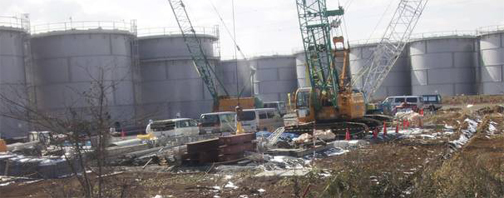
 Fukushima Nuclear Disaster: Plant’s Contaminated Water Storage Running Out Of Space HUFFINGTON POST, By MARI YAMAGUCHI 10/25/12 TOKYO — Japan’s crippled nuclear power plant is struggling to find space to store tens of thousands of tons of highly contaminated water used to cool the broken reactors, the manager of the water treatment team said.
About 200,000 tons of radioactive water – enough to fill more than 50 Olympic-sized swimming pools – are being stored in hundreds of gigantic tanks built around the Fukushima Dai-ichi plant. Operator Tokyo Electric Power Co. has already chopped down trees to make room for more tanks and predicts the volume of water will more than triple within three years. Continue reading
Harvey Wasserman lists America’s rust bucket nuclear reactors
 The Rust-Bucket Reactors Start to Fall http://www.nukefree.org/editorsblog/rust-bucket-reactors-start-fall , Harvey Wassermann, 26 Oct 12, The US fleet of 104 deteriorating atomic reactors is starting to fall. The much-hyped “nuclear renaissance” is now definitively headed in reverse.
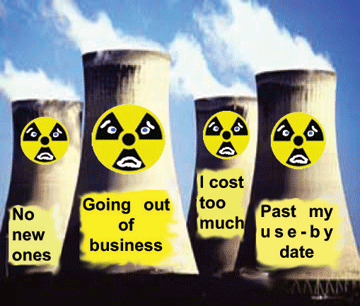
The announcement that Wisconsin’s Kewaunee will shut next year will be remembered as a critical dam break. Opened in 1974, Kewaunee has fallen victim to low gas prices, declining performance, unsolved technical problems and escalating public resistance.
Many old US reactors are still profitable only because their capital costs were forced down the public throat during deregulation, through other manipulations of the public treasury, and because lax regulation lets them operate cheaply while threatening the public health.
Plight of Fukushima’s heroic emergency workers
Nuclear workers in Japan Heroism and humility Meet the “Fukushima 50”, the men on the front line of the nuclear disaster The Economist Oct 27th 2012 | TOKYO | ACCORDING to his friends, the man in charge of the Fukushima Dai-ichi nuclear-power plant during the 2011 disaster, Masao Yoshida, says it felt like being on Iwo Jima. That is the North Pacific island heroically defended by the Japanese in 1945 but doomed to fall to the Americans.
His two underlings, Atsufumi Yoshizawa and Masatoshi Fukura, do not portray the struggle quite so graphically. In their first interviews since the disaster, they spoke of the sense of responsibility of the so-called Fukushima 50, those who risked their lives to fight the soaring levels of radiation coming out of the plant in the hours and days after the earthquake and tsunami on March 11th last year. They were driven, especially, by a desire to protect the local communities in which many of their families lived.
Yet the Fukushima 50, despite heroic efforts, still suffer from the complex of emotions that soldiers might experience when returning from a losing battle. A sense of shame and stigmatisation lingers. Continue reading
India stops Australian film maker entering Kudankulam anti nuclear protest area
 Australian filmmaker prevented from entering Kudankulam 25 Oct
  12http://www.dnaindia.com/india/report_australian-filmmaker-prevented-from-entering-kudankulam_1756187 , Oct 25, 2012, Three persons from Australia were today prevented from entering Idinthakarai, the epicentre of protests by People’s Movement Against Nuclear Energy leading the stir against Kudankulam Nuclear Power Plant in Tirunelveli district, police said.
Filmmaker David Bradbury along with his wife and son arrived in India on tourist visas and were about to enter Idinthankarai from Kanyakumari district this morning when police stopped them near Radhapuram police station, they said.
“After interrogations, the three were made to go back, since prohibitory orders were in place,” an officer said.
The PMANE has been leading protests against the plant for over a year citing safety concerns.
Commissioning of the first unit of the Indo-Russian project was originally scheduled for December last year, but has been delayed due to the protest.
Nuclear power obstacle in Japan: new evacuation plans
under the new radiation forecast, many more local governments will have to compile disaster management plans for areas that could require evacuation.
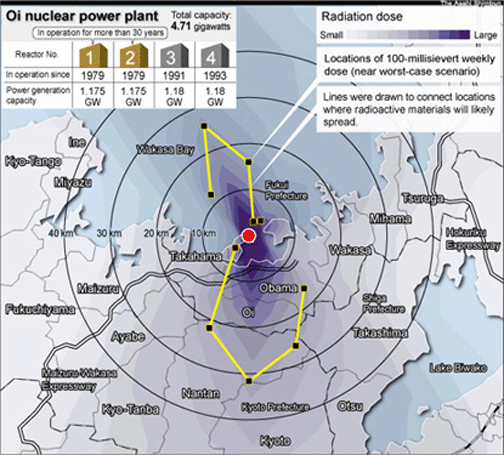
Radiation forecast creates hurdle in resuming nuclear plant operations UPDATE: Forecast predicts wider evacuations needed if nuclear disaster repeated October 25, 2012 THE ASAHI SHIMBUN Municipalities are demanding a greater say in whether utilities can restart their reactors after the new industry watchdog placed more communities in the danger zone of possible nuclear accidents. Continue reading
Inedible for years to come – fish near Fukushima coast

 Fukushima fish ‘may be inedible for a decade’ Fiona Harvey, environment correspondent guardian.co.uk 25 October 2012 Marine scientist finds levels of radioactivity in fish near stricken Fukushima nuclear plant are higher than expected
Fish from the waters around the Fukushima nuclear plant in Japan could be too radioactive to eat for a decade to come, as samples show that radioactivity levels remain elevated and show little sign of coming down, a marine scientist has warned.
According to a paper published in the journal Science on Thursday, large and bottom-dwelling species carry most risk, which means cod, flounder, halibut, pollock, skate and sole from the waters in question could be off limits for years, .
Sample fish caught in waters near the stricken reactors suggest there is still a source of caesium either on the seafloor or still being discharged into the sea, perhaps from what is left of the cooling waters. As the levels of radioactive isotopes in the fish are not declining as fast as they should have, the outlook for fishing in the area is likely to be poor for the next 10 years, the paper’s author told the Guardian.
“These fish could have to be banned for a long time. The most surprising thing for me was that the levels [of radioactivity] in the fish were not going down. There should have been much lower numbers,” said Ken Buesseler, senior scientist at the Woods Hole Oceanographic Institution in the US, who wrote the paper titled Fishing For Answers Off Fukushima.
He said his findings – taken in part from Japanese research and sampling of fish in the area – showed how difficult it was to predict the outcome of a nuclear incident such as that at Fukushima. ….. http://apps.facebook.com/theguardian/environment/2012/oct/25/fukushima-fish-inedible-decade-radioactivity
China puts the brakes on nuclear power
 China Slows Development of Nuclear Power Plants, NYT By KEITH BRADSHER, October 24, 2012 HONG KONG — Still responding to the partial meltdowns last year at nuclear reactors in Fukushima, Japan, the Chinese government has lowered its target for the construction of nuclear power plants by 2015, notably by not building more nuclear reactors at inland locations.
A white paper on energy policy released after a cabinet meeting on Wednesday said that the government planned to have 40 gigawatts of nuclear power capacity installed by 2015, and pledged strict safety standards. While the white paper and state-controlled media did not
describe this as a reduction in the target, the country’s current Five-Year Plan sets a target of 50 gigawatts….. Nuclear power generates only 1.8 percent of China’s electricity, far below the global average of 14 percent. http://www.nytimes.com/2012/10/25/business/global/china-reduces-target-for-construction-nuclear-power-plants.html?_r=2&
1 This Month



Tell the Ukrainian Government to Drop Prosecution of Peace Activist Yurii Sheliazhenko

Petition to revoke the licensing of the Near Surface Nuclear Disposal Facility (NSDF) at Chalk River. https://www.ourcommons.ca/petitions/en/Petition/Details?Petition=e-7247


of the week – STOP SMALL MODULAR REACTORS IN CANADA
To see nuclear-related stories in greater depth and intensity – go to https://nuclearinformation.wordpress.com
-
Archives
- March 2026 (222)
- February 2026 (268)
- January 2026 (308)
- December 2025 (358)
- November 2025 (359)
- October 2025 (376)
- September 2025 (258)
- August 2025 (319)
- July 2025 (230)
- June 2025 (348)
- May 2025 (261)
- April 2025 (305)
-
Categories
- 1
- 1 NUCLEAR ISSUES
- business and costs
- climate change
- culture and arts
- ENERGY
- environment
- health
- history
- indigenous issues
- Legal
- marketing of nuclear
- media
- opposition to nuclear
- PERSONAL STORIES
- politics
- politics international
- Religion and ethics
- safety
- secrets,lies and civil liberties
- spinbuster
- technology
- Uranium
- wastes
- weapons and war
- Women
- 2 WORLD
- ACTION
- AFRICA
- Atrocities
- AUSTRALIA
- Christina's notes
- Christina's themes
- culture and arts
- Events
- Fuk 2022
- Fuk 2023
- Fukushima 2017
- Fukushima 2018
- fukushima 2019
- Fukushima 2020
- Fukushima 2021
- general
- global warming
- Humour (God we need it)
- Nuclear
- RARE EARTHS
- Reference
- resources – print
- Resources -audiovicual
- Weekly Newsletter
- World
- World Nuclear
- YouTube
-
RSS
Entries RSS
Comments RSS
 nuclear-news