Price Anderson Nuclear Industries Indemnity Act – a whopper government subsidy
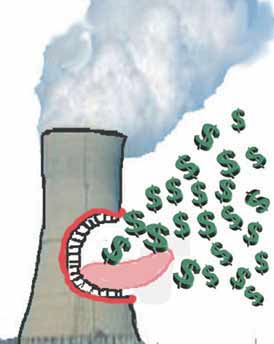 It is worth noting that Exelon, as an owner and operator of more nuclear power plants than any other American company, benefits to a considerable degree from what is potentially one of the largest government subsidies of energy production in world history, the Price Anderson Nuclear Industries Indemnity Act.
Nuclear Company Blasts Wind Industry Tax Incentive  KCET, by Chris Clarke
on October 23, 2012 The largest operator of nuclear power plants in the United States has blasted the Wind Production Tax Credit in a commissioned study……
Exelon, a large diversified energy generation and utility company
based in Chicago, owns 34,650 megawatts of generating capacity, 55% of
it nuclear. The company owns and/or operates 16 nuclear power stations
in the eastern half of the United States, including Pennsylvania’s
Three Mile ISland.
The Wind Production Tax Credit, which expires in December, has become
a bit of a political football in recent months as Republicans and
Democrats spar over the Obama administration’s energy policy. The
program offers 2.1 cents in tax credits to wind turbine owners for
every kilowatt hour of power their qualifying turbines produce. An
extension currently proposed by the Senate would continue the
Production Tax Credit for another year at a projected cost of $12.2
billion.
Legislators’ positions on the Production Tax Credit don’t break down
precisely along party lines: many recipients of the tax credits
generate their wind power in solidly Republican midwestern
Congressional districts, and their Representatives are often loath to
advocate taking income away from constituents……
It is worth noting that Exelon, as an owner and operator of more nuclear power plants than any other American company, benefits to a considerable degree from what is potentially one of the largest government subsidies of energy production in world history, the Price
Anderson Nuclear Industries Indemnity Act.
First passed in 1957 and currently extended until 2025, Price Anderson limits the liability ofnuclear power plant operators for any accident their reactors may
cause, and commits the federal government to pay any damages extending
beyond that cap. When the act was first passed, utilities contended
that it was vital to the existence of the nuclear industry: no
electrical power companies were willing to take on the potential
liability involved in running a nuclear power plant if they had to buy
their own insurance.
Under the Price Anderson language currently in force, a power plant
operator’s liability for damages caused by an accident at a single
power plant is limited to about $375 million, with damages above that
amount paid out of a pooled fund into which plant operators would
contribute $119 million per reactor if an accident occurs. With 104
reactors in the U.S., that fund would come to a bit under $13 billion.
Any shortfall or damage overage would be covered by the federal
government.
If the Fukushima reactors had been covered by the Price Anderson Act,
federal liability for damages from the 2011 accidents would have run
into the hundreds of billions of dollars. Which makes $12.2 billion
for a year’s worth of wind energy look like lunch money.
http://www.kcet.org/news/rewire/wind/nuclear-company-blasts-wind-industry-tax-incentive.html
No comments yet.
1 This Month


10 March A LIVE WEBINAR THE REAL EFFECTS OF NUCLEAR POWER
What the Industry Isn’t Telling Us
1:00 PM Mountain, 2 pm Central, 3 pm Eastern. Live on the Keepers of the Water Facebook page


18 March Webinar @ 1 PM EST: An Assessment of SMR Projects: The Case of Canada
register for the zoom:
https://us02web.zoom.us/webinar/register/WN_o8BIIOUvQ2ONJR1nta65DQ#/registration


of the week – STOP SMALL MODULAR REACTORS IN CANADA
To see nuclear-related stories in greater depth and intensity – go to https://nuclearinformation.wordpress.com
-
Archives
- March 2026 (76)
- February 2026 (268)
- January 2026 (308)
- December 2025 (358)
- November 2025 (359)
- October 2025 (376)
- September 2025 (258)
- August 2025 (319)
- July 2025 (230)
- June 2025 (348)
- May 2025 (261)
- April 2025 (305)
-
Categories
- 1
- 1 NUCLEAR ISSUES
- business and costs
- climate change
- culture and arts
- ENERGY
- environment
- health
- history
- indigenous issues
- Legal
- marketing of nuclear
- media
- opposition to nuclear
- PERSONAL STORIES
- politics
- politics international
- Religion and ethics
- safety
- secrets,lies and civil liberties
- spinbuster
- technology
- Uranium
- wastes
- weapons and war
- Women
- 2 WORLD
- ACTION
- AFRICA
- Atrocities
- AUSTRALIA
- Christina's notes
- Christina's themes
- culture and arts
- Events
- Fuk 2022
- Fuk 2023
- Fukushima 2017
- Fukushima 2018
- fukushima 2019
- Fukushima 2020
- Fukushima 2021
- general
- global warming
- Humour (God we need it)
- Nuclear
- RARE EARTHS
- Reference
- resources – print
- Resources -audiovicual
- Weekly Newsletter
- World
- World Nuclear
- YouTube
-
RSS
Entries RSS
Comments RSS
 nuclear-news
Leave a comment