Authorities keeping quiet about Fukushima reactor 4’s dire situation
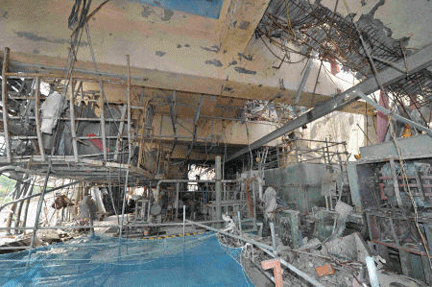
Fukushima Daiichi’s Reactor 3 and 4 are waterlogged, cracked and just one major earthquake jolt away from a catastrophe that one expert said could be “of biblical proportions.”
 Fukushima’s Hot Water: Now Fallout in Our Kitchens? On The Issue, by Kimberly Robertson, 21 Oct 12, Information about radioactive fallout from Japan has been in very short supply since the unprecedented triple nuclear meltdowns at Fukushima Daiichi on March 11, 2011.
“Nuclear meltdown” is a term for a catastrophic reaction in a nuclear reactor that has overheated. The uncontrolled heat damages the reactor itself, causing an uncontrolled release of life threatening radioactive material, also known as “radioactive fallout” into the environment.
At Fukushima this happened three times, an unprecedented catastrophe.With the 67th anniversary of the atomic bombing of Hiroshima in August 2012, it was strange to realize that Japan unwittingly dropped an even deadlier bomb on itself. Fukushima contained over 100 times more cesium-137 alone than Hiroshima, and there are literally hundreds of dangerous radionuclides in the “mix.”
Professor Tatsuhiko Kodama, head of the Radioisotope Center at University of Tokyo, underscored this point in testimony before the Committee on Welfare and Labor in Japan in August 2011. He stated: “When we research the radiation injury/sickness, we look at the total amount of radioactive materials.” Although no report from the government or TEPCO utility was available about the radioactive materials released by Fukushima, Kodama used the knowledge base at his center to calculate it. “Based on the thermal output, it is 29.6 times the amount released by the nuclear bomb dropped on Hiroshima. In uranium equivalent, it is 20 Hiroshima bombs. What is more frightening,” he said, “is that whereas the radiation from a nuclear bomb will decrease to one-thousandth in one year, the radiation from a nuclear power plant will only decrease to one-tenth.” (emphasis added)
There has been scant continuing attention from the media or politicians about the ongoing catastrophic consequences of Fukushima, but experts and citizens have continued to probe. Documents acquired under the U.S. Freedom of Information Act (FOIA) show that the U.S. Nuclear Regulatory Commission (NRC) was well aware of significant radioactive fallout blanketing the West Coast of the U.S. beginning the second week of March 2011. The radioactive plume spread as far east as Vermont. The Nuclear Regulatory Commission knew of significant danger to citizens, but made no warning.
Instead, the Food and Drug Administration (FDA) announced that it did not intend to test north Pacific fish for radiation from Fukushima, and the Environmental Protection Agency scaled back its testing of water and milk.
Other concerns arise from the ongoing incineration of contaminated tsunami debris. Japan has initiated a program by which it is moving tens of millions of tons of tsunami and earthquake rubble around the country and incinerating it at various locations nationwide, some of it containing industrial and nuclear waste. The debris in Japan is adding to steady delivery of more fallout via the Pacific jet stream and ocean.
Meanwhile, Fukushima Daiichi’s Reactor 3 and 4 are waterlogged, cracked and just one major earthquake jolt away from a catastrophe that one expert said could be “of biblical proportions.”…… http://www.ontheissuesmagazine.com/2012fall/2012fall_Roberson.php
No comments yet.
1 This Month

Petition to revoke the licensing of the Near Surface Nuclear Disposal Facility (NSDF) at Chalk River. https://www.ourcommons.ca/petitions/en/Petition/Details?Petition=e-7247

18 March Webinar @ 1 PM EST: An Assessment of SMR Projects: The Case of Canada
register for the zoom:
https://us02web.zoom.us/webinar/register/WN_o8BIIOUvQ2ONJR1nta65DQ#/registration


of the week – STOP SMALL MODULAR REACTORS IN CANADA
To see nuclear-related stories in greater depth and intensity – go to https://nuclearinformation.wordpress.com
-
Archives
- March 2026 (146)
- February 2026 (268)
- January 2026 (308)
- December 2025 (358)
- November 2025 (359)
- October 2025 (376)
- September 2025 (258)
- August 2025 (319)
- July 2025 (230)
- June 2025 (348)
- May 2025 (261)
- April 2025 (305)
-
Categories
- 1
- 1 NUCLEAR ISSUES
- business and costs
- climate change
- culture and arts
- ENERGY
- environment
- health
- history
- indigenous issues
- Legal
- marketing of nuclear
- media
- opposition to nuclear
- PERSONAL STORIES
- politics
- politics international
- Religion and ethics
- safety
- secrets,lies and civil liberties
- spinbuster
- technology
- Uranium
- wastes
- weapons and war
- Women
- 2 WORLD
- ACTION
- AFRICA
- Atrocities
- AUSTRALIA
- Christina's notes
- Christina's themes
- culture and arts
- Events
- Fuk 2022
- Fuk 2023
- Fukushima 2017
- Fukushima 2018
- fukushima 2019
- Fukushima 2020
- Fukushima 2021
- general
- global warming
- Humour (God we need it)
- Nuclear
- RARE EARTHS
- Reference
- resources – print
- Resources -audiovicual
- Weekly Newsletter
- World
- World Nuclear
- YouTube
-
RSS
Entries RSS
Comments RSS
 nuclear-news
Leave a comment