New! – Australia -Gillard ready to discuss Indian nuclear exports despite fears over safety
By Ben Doherty
Oct. 15, 2012, 2:30 a.m.
Fron Borderwatch
DELHI: India’s nuclear industry, Australia’s newest prospective uranium customer, has been slammed by the country’s own auditor as dangerously unsafe, disorganised and, in many cases, completely unregulated.
The two countries will soon begin negotiations on a safeguards deal to allow Australian uranium to be sold to India, after the Labor Party last year dropped its long-standing opposition to trading with countries outside the Nuclear Non-Proliferation Treaty.
Before Ms Gillard’s arrival in Delhi, the Minister of Foreign Affairs, Bob Carr, said Australia’s relationship with India was ”in good working order” and that progress was being made towards a safeguards agreement so that Australian yellowcake could be sold to India.
”The Indians are happy with the progress on this,” he said. ”We always, where there is the sale of Australian uranium, we always have a treaty that governs it and puts in place all the safeguards we require.”
While Indian media have reported Australia and India are poised to sign a uranium safeguards agreement during Ms Gillard’s visit, the Herald understands any deal is several months from being finalised.
Australia holds the world’s largest uranium reserves and exports more than 7000 tonnes every year, including to China. The government’s refusal to sell to India is a source of continuing friction between the two countries.
India is estimated to have between 80 and 100 nuclear weapons, but refuses to sign the treaty, arguing it discriminates against emerging nations and that it needs its nuclear weapons as a bulwark against nuclear-armed Pakistan.
Nobel Laureate and 6 More Cancer Scientists Quit Texas Institute Over Grants -Cancer industry “politically driven”
NY Times
By THE ASSOCIATED PRESS
Published: October 13, 2012
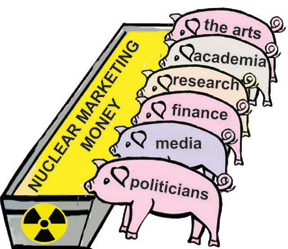
AUSTIN, Tex. (AP) — At least seven more scientists have resigned in protest from Texas’ embattled $3 billion cancer-fighting program, claiming that the agency in charge of it is charting a “politically driven” path that puts commercial interests before science.
The Cancer Prevention and Research Institute of Texas, created with the backing of Gov. Rick Perry and the cyclist Lance Armstrong, a cancer survivor, has awarded nearly $700 million in grants since 2009; only the National Institutes of Health offers a bigger pot of cancer-research money.
Scrutiny of how the state agency selects projects has intensified since May, when its chief scientific officer, Dr. Alfred G. Gilman, a Nobel laureate, resigned in protest after it approved a $20 million commercialization project without scientific review.
Scandal involving military’s top brass exposed in Britain -UK/military academic Funding details
The scandal, revealed in a Sunday Times investigation, involves retired high-ranking military officers, who are filmed claiming they can influence lucrative arms deals worth millions of pounds as lobbyists, despite Ministry of Defence (MoD) regulations banning the practice.
The three-month investigation by the paper has been carried out by reporters posed as representatives of arms manufacturing companies.
Retired military figures including General Lord Dannatt, the former head of the army, and Lord Stirrup, former chief of the defence staff, from among others have been filmed claiming they could give weapons manufacturers influence in
Whitehall and Westminster in return for six-figure sums.
According to the paper, Lieutenant General Sir John Kiszely, former head of the Defence Academy, claimed he could use his role as president of the Royal British Legion to influence his clients’ agenda with the Prime Minister.
Meanwhile, Lieutenant General Richard Applegate, a former Ministry of Defence procurement chief, reportedly described a secret lobbying campaign in parliament for a £500million military programme on behalf of an Israeli arms company.
It was also reported that Admiral Sir Trevor Soar, Commander of the naval fleet until March 2011, told undercover reporters he would “ignore” the two-year ban imposed on lobbying ministers.
Lord Dannatt, the former head of the army, also talked about ignoring a ban on discussion of a £400m contract by “targeting” the MoD’s top civil servant, with whom he went to school.
This comes as Prime Minister David Cameron vowed to tackle acts of lobbying before he came to power in May 2010 general elections.
“Just before the election, Cam [Prime Minister David Cameron] was passionate to stop next great scandal of lobbying. Action so far? Nothing. Scandal breaks up in Sunday Times”, said Paul Flynn MP in a tweet.
Threat to marine life in the Gulf! -Millions of unexploded bombs lie in waters off US coast, researchers say -FoxNews (Video)
War Games
Published October 08, 2012
Lurking (and leaking) beneath the world’s oceans are an estimated 200 million pounds of unexploded and potentially dangerous explosives — from bombs to missiles to mustard gas.
Texas A&M oceanographers William Bryant and Niall Slowey documented two such dumpsites in the Gulf of Mexico recently. They conservatively guess that at least 31 million pounds of bombs can be found not just in the Gulf, but also off the coasts of at least 16 states, from New Jersey to Hawaii.
Thousands of gallon containers of mustard gas lie strewn off the New Jersey coast, for example. And there are a total of seven dumpsites on the Gulf seafloor, each approximately 81 square miles, one at the mouth of the Mississippi River Delta.
“The amount that has been dumped was unbelievable,” Bryant said. “No one seems to have reported seeing explosives in the Gulf. We felt it was our responsibility to report it.”
The existence of unexploded ordnance (UXO) is hardly a secret, they acknowledge: Sea disposal of munitions was an accepted international practice until quite recently. Dumping conventional and chemical munitions captured from enemies — from Nazi Germany, for example — was also an accepted practice.
In 1970 the Department of Defense prohibited the practice, and Congress followed up by passing the Marine Protection, Research, and Sanctuaries Act in 1972, generally banning sea disposal.
‘We just don’t know much at all about these bombs, and it’s been 40 to 60 years that they’ve been down there.’
– Texas A&M oceanographer William Bryant
But after half a century or more on the sea floor, the condition of the munitions is a dangerous unknown.
“Is there an environmental risk? We don’t know, and that in itself is reason to worry,” Bryant said. “We just don’t know much at all about these bombs, and it’s been 40 to 60 years that they’ve been down there.”
Suspicions have long circulated that undocumented munitions have been “short-dumped” — as in dumped long before reaching their designated site, leaving them far closer to the coast than believed by authorities.
While conducting marine geology research on the sea floor of the Gulf, Bryant’s team came across the two dumpsites and vividly captured decaying canisters they believe most likely contain chemical weapons.
They presented their research at the International Dialogue on Underwater Munitions in Puerto Rico recently.
They also found themselves floating in a field of munitions as large as 500 pounds.
US nuclear submarine collides with warship off East Coast
Picture
USS Montpelier nuclear-powered submarine arrives pierside in Souda Bay near the town of Souda on the northwest coast of the Greek island of Crete on November 24, 2007.

The Saturday incident caused the cruiser’s sonar dome to collapse besides leading to possible other damage, but did not cause any casualties, Reuters reported. The dome covers some of the warship’s electronic navigation, detection, and ranging equipment.
Prior to the incident, the cruiser spotted the submarine’s periscope, but failed to avoid the collision.
A related investigation is underway and overall damage to both vessels is still being evaluated.
http://presstv.com/detail/2012/10/14/266555/us-nuclear-sub-collides-with-warship/
India, Sri Lanka to strengthen bilateral civil nuclear cooperation
The External Affairs Ministry said that both sides exchanged views on all aspects of the issue at their first round of talks on comprehensive civil nuclear co-operation held in New Delhi.
These included training of officials, nuclear safety and response to nuclear accidents beside other issues.
Both sides also reaffirmed their commitment to strengthen bilateral co-operation in the use of nuclear technology for peaceful purposes to mutually benefit the people in both the countries. The next meeting is scheduled to be held in Sri Lanka in the first half of next year
Nobel laureate debunks radiation myths – Trust in Nobel Peace Prize holders?
h/t jebus enenews contributer
Contributing Writer
Published: Friday, October 12, 2012
Nobel Prize laureate Professor of Physics Leon Cooper addressed the public perception of radiation’s effect in a discussion sponsored by the Triple Helix publication at the Brown Bookstore yesterday.
“Public response to radiation is one of exaggerated fear,” Cooper said. He pointed out that people do not rationally assess the relative risks that surround them as they go about their daily lives.
“The most dangerous thing we do with cell phones is texting while driving or crossing the street while on the phone,” he said.
Cooper, who received a Nobel Prize in physics in 1972 for his theory in superconductivity, is currently investigating the amount of gamma radiation that is actually harmful to an organism. In these experiments, conducted using fruit flies, the research team — consisting of Postdoctoral Research Associate Michael Antosh, Assistant Professor of Molecular Biology Nicola Neretti, David Fox and Cooper — is exposing the flies to varying amounts of gamma radiation and is measuring the gene expression of the fly. In preliminary studies, flies have shown resilience to low levels of radiation with a subsequent drop in the survival rate at higher levels. It is possible that at lower dose levels, the cell responds with mechanisms that can repair itself, thereby ameliorating the effects of radiation. If true, this could have widespread political consequences, Cooper said.
1974 -Iran first country to propose a nuclear free world -CND UK conference 2012 Video
“The Campaign for Nuclear Disarmament has held an international conference in Britain with the Middle East dominating discussions. The meeting is debating ways to make the region a genuine nuclear weapons free zone.”
None of these countries are in the Middle East. But most of the focus is on this region.
The campaign for nuclear disarmament is holding an international conference “building towards a nuclear weapons-free middle east” – Israel and Iran are inevitably on the agenda. In many ways the two are polar opposites in the debate. One accused of wanting nuclear weapons, and pressurized by the west. the other not admitting to a vast nuclear weapons arsenal, with no pressure from the west at all.
This event was held in preparation for a UN conference on the same issue to be held in Finland at the end of this year.
1 This Month

of the week – Shut Down Drone Warfare!


Tell the Ukrainian Government to Drop Prosecution of Peace Activist Yurii Sheliazhenko

Petition to revoke the licensing of the Near Surface Nuclear Disposal Facility (NSDF) at Chalk River. https://www.ourcommons.ca/petitions/en/Petition/Details?Petition=e-7247
To see nuclear-related stories in greater depth and intensity – go to https://nuclearinformation.wordpress.com
-
Archives
- April 2026 (57)
- March 2026 (251)
- February 2026 (268)
- January 2026 (308)
- December 2025 (358)
- November 2025 (359)
- October 2025 (376)
- September 2025 (257)
- August 2025 (319)
- July 2025 (230)
- June 2025 (348)
- May 2025 (261)
-
Categories
- 1
- 1 NUCLEAR ISSUES
- business and costs
- climate change
- culture and arts
- ENERGY
- environment
- health
- history
- indigenous issues
- Legal
- marketing of nuclear
- media
- opposition to nuclear
- PERSONAL STORIES
- politics
- politics international
- Religion and ethics
- safety
- secrets,lies and civil liberties
- spinbuster
- technology
- Uranium
- wastes
- weapons and war
- Women
- 2 WORLD
- ACTION
- AFRICA
- Atrocities
- AUSTRALIA
- Christina's notes
- Christina's themes
- culture and arts
- Events
- Fuk 2022
- Fuk 2023
- Fukushima 2017
- Fukushima 2018
- fukushima 2019
- Fukushima 2020
- Fukushima 2021
- general
- global warming
- Humour (God we need it)
- Nuclear
- RARE EARTHS
- Reference
- resources – print
- Resources -audiovicual
- Weekly Newsletter
- World
- World Nuclear
- YouTube
-
RSS
Entries RSS
Comments RSS
 nuclear-news