Washington Post: Persistent rumors on ‘blogs’ that BP’s oil continues to spew into Gulf — FSU Expert: May be freshly released from Macondo reservoir
Published: October 12th, 2012 at 5:58 pm ET
By ENENews
We’ve just seen Tepco indirectly blame the anti-nuclear movement for the Fukushima disaster— Now there’s the Washington Post claiming that ‘blogs’, rather than experts, are behind the allegations that BP’s Macondo reservoir “is not truly dead”:
[…] a BP internal slide presentation said the new oil sheen probably came from the riser […] “the size and persistence of this slick, the persistent location of the oil slick origin point, the chemistry of the samples taken from the slick … suggest that the likely source of the slick is a leak of Macondo … oil mixed with drilling mud that had been trapped in the riser of the Deepwater Horizon rig.”
But Ian MacDonald, a professor of oceanography at Florida State University and a spill expert, cautioned said [sic] that the origin of the new oil remains uncertain. “The jury is out here,” he said, adding that it was too early “to rule out that this is oil freshly released from the reservoir.”
[…] there have been persistent rumors and allegations on blogs that Macondo is not truly dead, and that it is continuing to spew oil into the gulf. […]
More from Professor MacDonald via Washington’s Blog, Oct. 12, 2012: “The key statement in the BP discussion was the fact that oil recovered on the ocean surface was not biodegraded. This is not consistent with a pool of oil supposedly trapped in the wreckage of the riser, which would have been exposed to ambient bacterial activity for over two years.”
The Washington Post reporters may want to consider a follow-up article using information provided by experts (not ‘blogs’) such as these:
- University of California Scientist: “It could be a persistent, significant, continuous oil spill again, and that would require BP to go back
- Stanford geophysicist suggests BP blowout could be traced to “cracks that formed in an underwater formation”
- Engineer who worked for BP: Geology around blow-out is “fractured” and “could keep leaking for years”
WSJ: Tepco in stunning reversal — Admits knowing of problems before 3/11 and doing nothing… then blames actions on anti-nuclear movement
Published: October 12th, 2012 at 2:34 pm ET
By ENENews
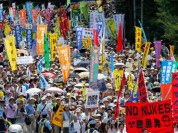
[Tecpo] said in a report that the company failed to adequately prepare for a disaster and that it knew it wasn’t prepared, and yet it did nothing, out of fear for the economic and social consequences.
“There was a worry that if the company were to implement a severe-accidentresponse plan, it would spur anxiety throughout the country and in the community where the plant is sited, and lend momentum to the antinuclear movement,” said the report
Rihanna and Shakira -Azerbaijan -The abuse of Zaur Gurbanli and Tony Blairs love of formaldehyde
“A regular blogger, he recently posted an article criticizing government corruption and nepotism. The piece ridiculed the inclusion of a poem by President Ilham Aliyev’s daughter as mandatory reading in the country’s school curriculum.
“It looks very much like the Azerbaijani authorities decided Zaur Gurbanli crossed the line when he poked fun at the president’s family,” said Dalhuisen. “If he is being targeted because of his legitimate political or online activity, he must be released immediately.”
Criticism of the president’s family frequently provokes a swift and harsh response from the Azerbaijani authorities. In March this year two musicians were arrested and tortured after they insulted the president’s late mother during a performance.”
Joint Letter Details Country’s Human Rights Violations
Contact: Sharon Singh, ssingh@aiusa.org, 202-675-8579, @spksingh
(New York) — Top-selling artists Rihanna and Shakira should bear in mind the human rights abuses being inflicted on the people of Azerbaijan before they perform in the country’s capital later this month, Amnesty International and Sing for Democracy warned in a letter addressed to the singers before their concerts. The two singers are appearing in Baku during the current FIFA U-17 Women’s World Cup 2012.
In a joint letter, the two organizations draw attention to the current state of human rights and freedom of expression in Azerbaijan. Stadiums may cheer for internationally renowned recording artists like Rihanna and Shakira, but citizens within the European country do not enjoy such freedom of expression and are often persecuted when attempting to speak out.
As the letter informs these artists, the 2005 murder of reporter Elmar Huseynov still remains unsolved. Today, many Azerbaijani journalists, bloggers and political activists have been arrested and persecuted multiple times.
A connection between Chernobyl and a recent Japanese study on PTSD in dogs
“There is more and more evidence of a “Chernobyl dementia” phenomena (deterioration of memory and motor skills, occurrence of convulsions, pulsing headaches), caused by the
destruction of brain cells in adult people (Sokolovskaya, 1997).”
Cortysol level raised interritories with 1 – 15 Ci/km2, and lowered in territories with a greater level of pollution in healthy newborns, Gomel and Mogyliov areas, Belarus
(Danil’chik et al., 1996; Petrenko, et al., 1993)
Table 11 presents some research showing correlations between the Chernobyl
radioactive pollution with the development of hormone/endocrine diseases.
Table 11 Endocrine/hormonal diseases in some Chernobyl polluted territories
On page 16 of this report
http://www.progettohumus.it/include/chernobyl/dintorni/dossier/chernobylbook.pdf
Dogs who survived tsunami show signs of PTSD — much like those found in humans
 Dogs that survived the 2011 earthquake, tsunami and nuclear disaster in Japan show symptoms not unlike those experienced by humans who suffer from post-traumatic stress disorder, a new study by a Japanese university says.

The research compared abandoned dogs rescued from Fukushima, site of the nuclear disaster, and Kanagawa, with non-disaster affected dogs abandoned in 2009 and 2010, before the earthquake.
Experts doubt! -Russian defense ministry says it will raise two sunken nuclear subs
Charles Digges, 12/10-2012
Bellona
The Russian Ministry of Defense says it is planning to raise and scrap two sunken nuclear submarines from the depths of the Barents and Kara Seas in an effort to stem radioactive contamination from the vessels, whose reactors are both loaded with spent nuclear fuel, Izvestia newspaper reported.
 |
| A subsea photo of the K-159’s bow section taken during radiation tests after its sinking |
| http://www.gremicha.narod.ru |
The ministry said it will announce an international tender, which may include companies from the France, the Netherlands, South Korea and United States, as the Russian Navy does not have the necessary equipment to carry out deep-sea salvage operations, Izvestia said, citing a military source that the paper did not name.
The source reported that the project to lift the two submarines, the K-27 and the K-159, is a part of a revised government draft for strategic development of Russia’s Arctic zone.
“A broad range of measures for cleaning Arctic waters of pollution is specified [in the draft],” the source told Izvestia. “In addition to the sunken submarines, particular attention is given to removal of dangerous waste left behind after the military units on Franz Josef Land, New Siberian Islands and Bely Island,” said the source.
Indeed, an accumulation of reports from Russia to the Norwegian Radiation Safety Authority (NRPA) reveal the Soviet and Russian Navies littered the Kara Sea with all manner of nuclear and radioactive waste over a period of decades, stopping in the early 1990s.
Artic nuclear waste zone
According to NRPA, the catalogue of waste in the Kara Sea includes 19 ships containing radioactive waste; 14 nuclear reactors, including five that still contain spent nuclear fuel; 735 other pieces of radioactively contaminated heavy machinery; 17,000 containers of radioactive waste,
Rossi: We Are Close To Present Our 1 MW Hot Cat Reactor – (But doesnt add up!) -Fail
“So the attachments, including Penon’s report, are missing again? And the calculations are still ambiguous/incorrect? This is getting a bit surreal, even by Rossi’s standards.”
On his official e-cat blog Journal of Nuclear Physics, Italian inventor Andrea Rossi made a very interesting revelation concerning his high temperature reactor. A frequent JONP poster Joseph Fine asked:
“Does the power rating of a module (1 kW, 5 kW, 10 kW) affect the time of startup or shutdown? If smaller or lower power modules heat up faster than larger ones (or vice versa), it might be possible to ramp up or ramp down a startup or shutdown by sequencing the startup or shutdown of several modules in order to avoid major power jumps.”
Rossi responded and surprisingly disclosed what seems to be very important information he may be sharing in the upcoming e-cat conference in Pordenone Italy on October 12.
“No, it does not affect. We are close to present our 1 MW Hot cat, which will have a tremendous elasticity. I think that at Pordenone we will get some fun.”
Rossi’s answer is absolutely unexpected because he hasn’t talked about a 1 megawatt high temperature reactor before. The latest information we received about the Hot Cat is it has now steam and pressure to generate electricity. When asked when he expects to start trials with turbines etc to make electricity, Rossi said it will be “as soon as possible, hopefully in 2013”.
UAE and Turkey to build second nuclear power plant – And does Turkey have the nuclear bomb?
“The US has supplied some 480 B61 thermonuclear bombs to five so-called “non-nuclear states”, including Belgium, Germany, Italy, the Netherlands and Turkey. Casually disregarded by the Vienna based UN Nuclear Watchdog (IAEA), the US has actively contributed to the proliferation of nuclear weapons in Western Europe.”
“According to a recent report, former NATO Secretary-General George Robertson confirmed that Turkey possesses 40-90 “Made in America” nuclear weapons at the Incirlik military base”.
12 October 2012 – 3:19pm

The UAE may become the Turkish partner for building the second nuclear power plant Sinop if South Korea wins the tender, Turkish Minister for Natural Resources Taner Yildiz said, Trend reports.
Canada, China, South Korea and Japan are tendering for construction of the Sinop nuclear power plant. The facility is expected to be launched before 2019. Construction of another power plant is planned for 2023.
Akkuyu is the first power plant of Turkey. It has four WWER-1200 reactors (Russia). Turkey and Russia signed the construction deal in May 2010. Each block will produce 1200 MW (4800 MW in total). They will be launched one by one with an interval of a year each.
http://vestnikkavkaza.net/news/politics/32517.html
Europe’s Five “Undeclared Nuclear Weapons States”
Are Turkey, Germany, Belgium, The Netherlands and Italy Nuclear Powers?
1 This Month

of the week – Shut Down Drone Warfare!


Tell the Ukrainian Government to Drop Prosecution of Peace Activist Yurii Sheliazhenko

Petition to revoke the licensing of the Near Surface Nuclear Disposal Facility (NSDF) at Chalk River. https://www.ourcommons.ca/petitions/en/Petition/Details?Petition=e-7247
To see nuclear-related stories in greater depth and intensity – go to https://nuclearinformation.wordpress.com
-
Archives
- April 2026 (91)
- March 2026 (251)
- February 2026 (268)
- January 2026 (308)
- December 2025 (358)
- November 2025 (359)
- October 2025 (376)
- September 2025 (257)
- August 2025 (319)
- July 2025 (230)
- June 2025 (348)
- May 2025 (261)
-
Categories
- 1
- 1 NUCLEAR ISSUES
- business and costs
- climate change
- culture and arts
- ENERGY
- environment
- health
- history
- indigenous issues
- Legal
- marketing of nuclear
- media
- opposition to nuclear
- PERSONAL STORIES
- politics
- politics international
- Religion and ethics
- safety
- secrets,lies and civil liberties
- spinbuster
- technology
- Uranium
- wastes
- weapons and war
- Women
- 2 WORLD
- ACTION
- AFRICA
- Atrocities
- AUSTRALIA
- Christina's notes
- Christina's themes
- culture and arts
- Events
- Fuk 2022
- Fuk 2023
- Fukushima 2017
- Fukushima 2018
- fukushima 2019
- Fukushima 2020
- Fukushima 2021
- general
- global warming
- Humour (God we need it)
- Nuclear
- RARE EARTHS
- Reference
- resources – print
- Resources -audiovicual
- Weekly Newsletter
- World
- World Nuclear
- YouTube
-
RSS
Entries RSS
Comments RSS
 nuclear-news