Thorium bred Uranium-233 can be used to make atomic bombs
 Thorium Nuclear Bombs (Shorter version) Kevin Meyerson, kevinmeyerson.wordpress.com 9 Oct 12, Thorium bred Uranium-233 can be used to make atomic bombs, despite what proponents may claim.
You don’t have to trust me on this, see what the experts at various institutions have to say below:
MIT Energy Initiative, The Future of the Nuclear Fuel Cycle
Appendix A starts on page 181 of the Appendices PDF file. The relevant statement from MIT is:
- Proliferation And Security Groundrules:
Irradiating thorium produces weapons-useable material. Policy decisions on appropriate ground rules are required before devoting significant resources toward such fuel cycles. U-233 can be treated two ways.
- Analogous to U-235. If the U-235 content of uranium is less than 20% U-235 or less than 13% U-233 with the remainder being U-238, the uranium mixture is non-weapons material. However, isotopic dilution in U-238 can significantly compromise many of the benefits.
- Analogous to plutonium. Plutonium can not be degraded thus enhanced safeguards are used. The same strategy can be used with U-233. A complicating factor (see below) is that U-233 is always contaminated with U-232 that has decay products that give off high energy gamma radiation which requires additional measures to protect worker health and safety. There has been no consensus on the safeguards / nonproliferation benefits of this radiation field.
The point being made here is that thorium can be used to make Uranium-233, which in turn can be used to make bombs. The complicating U-232 contamination mentioned above is what many of the thorium proponents refer to as making thorium resistant to proliferation. MIT has more to say about this proliferation protection in their summary:
On one hand, high radiation dose [from U-232 decay] provides self protection to separated fissile material against diversion and misuse. On the other hand, it makes the U-233 recycling more complex and costly.
The point here is that the U-233 is in fact subject to ‘diversion and misuse’ (like atomic bombs) if it can be separated out from the highly radioactive U-232 contaminants. If the U-232 is not somehow processed out, however, there is no way to operate the reactor for peaceful purposes, or otherwise.
Filtering contaminants out of thorium bred U-233 to make weapons grade fissile material is not rocket science. Oak Ridge National Laboratory (ORNL) created a process to do this. They kindly wrote about it in a history included in the ORNL Review publication (search the long page for the words “THOREX” or “Uranium-233″):
By 1954, the Laboratory’s chemical technologists had completed a pilot plant demonstrating the ability of the THOREX process to separate thorium, protactinium, and uranium-233 from fission products and from each other. This process could isolate uranium-233 for weapons development and also for use as fuel in the proposed thorium breeder reactors.
There are no technical issues for separating out Uranium-233 for weapons development.
UK National Nuclear Laboratory
The United Kingdom’s National Nuclear Laboratory (NNL) prepared a position paper on the thorium nuclear fuel cycle. It is pretty straightforward:
Contrary to that which many proponents of thorium claim, U-233 should be regarded as posing a definite proliferation risk.For a thorium fuel cycle which falls short of a breeding cycle, uranium fuel would always be needed to supplement the fissile material and there will always be significant (though reduced) plutonium production.
NNL believes that U-233 should be regarded as posing a comparable level of proliferation risk to High Enriched Uranium (HEU) and comparable with the U-Pu fuel cycle at best; this view is consistent with the IAEA, who under the Convention on the Physical Protection of Nuclear Materials, categorise U-233 on the same basis as plutonium. Attempts to lower the fissile content of uranium by adding U-238 are considered to offer only weak protection, as the U-233 could be separated in a centrifuge cascade in the same way that U-235 is separated from U-238 in the standard uranium fuel cycle.
The argument that the high U-232 content would be self- protecting are considered to be over-stated. NNL’s view is that thorium systems are no more proliferation resistant than U-Pu systems though they may offer limited benefits in some circumstances.
Here are some comments from other resources:
Oak Ridge National Labs U-233 Disposition Project Update (PDF, see page 3)
- U-233 has nuclear properties similar to weapons-grade plutonium, but the chemistry of uranium
- High specific alpha activity (inhalation hazard)
- Weapons-usable fissile nuclear material requiring strict safeguards, tight security, and criticality control……… http://kevinmeyerson.wordpress.com/2012/05/07/thorium-nuclear-bombs-short-version/
No comments yet.
1 This Month
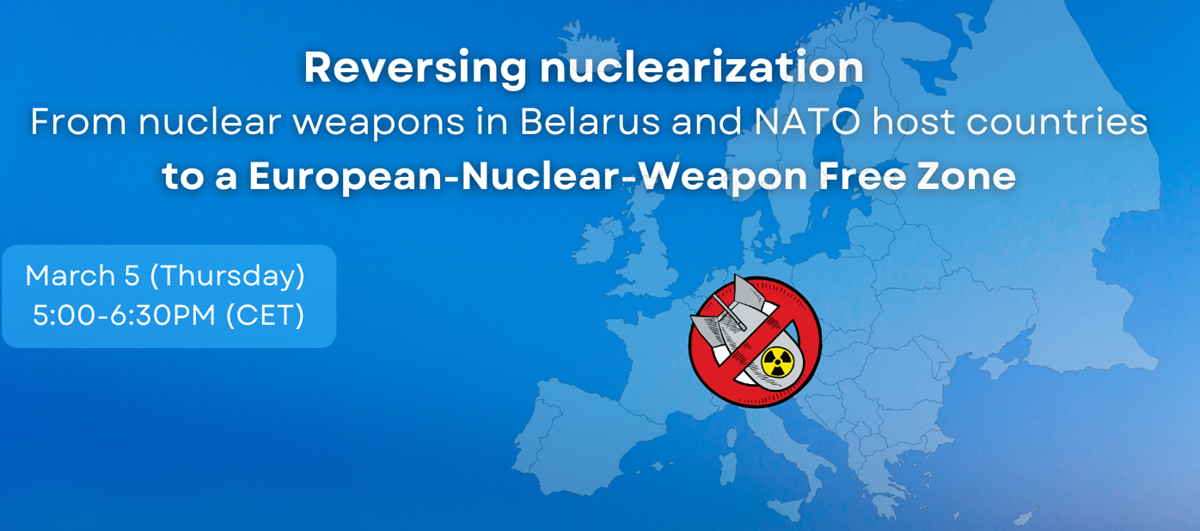
5 March -Online – Reversing nuclearization:
From nuclear weapons in Belarus and NATO host countries to a European-Nuclear-Weapon Free Zone
11am-12:30pm Eastern Time USA / 5pm-6:30pm CET

of the week – Advocating for a
nuclear free beach – https://www.samuellawrencefoundation.org/
The Samuel Lawrence Foundation advocates for a Nuclear Waste Free Beach at San Onofre, join us and take action!

10 March A LIVE WEBINAR THE REAL EFFECTS OF NUCLEAR POWER
What the Industry Isn’t Telling Us
1:00 PM Mountain, 2 pm Central, 3 pm Eastern. Live on the Keepers of the Water Facebook page

18 March Webinar @ 1 PM EST: An Assessment of SMR Projects: The Case of Canada
register for the zoom:
https://us02web.zoom.us/webinar/register/WN_o8BIIOUvQ2ONJR1nta65DQ#/registration

of the week – STOP SMALL MODULAR REACTORS IN CANADA
To see nuclear-related stories in greater depth and intensity – go to https://nuclearinformation.wordpress.com
-
Archives
- March 2026 (51)
- February 2026 (268)
- January 2026 (308)
- December 2025 (358)
- November 2025 (359)
- October 2025 (376)
- September 2025 (258)
- August 2025 (319)
- July 2025 (230)
- June 2025 (348)
- May 2025 (261)
- April 2025 (305)
-
Categories
- 1
- 1 NUCLEAR ISSUES
- business and costs
- climate change
- culture and arts
- ENERGY
- environment
- health
- history
- indigenous issues
- Legal
- marketing of nuclear
- media
- opposition to nuclear
- PERSONAL STORIES
- politics
- politics international
- Religion and ethics
- safety
- secrets,lies and civil liberties
- spinbuster
- technology
- Uranium
- wastes
- weapons and war
- Women
- 2 WORLD
- ACTION
- AFRICA
- Atrocities
- AUSTRALIA
- Christina's notes
- Christina's themes
- culture and arts
- Events
- Fuk 2022
- Fuk 2023
- Fukushima 2017
- Fukushima 2018
- fukushima 2019
- Fukushima 2020
- Fukushima 2021
- general
- global warming
- Humour (God we need it)
- Nuclear
- RARE EARTHS
- Reference
- resources – print
- Resources -audiovicual
- Weekly Newsletter
- World
- World Nuclear
- YouTube
-
RSS
Entries RSS
Comments RSS
 nuclear-news
Leave a comment