Japan authorities passing the buck on decision-making about nuclear restart
 Government tries to duck reactor-restart decisions Fujimura hints decision rests with new body, Japan Times By MASAMI ITO, 7 October 12, Chief Cabinet Secretary Osamu Fujimura suggested Thursday that the central government does not have the ultimate say, or responsibility, in reactivating nuclear reactors, triggering confusion over who is in charge of making the decision.
At a news conference, Fujimura repeatedly stressed that the new Nuclear Regulation Authority is in charge of assessing the safety of reactors and that power companies are only tasked with explaining reactor restarts to host municipalities and seeking their consent. Continue reading
An irreversible ripoff of the British public – new nuclear reactors
 the numbers now being talked about in terms of price guarantees for the energy giants are astronomical.
who will wave a flag and scream ‘rip off’ before the Government signs an irrevocable deal.
Nuclear deal is likely to leave a toxic legacy This Is Money, By LISA BUCKINGHAM, 6 October 2012 “…….Now, though, comes a set of negotiations that have the ability to swipe tens of billions out of the public purse and into private coffers. Chinese investors may be about to pick up part of the tab for building some of our new nuclear power stations, but this is not out of the goodness of their hearts.
French energy group EDF, in partnership with British Gas owner Centrica, has been embroiled in long negotiations with the Government over what will effectively be a subsidy to help them cover the huge building costs of these new generators. Continue reading
Japan’s new nuclear regulation agency- a nuclear promotion agency?
 New nuclear regulation agency lined with nuclear promoters http://www.japan-press.co.jp/modules/news/index.php?id=4147 September 25, 2012
The nuclear regulation agency will serve a clerical function for the Nuclear Regulation Authority (NRA). It will be essential for the people to strictly watch the agency along with the NRA led by Tanaka Shun’ichi, former dweller of the “nuclear power village”.
The agency’s top officials are Ikeda Katsuhiko (former superintendent general at the Tokyo Metropolitan Police Department), Morimoto Hideka (former senior official of the Environment Ministry), Yasui Masaya (former atomic policy chief of the Resources and Energy Agency), Kuroki Yoshihide (former official of the Tokyo Metropolitan Police Department), Nayuki Tetsuo (former official of the Nuclear Safety Bureau of the Science and Technology Agency), Sakurada Michio (former director of the nuclear fuel cycle industry division of the Resources and Energy Agency), and Yamamoto Tetsuya (former official of the Nuclear and Industrial Safety Agency – NISA).
Yasui is a person who once ordered the cover-up of estimated costs for disposal of nuclear spent fuel in order “to prevent public scrutiny.”
Kuroki, though he apologized later for his unfounded assertion, stated that “it makes no sense in Japan to include nuclear opponents” as nuclear regulators.
Akahata described the nuclear regulation agency as a nuclear promotion agency.
Mass anti nuclear trespass planned at Hinkley nuclear site
Anti-nuclear activists trespass Hinckley http://www.morningstaronline.co.uk/news/content/view/full/124750 07 October 2012 by Rory Mackinnon Anti-nuclear activists will attempt a mass trespass tomorrow to stop construction of a new nuclear power plant in Somerset. Continue reading
Jill Stein debating other Presidential candidates: TV 23 October
Drone may have been heading for Israel’s Dimona nuclear reactor
Route of Drone Hints It May Have Been Aimed at Nuclear Reactor The strange route of the enemy drone downed by the IAF indicates Israel may have diverted it from flying over the Dimona nuclear reactor. Arutz Sheva By Tzvi Ben Gedalyahu 10/7/2012,
The enemy drone downed by the Air Force, Saturday, took a strange route that did not cover strategic sites, indicating Israel may have diverted it from a route over the nuclear reactor in Dimona, located due east of Gaza.
The UAV entered Israeli air space from the Mediterranean Sea along the Gaza Coast and then made a U-turn, flying over the southern Hevron Hills before an F-16 plane destroyed it over a non-populated area.
The route raises questions because there are no army or air force bases or any other strategic sites along the route.
Officials estimate that it was guided by a pre-programmed GPS inside the drone and not from a control center at its origin, apparently Hizbullah-dominated southern Lebanon, DEBKA File reported. Israel may have carried out a cyber attack to scramble the GPS and change its route….. http://www.israelnationalnews.com/News/News.aspx/160604#.UHMZH5jA9dM
Halifax County Chamber opposes uranium mining in Southern Virginia
Chamber adopts anti-uranium resolution Halifax County Chamber of Commerce Board of Directors has gone on record adamantly opposing uranium mining in the commonwealth. Gazette Virginian 7 Oct 12, Continue reading
Fukushima nurses leaving, to protect their own children from radiation
 Nurses evacuate Fukushima to save their children from the potential risk of radiation http://fukushima-diary.com/2012/10/nurses-evacuate-fukushima-to-save-their-children-from-the-potential-risk-of-radiation/ by Mochizuki October 6th, 2012 Fukushima prefecture is facing a serious shortage of nurses and health workers.
The biggest reason is nurses have evacuated to save their children from the potential radiation risk because of Fukushima accident. On the other hand, the number of patients are increasing as evacuation period is prolonged.
According to Fukushima prefectural government, 14,556 nurses and other workers were at hospitals in the prefecture on 3/1/2011, shortly before 311, but it dropped to 14,089 on 3/1/2012.
Fukushima nursing association comments in 2/2011, there were 216 applications for 366 jobs, the job opening-to-application ratio was 1.69. However, at the end of this August, there were 174 applications for 768 jobs. The job-opening-to-application ratio was 4.41, which made a huge increase since before 311.
The number of young people receiving checkups is expected to increase in line with the Oct. 1 launch of a system providing free medical care to people aged 18 or under, and the association remains concerned about the situation, which could hinder health checks, saying a shortage of people in the medical profession could impede local restoration efforts.
In other disaster areas, Iwate and Miyagi are also having shortages of medical workers, but the situation has been particularly serious in Fukushima Prefecture due to the nuclear disaster, and it is expected to continue for a long time.
Midori Suzuki, a senior director of the Fukushima Nursing Association comments, “The shortage of regular nurses and health nurses was an issue even before the disaster, but since the nuclear disaster, the situation has gotten unusually serious, I want the government to widen its awareness of what is hindering restoration.”
Fukushima information website
http://fukushimaappeal.blogspot.com.au/2012/10/new-nuclear-regulation-agency-lined.htm We are Japanese people living in the UK. We are not activists or scientists, just normal citizens who want peace in the world and to protect our environment in a way that serves everybody. We are aware that there isn’t enough information in the main stream media in the UK about what’s going on in Fukushima, and we would like to share with you what we’ve found from Japanese web sites: information and news from scientists and doctors who are extremely worried about the safety of citizens, and from concerned freelance journalists and ordinary people. Since the magnitude-9 earthquake and tsunami, followed by the Fukushima nuclear disaster, we have been feeling a huge sense of loss… and have learned that nothing stays the same. Also we think that the Fukushima disaster was actually the result of many years of global political and economic corruption going on behind the scenes, and that the Japanese government was taken in by the worldwide drive for nuclear power, without learning the lessons of the Nagasaki and Hiroshima bombings. (NB: English is not our native language, so please take this into account when reading this blog.)
Japan’s Science Ministry may have “doctored” Fukushima radiation readings
Group: Ministry may have manipulated Fukushima radiation readings October 06, 2012 THE ASAHI SHIMBUN Citizens and scientists have raised concerns that the science ministry manipulated its measurement of radiation levels in Fukushima Prefecture to show figures lower than they really were.
The Association for Citizens and Scientists Concerned About Internal Radiation Exposures said on Oct. 5 that its survey this year of airborne dose levels found an average 10-30 percent higher than the ministry’s numbers, and in certain areas, the discrepancy was even
greater….. http://ajw.asahi.com/article/0311disaster/fukushima/AJ201210060041
Renewable energy resulting in cheaper baseload power
German baseload power cheaper than French 12 months running, Renewables International, 7 Oct 12 Yesterday, the European Energy Exchange (AEX) released figures for September, revealing that the price of baseload power in Germany has fallen by nearly 0.8 cents per kilowatt-hour over the past year – and has been cheaper than baseload power in France for 12 consecutive months.
The EEX published the trading results for September yesterday, but unfortunately the press release is currently only available in German.
What it shows is that day-ahead prices in Germany & Austria are lower than in France or Switzerland both in terms of base load and peak load. Indeed, though the press release explains that prices on the German and French markets “converge 75% of the time” (during periods of low consumption, such as during the night and on weekends), the difference in prices has become considerable, with the difference in base load prices being 4% on the average for September…..
day-ahead prices have been lower in Germany than in France for 12 consecutive months. The average German baseload price in September was slightly below the price in August, so the downward pressure on prices continues. The drop over the past 12 months in Germany has indeed been quite dramatic at around 18% – from 5.264 cents per kilowatt-hour in
September 2011 to the current 4.467 cents last month.
The news is especially important because nuclear power, which provides slightly more than 75% of France’s power supply, is often held to be an especially inexpensive source of baseload power. Furthermore, opponents of renewables repeatedly voice their concern about the cost impact of green power scaring away industry. …..
http://www.renewablesinternational.net/german-baseload-power-cheaper-than-french-12-months-running/150/537/57302/
Renewable energy taking over in European regions
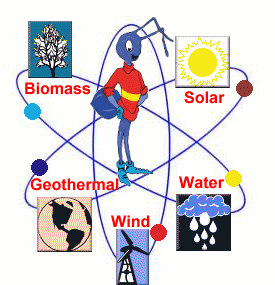 100 % RENEWABLE ENERGY IS ALREADY REALITY World Future Council, 8 Oct 12, Anna Leidreiter Europe is showing the world that we can move to a sustainable energy future based on cost-effective, clean and stable supplies. Renewable energies (RE) accounted for more than 71% of total electric capacity additions in 2011, bringing renewable energy’s share of total electric capacity to 31.1%. A number of European cities, regions and countries have committed to and even already achieved 100% renewable energy-sourced electricity, heating, and transport.
A network of 100% RE regions in Germany has 74 regions and municipalities that have already reached 100% renewable energy. One of these is Jühnde, the first bioenergy village in Germany. Through its 712kW biogas plant Jühnde produces twice the amount of electricity demanded by the local area and provides heat for 70% of the inhabitants through the co-operative, with 80% of the revenue remaining in the region. The initiative began with a public meeting in 2001 and citizen participation continues to be emphasised.
The municipality of Skellefteå, Sweden, is another good example of ambitious RE targets being set and met through community-owned power. Skellefteå Kraft is Sweden’s fifth largest electricity producer and 100% municipality-owned. The company, therefore, has a social mandate over and above its commercial pursuits. With renewables accounting for nearly 90% of its energy production it is in a good position to contribute to reaching the national targets of 50% share of renewable energy in the energy mix and 10% in transport by 2020, targets that will increase to 100% by 2050 and 2030, respectively.
This is reality not only in small towns: Denmark makes the case that 100% RE targets are set and can be met at a national level in one of the world’s wealthiest countries. As with Germany’s approach to achieving the 100% renewable energy target, the Danish experience has been one of bottom-up, participatory community power. On the Thy peninsula, where the World Future Council‘s workshop on 100% Renewable Energy in European Regions is taking place this wekeend at the Folkecenter, renewable energy – the bulk of which coming from wind – account for 100% of electricity consumption and 85% of space heating. The ‘Fossil-Free Thy’ project initiated by the Folkecenter aims to reach 100% renewable energy heating in the region in several years, and Thy is but one European example already demonstrating the feasibility of a fully renewable energy supply….. http://power-to-the-people.net/2012/10/100-renewable-energy-is-already-reality/
Boss of International Atomic Energy Agency (IAEA) at Japan’s Nuclear-Free Forum
Japan forum to discuss nuclear-free energy future, 06 October 2012 Muhammad Iqbal TOKYO: Japanese and European officials are to discuss future energy solutions at a forum in Kyoto this weekend in the wake of Japan’s plans to eliminate atomic power from the country’s energy mix by 2040.
Officials at the annual Science and Technology in Society (STS) forum Sunday will discuss the experience of removing nuclear power from a country’s energy mix, and what independent institutions can advise on the process.
Prime Minister Yoshihiko Noda’s administration in September declared its aim to eliminate atomic power over the next 30 years, as the cabinet declared a three-pronged strategy leading up to the halt, with tougher safety standards, the shuttering of reactors 40-years-old and a ban on the building of new units.
Since the tsunami-sparked meltdowns at the Fukushima plant last year there has been a grounds well of public opposition to nuclear power, which once provided a third of energy-hungry Japan’s electricity.
Genevieve Fioraso, France’s minister of higher education and research, told reporters Saturday ahead of the forum that Japan fared well despite its energy problems but said development of renewable energy solutions was “difficult”.
Among officials attending the forum Sunday are Yukiya Amano, director general of the International Atomic Energy Agency (IAEA), UK government chief scientific adviser John Beddington, and members of the Fukushima inquiry commission…..http://www.brecorder.com/world/southeast-asia/84115-japan-forum-to-discuss-nuclear-free-energy-future.html
Independent Scotland would ban nuclear weapons but join Nato Telegraph 7 Oct 12 Alex Salmond has promised SNP members a separate Scotland will have a written constitution banning nuclear weapons if they reverse their decades-long opposition to Nato.By Simon Johnson, Scottish Political Editor 07 Oct 2012161 The First Minister said the document would include a clause declaring weapons of mass destruction illegal, meaning the UK’s Trident submarine fleet would have to be moved from its base on the Clyde.
He made the pledge to placate his party members ahead of their conference later this month, at which they will vote to reverse SNP policy on an independent Scotland being part of Nato. The Nationalists have opposed membership for years because the
alliance is based on nuclear weapons, but this stance has severely undermined the credibility of their defence policy in the debate over separation.
Mr Salmond and Angus Robertson, his defence spokesman, are aiming to convince the SNP rank-and-file they can safely back Nato without compromising their anti-nuclear credentials or their determination to remove Trident…
… Patrick Harvie, the Scottish Greens’ co-leader, said: “The idea that we sign up to a nuclear alliance, the implication of which is to ask other countries to deploy nuclear weapons on our behalf, and then have a debate about whether they should be moved from the Clyde is a nonsense.” http://www.telegraph.co.uk/news/politics/SNP/9592522/Independent-Scotland-would-ban-nuclear-weapons-but-join-Nato.html
15 Nuclear Reactors on New Madrid Fault Line Before It’s News , 16 Mar 2011 Bob Nations, Jr., the Director of Shelby County Office of Preparedness, says that since the lack of preparation exposed by Hurricane Katrina, he is “preparing for the catastrophic event” in his six-county jurisdiction.
Nations admitted that after a major quake, Tennessee’s infrastructure and response capabilities “would get overwhelmed fairly quickly.”
There are 15 nuclear power plants in the New Madrid fault zone — three reactors in Alabama — that are of the same or similar design as the site in Japan experiencing problems.
The USGS report predicts that a major quake would create horrific
scenes like something out of a science fiction movie, potentially
cutting the Eastern part of the country off from the West in terms of
vehicular traffic and road commerce. …..
http://www.sott.net/article/225939-15-Nuclear-Reactors-on-New-Madrid-Fault-Line
1 This Month


Tell the Ukrainian Government to Drop Prosecution of Peace Activist Yurii Sheliazhenko

Petition to revoke the licensing of the Near Surface Nuclear Disposal Facility (NSDF) at Chalk River. https://www.ourcommons.ca/petitions/en/Petition/Details?Petition=e-7247


of the week – STOP SMALL MODULAR REACTORS IN CANADA
To see nuclear-related stories in greater depth and intensity – go to https://nuclearinformation.wordpress.com
-
Archives
- March 2026 (193)
- February 2026 (268)
- January 2026 (308)
- December 2025 (358)
- November 2025 (359)
- October 2025 (376)
- September 2025 (258)
- August 2025 (319)
- July 2025 (230)
- June 2025 (348)
- May 2025 (261)
- April 2025 (305)
-
Categories
- 1
- 1 NUCLEAR ISSUES
- business and costs
- climate change
- culture and arts
- ENERGY
- environment
- health
- history
- indigenous issues
- Legal
- marketing of nuclear
- media
- opposition to nuclear
- PERSONAL STORIES
- politics
- politics international
- Religion and ethics
- safety
- secrets,lies and civil liberties
- spinbuster
- technology
- Uranium
- wastes
- weapons and war
- Women
- 2 WORLD
- ACTION
- AFRICA
- Atrocities
- AUSTRALIA
- Christina's notes
- Christina's themes
- culture and arts
- Events
- Fuk 2022
- Fuk 2023
- Fukushima 2017
- Fukushima 2018
- fukushima 2019
- Fukushima 2020
- Fukushima 2021
- general
- global warming
- Humour (God we need it)
- Nuclear
- RARE EARTHS
- Reference
- resources – print
- Resources -audiovicual
- Weekly Newsletter
- World
- World Nuclear
- YouTube
-
RSS
Entries RSS
Comments RSS
 nuclear-news