Politics in Japan, as government muddles over Fukushima crisis
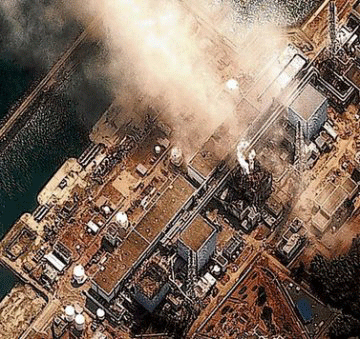 Fukushima Nuclear Crisis Update for October 2nd to October 4th, 2012 Greenpeace International, by Christine McCann – October 5, 2012 Nuclear Regulation Authority Japan’s Nuclear Regulation Authority (NRA) has released new guidelines for nuclear disasters, including expanding the evacuation zone around nuclear reactors from 10 to 30 km. The move will have a significant impact on local communities, which now need to craft complicated evacuation plans. Previously, only 45 municipalities in 15 prefectures were required to have nuclear emergency plans; now 135 municipalities in 21 prefectures are required to submit them by March 2013. Iodine tablets will also be distributed to anyone living within 50 km of a nuclear reactor. Local officials are complaining that the central government has not shared radiation diffusion simulation data, which makes it impossible to determine where to send people if a nuclear accident occurs.
In addition, many areas lack the infrastructure to conduct such large-scale evacuations. In some towns, roads are inadequate; in others, there are not enough vehicles to quickly evacuate all residents. For example, 930,000 residents live in Ibaraki Prefecture’s Urgent Protective Action Planning Zone (UPZ) near the Tokai #2 Power Station, but the prefecture only owns enough buses to transport 240,000 people. Although some residents could escape in their own cars, roads are inadequate and officials fear complete gridlock in the case of a nuclear crisis. The NRA is also mandating that emergency response centers be no closer than 5 km to a nuclear power plant, and no further than 30 km away. Analysts point out that the increased burden on local communities may make it more difficult for nuclear plant operators, who hope to restart idled reactors, to get permission from municipal officials.Tanaka continues to insist that although the NRA is responsible for determining safety at the nation’s nuclear power plants, it will not make the final decision about whether or not idled reactors should be restarted. “We are responsible for confirming whether safety standards are met from a scientific and technological standpoint. We will not be involved in [decisions regarding] electricity supply and demand and socioeconomic issues.” He added that determining whether or not the reactors should be restarted “is a major decision that must be made by somebody, and I believe that our safety assessment plays an important role in making that judgment. But to reactivate the reactors, there are various issues to consider, including gaining permission from local residents and municipal officials, and that is beyond the bounds of our authority.”
Tanaka’s position, which he has stated repeatedly, contradicts that of Prime Minister Yoshihiko Noda, who said last week that the NRA, not the government, would make the final decision on restarts. Chief Cabinet Secretary Osamu Fujimura echoed that sentiment at a press conference on Wednesday, saying, “As an important source of electricity, a reactor will be utilized when the NRA confirms its safety from an independent standpoint.” On Thursday, Fujimura repeated that stance, saying, “In terms of giving approval, that duty has shifted from the trade minister and the Nuclear and Industrial Safety Agency (NISA) to the regulatory committee that is now in charge of authorizing [the restarts].”
Fujimura added, however, that even if the NRA deems reactors safe, they may not be restarted unless they are determined necessary for power supply. “The problem of power supply and demand will naturally crop up. The government may decide it is unnecessary to restart reactors,” he said. Forty-eight of Japan’s fifty reactors have been offline since spring, and yet despite grave predictions from the nuclear power industry of widespread blackouts, no power loss occurred, even during peak-use days in August.
The government’s apparent shirking of the final decision has been poorly received by many, including the Mayor of Tomari, Hiroomi Makino, who said, “Any decision on a reactor restart must be made by the government and ultimately by the Prime Minister. I cannot but believe that the government is shunning responsibility by leaving the decision in the NRA’s hands.”The vast majority of the Japanese public opposes restarting the reactors; with elections looming within the next year, many politicians are loath to be seen as responsible for the restarts. However, the business and nuclear communities, worried about profits, continue to place pressure on them”…….. http://www.greenpeace.org/international/en/news/Blogs/nuclear-reaction/fukushima-nuclear-crisis-update-for-october-2/blog/42456/
No comments yet.
1 This Month

Petition to revoke the licensing of the Near Surface Nuclear Disposal Facility (NSDF) at Chalk River. https://www.ourcommons.ca/petitions/en/Petition/Details?Petition=e-7247


of the week – STOP SMALL MODULAR REACTORS IN CANADA
To see nuclear-related stories in greater depth and intensity – go to https://nuclearinformation.wordpress.com
-
Archives
- March 2026 (153)
- February 2026 (268)
- January 2026 (308)
- December 2025 (358)
- November 2025 (359)
- October 2025 (376)
- September 2025 (258)
- August 2025 (319)
- July 2025 (230)
- June 2025 (348)
- May 2025 (261)
- April 2025 (305)
-
Categories
- 1
- 1 NUCLEAR ISSUES
- business and costs
- climate change
- culture and arts
- ENERGY
- environment
- health
- history
- indigenous issues
- Legal
- marketing of nuclear
- media
- opposition to nuclear
- PERSONAL STORIES
- politics
- politics international
- Religion and ethics
- safety
- secrets,lies and civil liberties
- spinbuster
- technology
- Uranium
- wastes
- weapons and war
- Women
- 2 WORLD
- ACTION
- AFRICA
- Atrocities
- AUSTRALIA
- Christina's notes
- Christina's themes
- culture and arts
- Events
- Fuk 2022
- Fuk 2023
- Fukushima 2017
- Fukushima 2018
- fukushima 2019
- Fukushima 2020
- Fukushima 2021
- general
- global warming
- Humour (God we need it)
- Nuclear
- RARE EARTHS
- Reference
- resources – print
- Resources -audiovicual
- Weekly Newsletter
- World
- World Nuclear
- YouTube
-
RSS
Entries RSS
Comments RSS
 nuclear-news
Leave a comment