Iwaki City Japan -Child with 3,300 becquerels of radioactive cesium.
http://ex-skf.blogspot.co.uk/2012/09/radioactive-japan-wbc-result-of-child.html
“…the test has found one child with 3,300 becquerels of radioactive cesium.
Some speculate that this particular child was eating food grown in the home garden. Iwaki City hasn’t disclosed the details of the child (age, sex, where he/she lives, what he/she eats, etc.). The date this child was tested hasn’t been disclosed. ..”
Iwaki City in southern Fukushima Prefecture has been testing the residents in higher radiation districts since November last year using the Whole Body Counter (WBC) for internal radiation exposure. On September 25, the municipal government announced the result of the test for about 12,000 residents. (Iwaki City’s population is about 330,000.)
Iwaki City’s radiation levels are moderately high (it was on the path of the radioactive plume (or cloud) on March 15, 2011), but compared to the municipalities in Nakadori (middle third, including Date City, Fukushima City, and Koriyama City) and northern Hamadori (ocean-side third, including Futaba-machi, Okuma-machi, and Namie-machi) they are much lower. Still, the test has found one child with 3,300 becquerels of radioactive cesium.
Some speculate that this particular child was eating food grown in the home garden. Iwaki City hasn’t disclosed the details of the child (age, sex, where he/she lives, what he/she eats, etc.). The date this child was tested hasn’t been disclosed.
From Mainichi Shinbun Fukushima local version (9/26/2012):
東日本大震災:いわき・内部被ばく検査 国の基準下回る 妊婦と18歳以下計1万2134人
Iwaki City’s internal radiation exposure test on 12,134 pregnant women and children under 18 show radiation exposure below the national standard
いわき市は25日、昨冬から実施している市内の18歳以下の子どもと、昨年7月末までに妊娠した妊婦対象の内部被ばく検査結果を発表した。計1万2134人全員が、健康に影響を与えるとされる国基準の預託実効線量1ミリシーベルトを下回った。
Iwaki City announced the result of the internal radiation exposure test it had been doing since last winter on children under 18 and women who had been pregnant by July last year. All 12,134 people tested were below the national standard of 1 millisievert effective dose, which is said to affect health.
昨年11月から、県の車載型ホールボディーカウンター(WBC)で学校を巡回し、4235人を検査。最大値の子どもは放射性セシウム3300ベクレルで、生涯にわたって受ける内部被ばく線量の累計量を推計した預託実効線量は0・34マイクロシーベルトだった。
The city went to schools with the Whole Body Counter (WBC) mounted on a vehicle [bus], and tested 4,235 children. The maximum internal radiation was 3,300 becquerels of radioactive cesium, and the effective dose for the child in the course of the child’s life was 0.34 microsievert.
市は5月に固定型WBC2台を購入し、市総合保健福祉センターと総合磐城共立病院で、1日計110人を検査。8829人(集計済み7899人)の最大値は990ベクレル(預託実効線量0・053マイクロシーベルト)で、97%の人が検出限界値未満(下限値420ベクレル)だった。
The city purchased two fixed-type WBC this May, and tested 110 people per day at the city’s Health and Welfare Center and Iwaki Kyoritsu General Hospital. Of 8,829 people tested so far (with data totaled up for 7,899 of them), the maximum was 990 becquerels (effective dose of 0.053 microsievert), with 97% people below the detection limit (420 becquerels).
職員がWBCの扱いに慣れ、現在は1日計194人まで検査枠を拡大。市内の対象者約6万4000人の検査を来夏までに終える予定だったが、今年度末に前倒しし、新たに出産前の妊婦全員に検査対象を拡大する。
As the city workers have gotten used to handling the WBC, they can now test up to 194 people a day. The city planned to finish the testing of 64,000 people in the city by next summer, but the test will be finished by the end of the fiscal 2012 (March 2013) and expand the test to include all pregnant women.
What this Mainichi article doesn’t tell you is the percentage of children found with internal radiation exposure above the detection limit. It only mentions the percentage of pregnant women.
Iwaki City posted this table on their website without further breakdown by age or district. From the Mainichi article above, the first row is children under 18 who were tested by the mobile WBC, and the second row is pregnant women (click to enlarge):
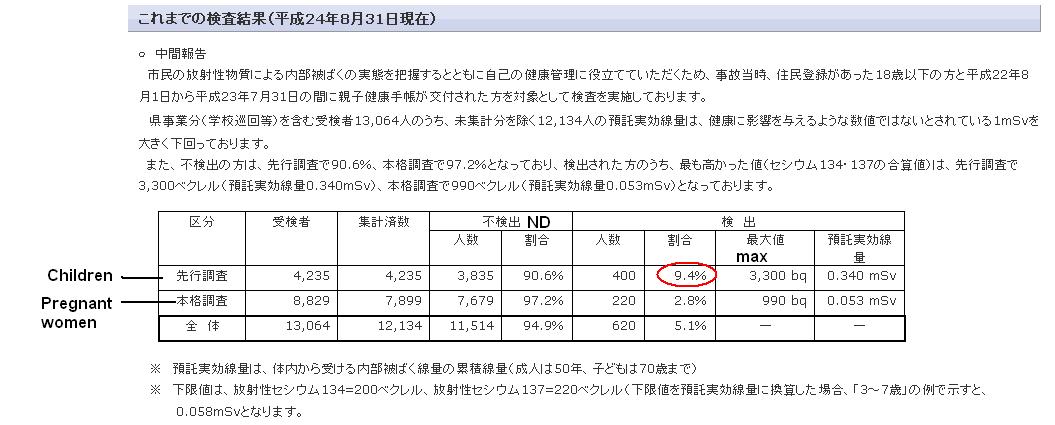
So, internal radiation exposure above the detection limit of 420 becquerels was found in 9.4% of children tested, while in adults, with much bigger sample numbers, it was only 2.8%, with much lower maximum exposure (990 becquerels).
If the child was tested in November when Iwaki City started testing children under 18 in the particular districts within the city known for higher levels of radiation, then it was about 8 months, or 240 days from the time of the accident. Looking at the chart from ICRP publication 111, page 21, in order to reach 3,300 becquerels in 240 days, the child would have to be ingesting much more than 10 becquerels of radioactive cesium per day, more likely over 20 becquerels and possibly close to 30 becquerels per day.

Why were children found with internal radiation exposure at a much higher percentage than adult women? They may absorb more but I thought they would excrete faster.
I remember reading an article about internal radiation exposure and WBC very early in the accident last year. People who worked in the nuclear industry were freaking out that staying for a short time in Fukushima after the accident resulted in thousands of becquerels of radioactive cesium inside the body. So that was a big deal then, and this child having thousands of becquerels of radioactive cesium is not, judging by the reaction in Japan. The focus seems to be on the effective dose, and the thinking is “since it’s so low there’s nothing to worry about”.
By the way, there are sites (both in Japanese and in English) that claim 3,300 becquerels of radioactive cesium has been detected in a pregnant woman and that number is per kilogram. That information is wrong. It was from a child, and it is not per kilogram.
No comments yet.
1 This Month

of the week – Shut Down Drone Warfare!


Tell the Ukrainian Government to Drop Prosecution of Peace Activist Yurii Sheliazhenko

Petition to revoke the licensing of the Near Surface Nuclear Disposal Facility (NSDF) at Chalk River. https://www.ourcommons.ca/petitions/en/Petition/Details?Petition=e-7247
To see nuclear-related stories in greater depth and intensity – go to https://nuclearinformation.wordpress.com
-
Archives
- April 2026 (114)
- March 2026 (251)
- February 2026 (268)
- January 2026 (308)
- December 2025 (358)
- November 2025 (359)
- October 2025 (376)
- September 2025 (257)
- August 2025 (319)
- July 2025 (230)
- June 2025 (348)
- May 2025 (261)
-
Categories
- 1
- 1 NUCLEAR ISSUES
- business and costs
- climate change
- culture and arts
- ENERGY
- environment
- health
- history
- indigenous issues
- Legal
- marketing of nuclear
- media
- opposition to nuclear
- PERSONAL STORIES
- politics
- politics international
- Religion and ethics
- safety
- secrets,lies and civil liberties
- spinbuster
- technology
- Uranium
- wastes
- weapons and war
- Women
- 2 WORLD
- ACTION
- AFRICA
- Atrocities
- AUSTRALIA
- Christina's notes
- Christina's themes
- culture and arts
- Events
- Fuk 2022
- Fuk 2023
- Fukushima 2017
- Fukushima 2018
- fukushima 2019
- Fukushima 2020
- Fukushima 2021
- general
- global warming
- Humour (God we need it)
- Nuclear
- RARE EARTHS
- Reference
- resources – print
- Resources -audiovicual
- Weekly Newsletter
- World
- World Nuclear
- YouTube
-
RSS
Entries RSS
Comments RSS
 nuclear-news
Leave a comment