Repairs to nuclear plants getting more costly – not viable?
Nuclear Repairs No Easy Sale as Cheap Gas Hits Utilities Bloomberg, By Julie Johnsson – Sep 11, 2012 A damaged Florida nuclear plant that spurred a boardroom coup at Duke Energy Corp. (DUK)in July risks getting scrapped unless the power company can justify spending more than $1.3 billion on the costliest-ever U.S. atomic repair……
Rising Risks The dispute underscores the stakes for U.S. power companies weighing nuclear investments against falling power prices and risks that plants won’t be relicensed or may close prematurely. Regulators haven’t approved Duke’s plans to pass repair expenses on to clients, and decommissioning costs haven’t been tallied.
Edison International (EIX) faces a similar decision with its 30- year-old San Onofre atomic station near Los Angeles , shut down since January because of leaks and unusual wear to its steam generators.
The surplus of gas-fired power plants in the western U.S. weakens the case for repairing and restarting San Onofre’s twin reactors. “The argument that ratepayers need to keep supporting Grandma lasts for about 15 seconds,” John Geesman, a former California energy commissioner, said in a phone interview. He serves as outside counsel for the Alliance for Nuclear Responsibility, which has lobbied the state to keep that plant idle…..
Oyster Creek Exelon Corp. (EXC) of Chicago decided in 2010 that it was more economical to close its Oyster Creek reactor in Forked River, New Jersey , when its license expired in 2019 than spend as much as $801 million to build a cooling tower demanded by state officials.
Duke’s board faces a more complicated analysis as it decides the best approach to its Crystal River plant, 80 miles (129 kilometers) north of Tampa.
The silo-shaped concrete building that houses the Crystal River 3 reactor cracked in 2009 as crews replaced the steam generators, huge pipe assemblies that transfer heat from the nuclear reactor to power-generating turbines. Once the damaged panel was patched, two other sections cracked in March and July 2011 after workers tightened steel tendons intended to strengthen the structure.
“We’re not joking when we call it the Humpty Dumpty reactor,” Stephen Smith , executive director of the Southern Alliance for Clean Energy, said in a phone interview. “We think they ought to quit throwing good money after bad.”
Lynas rare earths plant – troubles are far from over
The world will witness one of the biggest civil disobedience events in this nation”
Mr Ibrahim has demanded that Australians ”hear the frustrations of Malaysians” over the project.
First Weld war looms – Malaysians mobilise to fight Lynas plant, The Age, September 13, 202 Lindsay MurdochACTIVISTS are planning a multi-pronged attack to try to stop the Australian miner Lynas Corp opening a rare earths
processing plant in Malaysia.
Opposition parties, led by Anwar Ibrahim, are also planning to make the $230 million plant a key issue of the country’s national elections, which must be held by April next year. They have vowed to shut the plant if they oust the government. Continue reading
Palisades managers admit problems at nuclear plant, tell regulators how they’re improving Michigan Live By Fritz Klug , September 12, 2012, “…..While the NRC was looking into issues at Palisades, Entergy contracted with an independent firm to survey the plant’s workforce in January. From responses by about 600 employees, the survey found three key takeaways:
There had been a significant loss of confidence in the site’s leadership team, and leadership did not challenge each other to make the right decisions.
Leadership did not value or prioritize processes to improve plant performance or develop “a learning organization.”
Accountability was viewed as punitive.
Management said these problems were widespread across different departments at the plant…. n May, Gregory Jaczko, the NRC chairman at the time, toured Palisades and said Entergy needed to improve on basics of nuclear safety.….. On Thursday, anti-nuclear activist Kevin Kamps will give a talk in Kalamazoo about what he contends are worsening conditions at the plant…. http://www.mlive.com/news/kalamazoo/index.ssf/2012/09/palisades_nuclear_power_plant_6.html
Randy Brock, Republican guv candidate wants new nuclear plant in Vermont
 Vt. guv candidates spar over energy, other issues Boston.com By DAVE GRAM
Associated Press / September 12, 2012 MONTPELIER, Vt. (AP) — Gov. Peter Shumlin and Republican challenger Randy Brock differed sharply on energy and other issues in a debate Wednesday evening, with Brock saying he would support construction of
a new nuclear plant in Vernon and Shumlin saying he thought ridge-top wind turbines were ‘‘aesthetically pleasing.’’….
On energy, Brock said he thought Vermont should look into inviting a nuclear company to
build a new power plant in Vernon, home to the 41-year-old VermontYankee reactor, which Shumlin has been pushing to close…..
http://www.boston.com/news/local/vermont/2012/09/12/candidate-brock-build-new-nuclear-plant/Yjbvk3KPf9oOQbjcFQpyPM/story.html
San Onofre nuclear plant to be offline for months, Market Watch, By Ryan Tracy, Sept. 12, 2012, WASHINGTON–-The chairman of the U.S. Nuclear Regulatory Commission said Wednesday that the shut-down San Onofre nuclear station in California will remain offline for months while the agency reviews Southern California Edison’s assessment of the plant’s problems…. http://www.marketwatch.com/story/san-onofre-nuclear-plant-to-be-offline-for-months-2012-09-12
It will be very costly NOT to act on Climate Change
it is worth exploring the question, what would a world with >2°C global surface warming look like?
Global Warming Impacts
The 2007 IPCC Fourth Assessment Report (AR4) summarizes the magnitudes of impact of various degrees of warming here, and graphically….
This is Why Reducing Emissions is Critical
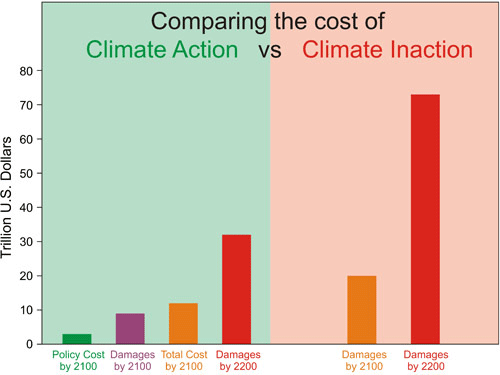
Realistically What Might the Future Climate Look Like? Sceptical Science 31 August 2012 by dana1981Robert Watson, former Chair of the Intergovernmental Panel on Climate Change (IPCC),recently made headlines by declaring that it is unlikely we will be able to limit global warming to the 2°C ‘danger limit’. This past April, the International Energy Agency similarly warnedthat we are rapidly running out of time to avoid blowing past 2°C global warming compared to late 19th Century temperatures. The reason for their pessimism is illustrated in the ‘ski slopes’ graphic, which depicts how steep emissions cuts will have to be in order to give ourselves a good chance to stay below the 2°C target, given different peak emissions dates
Clearly our CO2 emissions have not yet peaked – in fact they increased by 1 billion tonnes between 2010 and 2011 despite a continued global economic recession; therefore, the green curve is no longer an option. There has also been little progress toward an international climate accord to replace the Kyoto Protocol, which suggests that the blue curve does not represent a likely scenario either – in order to achieve peak emissions in 2015 we would have to take serious steps to reduce emissions today, which we are not. The red curve seems the most likely, but the required cuts are so steep that it is unlikely we will be able to achieve them, which means we are indeed likely to surpass the 2°C target. Continue reading
Solar power use – the top 20 USA commercial users
USA’s Top 20 Commercial Solar Power Users http://www.energymatters.com.au/index.php?main_page=news_article&article_id=3379 by Energy Matters, 12 Sept 12, U.S. commercial solar installations could power more than 390,000 American homes according to a new report from the Solar Energy Industry Association (SEIA) and the Vote Solar Initiative.
The top 20 corporate solar users’ installations alone combined generate an estimated $47.3 million worth of electricity each year; enough to power 46,500 average American homes.
Those who made the top 20 list, in order of on-site capacity are: Walmart, Costco, Kohl’s Department Stores, IKEA, Macy’s, McGraw-Hill, Johnson & Johnson, Staples, Inc., Campbell’s Soup, Walgreens, Bed, Bath & Beyond, Toys ‘R’ Us, General Motors, FedEx, White Rose Foods, Dow Jones, Snyder’s of Hanover, ProLogis, Hartz Mountain Industries and Crayola.
The report states the above companies have installed more than 1.2 million solar panels, which would cover more than 544 acres of rooftops. This is an important point – while large ground mount solar farms certainly have their place; our towns and cities offer a massive and under-utilised rooftop real estate resource. The area of suitable roof space available in Australia is said to be enough to provideall of the nation’s electricity needs.
The SEIA/Vote Solar Initiative report also says just two companies, Walmart and Costco, have more installed solar PV capacity than all of that deployed in the state of Florida, commonly known as the Sunshine State. Furthermore, the top 10 companies (by capacity) have deployed more solar energy than most electric utilities in the USA.
As of the middle of this year, businesses, non-profits and governments across the United States have deployed more than 2.3 gigawatts of commercial solar power systems and during the first half of 2012 one non-residential PV system came online every 72 minutes.
While installing solar panels can help a company’s green credentials, it also makes good business sense in another very important way; slashing operational expenses and buffering against continually increasing electricity costs.
The full Top Commercial Solar Customers in the U.S. report can be viewed here.
New Nuclear Regulatory Commission proposal to ease safety requirements for new plants
New proposal from the Nuclear Regulatory Commission would allow nuclear power plants to skip inspections and inservice testing
http://enformable.com/2012/09/new-proposal-from-the-nuclear-regulatory-commission-would-allow-nuclear-power-plants-to-skip-inspections-and-inservice-testing/
A new draft document released for public comment by the Nuclear Regulatory Commission, would allow nuclear power plants to skip inservice testing and inspection of key safety components such as pumps, valves, welds, nozzles, vessels, and other components due to
impracticality, hardship, unusual difficulty, or when they would like to use a different approach for meeting requirements.
When making a decision on a request for relief, the NRC staff assesses the limitations of the examination or testing, evaluates the susceptibility to known degradation, mechanisms or failure modes, the consequences of a failure at the location where the test or
examination is impractical, and if any other inspections or tests should be implemented to compensate for the impracticality, according to the document.
The industry would also be allowed to submit alternative plans due to hardship regarding radiation exposure during an examination or test, which may offer utilities another argument for exemption if none of the other circumstances apply. The licensee would need to communicate the radiation levels at the test or examination area in this event.
Public comments will be accepted through October 22nd, 2012. Source: Nuclear Regulatory Commission
Scientists Have a Plan To Power 95% Of the World With Renewable Energy Motherboard, by Brian_Merchant , Sep 12, 2012 “…..It is the dream of every clean energy advocate that the world come to understand that the barriers lie not with technology, but beyond two much deeper moats: a lack of political will and the organized opposition from the powerful fossil fuel companies whose lifeblood it shall displace……. Continue reading
Riot police attack Kudankulam anti nuclear protestors
 Indian riot police attack 4000 nuclear protesters, Examiner SLIDESHOW SEPTEMBER 10, 2012 BY: DEBORAH DUPRE Saturday and Sunday, Indian riot police opened fire one group and assaulted thousands of others with tear gas, mainlywomen and children on the beach protesting Kudankulam Nuclear Power Project (KNPP), the country’s largest nuclear power facility, due to fire up soon. By late Sunday, there was one dead and many injured as police began rampaging homes of protesters.
“A large riot-gear bedecked police force is in the frontline facing the people, and tear gas lobbers are apparently on stand-by,” a human rights defender informed Counter Currents Sunday morning.

“Police are intimidating people by moving closer, swaying batons,” Dr. S P Udayakumar at the scene texted in an SMS at 11:30 a.m. “Thousands of women and children are here. Officials threatened with naval intervention. Situation is very tense and dangerous. We need your appeals to the governments.”
Koodankulam anti nuclear protest – in photos
20,000 Villagers Occupy Koodankulam Nuclear Power Plant
http://www.salem-news.com/articles/september102012/india-koodankular-jjs.php
 PHOTOS Joseph John Sunder Special to Salem-News.com Includes timeline of events unfolding in India.
Special thanks to countercurrents.org (CHENNAI Countercurrents) – More than 20,000 villagers have put the Koodankulam nuclear power plant under siege to protest fuel loading in preparation for the commissioning of the plant. More than 4000 police personnel, including Rapid Action Force (RAF), are deployed around the plant. People are camping in front of the nuclear plant and refuse to go back to their homes.
Here are the days events as it happened -…..
Dispelling the myths of the pro nuclear astroturfers
 The top ten common myths of the nuclear cheerleaders, daryanenergyblog, “……Myth I – The Fukushima accident is a “Triumph” of nuclear technology, it proves it works safely – Reality: It raises some important questions about aspects of nuclear safety
Myth II – Only 56 people were killed by the Chernobyl accident – Reality: The death toll from Chernobyl was many times higher, in the thousands or possibly tens of thousands
Myth III – Radiation isn’t that dangerous at all, it’s over exaggerated by the media, why the impact of Chernobyl was no worse than a few dozen chest x-rays each, and TMI was no worse than you’d get eating a banana – Reality: The effects of radiation from artifical sources is potentially quite serious
Myth IV – Nuclear power is cheaper than any of the alternatives – Reality: Its actually more expensive than most of the alternatives!
Myth V – But we can’t rely on renewables, because of their intermittent nature – Reality: Nuclear power has its own issues with intermittency
Myth VI – there’s plenty of fissile material in the world – Reality: While no immediate supply problems are anticipated, ultimately the world’s stockpiles of fissile material are limited in scale
Myth VII – We can’t build Renewables fast enough only nuclear power plants can be built quickly enough to prevent climate change – Reality: The current build rate of nuclear power stations is a small fraction of the annual build rate of renewables, even the maximum ever build rate of NPP’s in the 70′s is still exceeded by the currrent build rate of renewable systems
Myth VIII – Yes, you’ve highlighted several problems but you see once we get these new fast reactors working all these problems will be solved – Reality:Fast-reactors are a failed series of white elephants that are unlikely to ever work
Myth IX – All these problems will be solved when we develop Fusion, which will happen in the near future – Reality: While we’re making progress, its far to early to say when Nuclear Fusion will become commercially viable….if ever!
Myth X – Disposal of nuclear waste is easily solved, indeed we’ve already sorted it out – Reality: While there are options available, the nuclear industry is not pursing them, this is leading to a gradually worsening problem which needs to be tackled soon
Stop press, Bonus feature! Myth XI – We need to use MOX and reprocessing to stop Terrorists getting their hands on Plutonium in the future – Reality: This statement merely shows how out of touch the nuclear industry is….with reality! http://daryanenergyblog.wordpress.com/2011/04/02/the-top-ten-common-myths-of-the-nuclear-cheerleaders/
Police shoot dead an anti nuclear fisherman in Southern India
One killed in India nuclear plant protest http://www.heraldsun.com.au/news/breaking-news/one-killed-in-india-nuclear-plant-protest/story-e6frf7k6-1226471469932 From: Herald Sun, AFP September 11, 2012 POLICE have shot dead a fisherman during a mass protest against the loading of uranium at a nuclear power plant in southern India.
Steel-helmeted officers ringed one of two 1000-megawatt nuclear reactors in Tamil Nadu state’s Koodankulam region as hundreds of activists tried to lay a siege of the Russia-backed project, television footage showed.
The protests then spread and a 48-year-old fisherman was killed when police opened fire at activists staging another rally in the nearby Tuticorin district, according to a report by the Press Trust of India.
“A number of people including police personnel have received injuries in the clashes,” another officer said while TV footage showed anti-riot personnel chase some of the activists, including women, into the nearby sea.
Monday’s violence comes six months after a lull in protests at the plant, which campaigners say could endanger the lives of locals in the case of a nuclear disaster.
The Press Trust of India said the new protests were in opposition to the loading of enriched uranium in the plant’s reactor…..
Since Fukushima, Indian activists have also campaigned to stop work scheduled to start in 2013 at Jaitapur in western Maharashtara state which would be one of the world’s biggest nuclear facilities.
Nuclear energy has been a priority for India since 2008 when then-US president George W. Bush signed into law a deal with New Delhi that ended a three-decade ban on US nuclear trade with the country.
Since then, France, Russia and private US and Japanese firms have been locked in fierce competition to sell new reactors to India.
The world’s most dangerous nuclear reactor – Monju, Japan
Problem plagued nuclear reactor called world’s most dangerous via ABC News, The Atomic Age, May 2012 http://lucian.uchicago.edu/blogs/atomicage/2012/09/10/problem-plagued-nuclear-reactor-called-worlds-most-dangerous-via-abc-news/
Japan’s Monju nuclear reactor was supposed to be a model of power generation in the future, but it’s had many problems and in two decades it’s only generated one hour’s worth of electricity.
EMMA ALBERICI, PRESENTER: It’s supposed to be the future of nuclear power generation, a reactor that produces its own fuel in a self-sustaining cycle. Known as Monju, the reactor on the country’s west coast is held up as the saviour of a nation without energy resources. But Monju has been plagued with problems and many call it the most dangerous reactor in the world. In part two of his series on Japan’s so-called nuclear alley, North Asia correspondent Mark Willacy was given an exclusive look inside Monju.
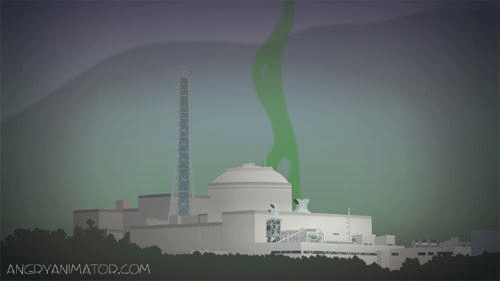
MARK WILLACY, REPORTER: People frolic in its shadow, a reactor its critics call the most dangerous in Japan. The name Monju comes from one of Buddha’s chief attendants, a purveyor of enlightenment depicted resting on the back of a lion, a beast whose phenomenal powers are controlled only by Monju’s wisdom.
But opponents of this prototype reactor fear its operators do not have the wisdom to harness its enormous energy.
KEIJI KOBAYASHI, FAST-BREEDER REACTOR EXPERT (voiceover translation): If a meltdown happens, it will get out of control very quickly. If the reactor core was to melt, the explosive energy would produce a blast like a nuclear bomb.
FUKIKO IKEJIMA, ‘STOP MONJU’ GROUP (voiceover translation): If a big accident were to happen, the impact would not stop in Japan, but spread around the world. It is our most dangerous reactor.
MARK WILLACY: And this is one of the reasons many Japanese fear Monju, because it uses sodium to cool a reactor, the substance that can ignite upon contact with oxygen. In 1995, a sodium leak at Monju caused a serious fire, one that resulted in the plant being out of operation for 15 years.
Lateline was given an exclusive tour of Monju, including an interview with the plant’s director-general, Satoru Kondo.
Continue reading at Problem plagued nuclear reactor called world’s most dangerous
Japan – no blackouts despite nuclear power almost completely shut down

 No summer blackouts: nuclear scaremongering in Japan proven false http://www.greenpeace.org/international/en/news/Blogs/nuclear-reaction/no-summer-blackouts-nuclear-scaremongering-in/blog/42057/
by Justin McKeating – September 10, 2012 Despite the dire warnings from the nuclear industry and its backers, Japan’s hot summer has passed with no power blackouts or shortages even though just two out of its 50 nuclear reactors were in operation. Continue reading
1 This Month

Protect Sazan Island from the Trump family! https://secure.avaaz.org/campaign/en/protect_sazan_island_from_the_trump_family_loc/?bqFCVab&v=174511&cl=22707147157&_checksum=5e9dde668860e8231c33699735e16a1fbf22ab2cb01da50c999fe8732b9775ef&utm_source=email&utm_medium=blast_email&utm_campaign=174511


Cuba Is Not a Failed State – It Is a Besieged State
PETITION: “Global Appeal to Endorse Palestinian Right of Return of Refugees”
To see nuclear-related stories in greater depth and intensity – go to https://nuclearinformation.wordpress.com
-
Archives
- June 2026 (129)
- May 2026 (306)
- April 2026 (356)
- March 2026 (251)
- February 2026 (268)
- January 2026 (308)
- December 2025 (358)
- November 2025 (359)
- October 2025 (376)
- September 2025 (257)
- August 2025 (319)
- July 2025 (230)
-
Categories
- 1
- 1 NUCLEAR ISSUES
- business and costs
- climate change
- culture and arts
- ENERGY
- environment
- health
- history
- indigenous issues
- Legal
- marketing of nuclear
- media
- opposition to nuclear
- PERSONAL STORIES
- politics
- politics international
- Religion and ethics
- safety
- secrets,lies and civil liberties
- spinbuster
- technology
- Uranium
- wastes
- weapons and war
- Women
- 2 WORLD
- ACTION
- AFRICA
- Atrocities
- AUSTRALIA
- Christina's notes
- Christina's themes
- culture and arts
- Events
- Fuk 2022
- Fuk 2023
- Fukushima 2017
- Fukushima 2018
- fukushima 2019
- Fukushima 2020
- Fukushima 2021
- general
- global warming
- Humour (God we need it)
- Nuclear
- RARE EARTHS
- Reference
- resources – print
- Resources -audiovicual
- Weekly Newsletter
- World
- World Nuclear
- YouTube
-
RSS
Entries RSS
Comments RSS
 nuclear-news