Democratic freedoms trampled: the sorry story of India’s Kudankulam nuclear power project
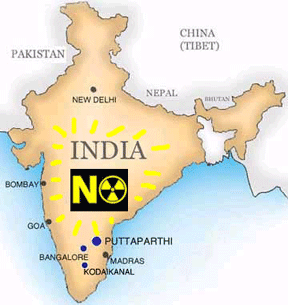 Despite mass opposition, India pushes ahead with operationalizing nuclear plant WSWS, By Arun Kumar and Kranti Kumara 27 September 2012 Despite mass protests by villagers, the Indian government in partnership with the Tamil Nadu state government is pushing ahead with the loading of nuclear fuel at the recently built 2000 MW Kudankulam Nuclear Power Plant (KNPP) located on the Tamil Nadu coast.
This massive power plant is a joint venture between India and Russia and has cost 172 billion Rupees (about $3.2 billion) to build. The plant currently houses two nuclear pressurized water reactors (PWR) reactors, each capable of driving a 1000 MW electric generator. But there are plans to construct four additional reactors at the site…..
Despite the deep misgivings of the population, the Indian elite, without any democratic debate, is rushing feverishly ahead, claiming that nuclear plants are essential to satisfying growing domestic electricity needs.
This particular plant is causing great concern among villagers and fishermen living in its vicinity, because it is situated right next to the ocean just like the Japanese Fukushima plant. Built at the southern tip of the state, KNPP is highly vulnerable to undersea earthquakes and tsunami that are an ever-present danger in the Indian Ocean region. That such concerns are far from hypothetical was demonstrated when the plant installations got inundated from ocean waves unleashed by the massive undersea earthquake that occurred in the Indian Ocean in 2004….
Last April witnessed a particularly brutal response by joint forces deployed by the Indian and the state governments. The police cut off water, food and power-supply to protesting villagers and imposed a curfew in the villages where the agitation has been centered. Nearly 200 people were arrested including women and children. Subsequently protests abated somewhat as the People’s Movement against Nuclear Energy (PMANE), which has led the agitation, called it off in the hope that the Tamil Nadu and Indian judiciaries would intervene on its behalf.
However, by late August the Madras High Court gave the green light to the Indian government to proceed with the steps it needs to take to make the plant operational. An appeal was then filed by an anti-nuclear activist with the Indian Supreme Court asking the court to halt further progress on operationalizing the plant, since 11 of the 17 critical safety measures recommended by the government’s own Atomic Energy Regulatory Board (AERB) had not been implemented.
Around this time, widespread protests resumed and the police responded with still greater violence. On Sept. 10 a protesting fisherman, 48 year-old Antony John, was shot dead. A young girl was also trampled to death when police resorted to charges to break up the protests. To observe and terrify those conducting a water protest, the Coast Guard flew low-flying aircrafts. One of the protesting fisherman named Sathyam panicked when a surveillance aircraft flew low, then slipped hitting his head against a boulder and subsequently died. Sathyam’s funeral became a rallying point for opposition to the nuclear power plant attracting large number of villagers from neighbouring areas.
Earlier this month, India’s Supreme Court refused to even hear the petition against operationalizing KNPP. In so doing, the court ignored publicly available evidence of shoddy workmanship, the dangers inherent from using an untested reactor design, and the fact that over 1 million people live within a 30 Km. radius of the plant, which violates even the AERB’s feeble safety regulations.
Following this, the Indian government proceeded post-haste to begin loading enriched-uranium fuel rods into one of the reactors. The government has said that it expects the fuel loading to be complete by Sept. 28 and the plant fully operational soon afterwards.
This move provoked the villagers into intensifying their agitation.
On Saturday, Sept. 22, over 500 fishing boats laid siege for several hours to the Tuticorin port about 100 Km north of KNPP. This port is used for unloading nuclear fuel rods from ships for transportation to the reactor at the plant. Simultaneously other protestors including villagers led by PMANE undertook “Jal Satyagraha” (Water Agitation), by standing in waist-deep water in the ocean near the plant and forming a human chain.
Solidarity protests also sprung up across the state. But the police repression has continued unabated with arrest warrants being issued for activist-leaders, many of whom including PAME leader Udayakumar have now gone into hiding. Under the pretext of looking for protest leaders, the police in bands of 10 have gone on a rampage, breaking down doors and ransacking the houses of villagers living in the Kudankulam area. This is clearly an attempt by the government to terrorize the populace into submission.
Kudankulam has been practically sealed off by armed policemen who are allowing only the transport of essential goods into the area. Public transport has also been barred from entering some of the areas surrounding the plant.
To the consternation of the authorities, the protests have now snowballed with growing numbers of people, including students, advocates and villagers, joining protests across the state and even in the Bangalore, the capital of the neighbouring state of Karnataka. … http://www.wsws.org/articles/2012/sep2012/indi-s27.shtml
No comments yet.
1 This Month
10 March A LIVE WEBINAR THE REAL EFFECTS OF NUCLEAR POWER
What the Industry Isn’t Telling Us
1:00 PM Mountain, 2 pm Central, 3 pm Eastern. Live on the Keepers of the Water Facebook page


18 March Webinar @ 1 PM EST: An Assessment of SMR Projects: The Case of Canada
register for the zoom:
https://us02web.zoom.us/webinar/register/WN_o8BIIOUvQ2ONJR1nta65DQ#/registration


of the week – STOP SMALL MODULAR REACTORS IN CANADA
To see nuclear-related stories in greater depth and intensity – go to https://nuclearinformation.wordpress.com
-
Archives
- February 2026 (268)
- January 2026 (308)
- December 2025 (358)
- November 2025 (359)
- October 2025 (376)
- September 2025 (258)
- August 2025 (319)
- July 2025 (230)
- June 2025 (348)
- May 2025 (261)
- April 2025 (305)
- March 2025 (319)
-
Categories
- 1
- 1 NUCLEAR ISSUES
- business and costs
- climate change
- culture and arts
- ENERGY
- environment
- health
- history
- indigenous issues
- Legal
- marketing of nuclear
- media
- opposition to nuclear
- PERSONAL STORIES
- politics
- politics international
- Religion and ethics
- safety
- secrets,lies and civil liberties
- spinbuster
- technology
- Uranium
- wastes
- weapons and war
- Women
- 2 WORLD
- ACTION
- AFRICA
- Atrocities
- AUSTRALIA
- Christina's notes
- Christina's themes
- culture and arts
- Events
- Fuk 2022
- Fuk 2023
- Fukushima 2017
- Fukushima 2018
- fukushima 2019
- Fukushima 2020
- Fukushima 2021
- general
- global warming
- Humour (God we need it)
- Nuclear
- RARE EARTHS
- Reference
- resources – print
- Resources -audiovicual
- Weekly Newsletter
- World
- World Nuclear
- YouTube
-
RSS
Entries RSS
Comments RSS
 nuclear-news
Leave a comment