The lies of nuclear food, alcohol, water and the IAEA cover up!
Official Journal of the European Union February 2011
Radioactive contamination of foodstuffs ***I
P7_TA(2011)0055
European Parliament legislative resolution of 15 February 2011 on the proposal for a Council
regulation (Euratom) laying down maximum permitted levels of radioactive contamination of
foodstuffs and of feedingstuffs following a nuclear accident or any other case of radiological
emergency (recast) (COM(2010)0184 – C7-0137/2010 – 2010/0098(COD))
Note
This report came out a month before the japan earthquake nuclear disaster. It made requirements of European countries to monitor and manage levels of contamination. Since Fukushima the European governments have covered up the large contamination incident in Hungary that has doomed many young people from around the Bucharest medical isotope institute, and others further downwind too. The IAEA was instrumental to this play down and cover up as were the main stream media. And the fallout from fukushima in Europe, though minor was not a minor health hazard as we were told to believe by the paid for university specialists. Also, the releases from hungary brought drinking water Pb210 lead contamination to above safety drinking standards in the uk according to a cached copy of a removed link to a USA military base in the UK (Milford Haven) no measurement for iodine isotopes of any sort, but the warning level was changed and a second reading was done a month later that mathched the new limit, just!
Here are some links you might not have seen that outline these hidden nuclear horrors. Continue reading
Japan’s government stops the “bad news” from Fukushima
 July, 2011, Japan passes law to cleanse “bad” Fukushima news from internet
  http://www.huntingtonnews.net/6482 EDITED BY TONY RUTHERFORD FROM MULTIPLE REPORTS Japan has passed a new law to cleanse the internet of “bad” Fukushima news. In fact, Japan in this You Tube video tells citizens they have no right to
  live a radiation free life. . http://japanfocus.org/-Makiko-Segawa/3516
The following is a quote from “Fukushima Residents Seek Answers Amid Mixed Signals From Media, TEPCO and Government. Report from the Radiation Exclusion Zone (Updated May 16) Makiko SEGAWA in Fukushima, published byh Asia-Pacific Journal, Japan Focus.
“Now the Japanese government has moved to crack down on independent reportage and criticism of the government’s policies in the wake of the disaster by deciding what citizens may or may not talk about in public.
A new project team has been created by the Ministry of Internal Affairs and Communication, the National Police Agency, and METI to combat “rumors” deemed harmful to Japanese security in the wake of the Fukushima disaster.
The government charges that the damage caused by earthquakes and by the nuclear accident are being magnified by irresponsible rumors, and the government must take action for the sake of the public good. The project team has begun to send “letters of request” to such organizations as telephone companies, internet providers, cable television stations, and others, demanding that they “take adequate measures based on the guidelines in response to illegal information. ”The measures include erasing any information from internet sites that the authorities deem harmful to public order and morality.” Japan Focus…… http://nuclearhistory.wordpress.com/2012/09/14/28-july-2011-japan-passes-law-to-cleanse-bad-fukushima-news-from-internet/
Indian govt’s harsh crackdown on anti nuclear protesors

 India: Government crushes nuclear protests http://www.globalpost.com/dispatches/globalpost-blogs/india/india-nuclear-protests 14 Sept 12, Nuclear projects in India can only be thrust on unwilling citizens at gunpoint, writes activist Praful Bidwai In the wake of police firing that killed one of the many Indians protesting against the Kudankulam nuclear power plant in Tamil Nadu, activist Praful Bidwai lays it into the government that not long back was hailed for its groundbreaking civilian nuclear agreement with George W. Bush.
“The repression, including lethal firing, unleashed on peaceful protesters against the Kudankulam nuclear plant on Monday, on top of FIRs over many months charging thousands with sedition, makes two things clear. Nuclear projects in India can only be thrust on unwilling citizens at gunpoint. [And] as the jalsatyagraha (water civil disobedience) shows, people will resist them tenaciously, because they are aware of their hazards,” Bidwai writes in India’s Hindustan Times newspaper .
As GlobalPost reported last year, a massive nuclear project planned for Jaitapur, Maharashtra, has also faced large protests.
Casual readers and the government dismisses these protests as the work of ignorant villagers and eco-radical agitators (as demonstrated by the claim that the opposition can be traced to various “foreign-funded” NGOs).
But Bidwai points out that every single nuclear project India has planned has spurred committed resistance:
“That’s true of every nuclear project, whether Jaitapur (Maharashtra), Gorakhpur (Haryana), Mithi-Virdi (Gujarat), Kovvada (Andhra Pradesh), Haripur (West Bengal), Chutka (Madhya Pradesh) or Banswada (Rajasthan). For instance, at Gorakhpur, there has been a daily dharna against four proposed reactors for two years, unbeknownst to Delhi, which lies in their potential radiation-fallout zone,” he writes.
And when some 100 activists met in Delhi this August, nobody listened to their reservations about the Kudankulam project, which Bidwai says “was cleared in violation of the recommendations of an official Task Force, and without even the fig leaf of an Environmental Impact Assessment (EIA) report.”
Now villagers, and, yes, more than a few “agitators” have walked into the sea near the reactor, in imitation of a protest against the flooding of villages in Gujarat earlier this month.
They might be wrong. The government says Kudankulam is safe. Coal isn’t without its dangers. And the huge number of hydropower projects planned for Northeast India will destroy cultures and wildlife in one of the country’s last remaining wilderness areas. (Personally, I was sold on nuclear after visiting Arunachal Pradesh for this series on dams–if the government can proceed responsibly).
But it is foolishness bordering on the criminal to undertake such projects on the assurances of company insiders and circumvent the environmental clearance regime, as Bidwai and others say has been done for nuclear plants, and other environmental activists say is routinely done for big dams, coal mines, and every sort of industrial activity.
And it’s bad politics simply to dismiss those claims because of some hidebound commitment to the ideology of economic growth.
Japan, Germany, Switzerland, Belgium lead the flight from nuclear power
 Nuclear best friends turn cold shoulder after Fukushima Business Recorder, 14 September 2012 LONDON: Nuclear industry was dealt a big blow on Friday when two of the most nuclear-friendly countries decided to exit or sharply curb their reliance on the technology following a public opinion backlash after the Fukushima accident in Japan last year.
Japan, which produced more than 10 percent of the global nuclear power before Fukushima, joins Germany, Switzerland and Belgium in deciding to shut down their nuclear plants and to spend money on renewable energy instead. Continue reading
A warning on the genetic effects of low dose radiation
“Radioactive waste – the source of which is mostly human-made, like nuclear power plants, nuclear testing, wrong disposal of nuclear or radioactive medicines by hospitals and so on — can cause serious impact on marine and land species,”
There is a link between other species and humans via the associated food chain,”
‘Man-made radiation makes repairing broken genes harder’ The Gulf Today BY A STAFF REPORTER September 15, 2012 DUBAI: All living things on earth and in the oceans live with exposure to natural levels of ionising radiation, which is high-frequency radiation with enough energy to change the DNA of organisms.
Most such genetic damage heals, but the addition of human-made radiation can make it harder for the body to repair broken genes, according to Master Pritvik Sinhadc, the world’s youngest author on palaeontology, the earth science that studies fossil organisms and related remains. Continue reading
USA government worried about Japan cutting out nuclear power?
U.S. energy official voices concern over zero nuclear energy target, Japan Times, 14 Sept 12, Jiji WASHINGTON — U.S. Deputy Secretary of Energy Daniel Poneman has voiced concerns about Japan’s apparent plans to end its nuclear energy dependence by the 2030s, Democratic Party of Japan executive Seiji Maehara said Wednesday.
At a meeting with the DPJ’s policy chief Tuesday, Poneman said that if Japan takes such steps it might have unexpected effects on the United States and other concerned parties, Continue reading
Japan’s radiation standards relaxed following lobbying by nuclear power companies
Fukushima Nuclear Disaster – Public Health Lessons and Challenges
“Federation of Electric Power Companies of Japan has successfully lobbied radiation specialists including ICRP members and the Nuclear Safety Commission to relax radiation standards.”
—
FEPC has covered travel costs for ICRP members
to attend international conferences through the
Radiation Effects Association….
Conclusions
The health risks posed by radiation are not
limited to cancer.
There is risk of cancer even at levels less than 100mSv.
There is both theoretical and epidemiological evidence
for this.
The risk is purported to be an unknown. Is this to maintain
the power of MEXT, METI, and the utilities in order to
promote nuclear power?…
CITIZENS’ RESPONSES IPPNW public mee.ng, 27 August 2012, Tokyo
HOSOKAWA Komei(細川弘明), k22m@me.com
Takagi Fund for Ci.zen Science / Asia-Pacific Resource
Center / Greenpeace Japan / Kyoto Seika University http://fukushimasymposium.files.wordpress.com/2012/08/e382abe38390e383bceng.pdf
USA public waking up to the dangers of MOX nuclear fuel reprocessing
 MOX or not? Gov’t likes weapons fuel, public doesn’t Equities.com, By Eric Fleischauer, The Decatur Daily, Ala.
  McClatchy-Tribune Information Services Sept. 14--The Energy Department believes it is safe to use weapons-grade fuel at Browns Ferry Nuclear Plant, but not many residents attending a public hearing Thursday agreed.
“They don’t need to have it here,” said Sara Crossfield of Athens, who has a farm near the Limestone County plant. “TVA’s charter requires them to protect us.”
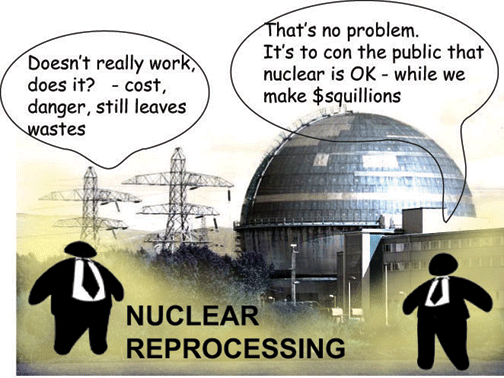
U.S. treaties with Russia require the disposal of 50 tons of surplus plutonium. The treaties authorize disposal by recycling the weapons-grade plutonium into mixed-oxide fuel, or MOX, for use in nuclear reactors. MOX is a mixture of plutonium and low-enriched
uranium.
The purpose of Thursday’s public hearing was to receive comments on a draft document describing the environmental impact of using MOX. About 60 people attended.
While MOX is the Energy Department’s preferred alternative for most of the surplus plutonium, the Tennessee Valley Authority said it has no preference. Sachiko McAlhany, document manager for the U.S. Department of Energy, presented a summary of the environmental impact statement. She said the department concluded using MOX “does not appreciably change” the risk posed by conventional uranium fuel.
Neither McAlhany nor a TVA representative, Mick Mastilovic, answered questions at the hearing. The comments from the public will be incorporated into the final environmental impact statement, scheduled for a spring 2013 release.
The plutonium would be reprocessed into MOX at a $6 billion plant in South Carolina, operated by France-based AREVA. It would then have to be transported to Browns Ferry.
Many of the concerns expressed by those attending the hearing involved the cost of creating MOX and the risks involved in transport.
Concerns specific to Browns Ferry focused on the impact of the fuel — which burns at slightly higher temperatures than conventional fuel — on the reactors and the possibility that Browns Ferry would become a terrorist target. Continue reading
Emergency preparedness on nuclear power – don’t be lulled by pro nuke propaganda
Emergency Preparedness–Nuclear 911 Campaign http://www.nirs.org/reactorwatch/emergency/emergencyhome.htm includes excellent VIDEO
September 13, 2012.Statement of Michael Mariotte, NIRS Executive Director, at NRC scoping meeting on emergency planning on need to expand EPZs, not be fooled by computer accident simulations, and public’s expectations of protection from radiation exposure.Statement of Dominique French, NIRS Campaigner, at same NRC meeting, on lessons from Fukushima & Chernobyl…….
France to cut nuclear power, promote renewable energy
On nuclear power, Hollande said he wanted to close France’s oldest plant, Fessenheim, at the end of 2016, bringing the closure date forward by several months.
Hollande also confirmed his campaign pledge to cut the share of nuclear power in the country’s energy mix to 50 percent by 2025 from 75 percent at present.
 France seeks more ambitious EU carbon cuts By Julien Ponthus and Muriel Boselli PARIS Sep 14, 2012 (Reuters) – French President Francois Hollande on Friday called for deeper cuts in European Union carbon dioxide emissions as he sought to put the environment back at the top of the international
agenda…….
….NUCLEAR .The two-day environmental conference in Paris marked the launch of a review of the world’s most nuclear-dependent country’s energy policy, with a focus on the small and struggling renewable sector. Continue reading
Strong push for American Clean Energy Agenda – join us!
End Dirty Energy! Support the American Clean Energy Agenda September, 2012
Nearly 100 organizations, including NIRS, representing more than 1 million Americans, have joined together to fight for a new American Clean Energy Agenda and create a renewable energy reality by 2030. We ask you to join us and add your voice.
Make no mistake, the American people are with us. An April 25, 2012 poll commissioned by Civil Society Institute found that more than eight out of 10 Americans (83%)–including 69% of Republicans, 84% of Independents, and 95% of Democrats–agree with the following statement: “The time is now for a new, grassroots-driven politics to realize a renewable energy future.”
The dirty energy lobbyists–those representing the nuclear, coal, oil, fracking and unsustainable biomass industries–count on dividing us and marginalizing us.
No more. We are united. No matter who wins the elections, no matter what the new Congress looks like, we will not sit back. We will not accept the status quo. We are going on the offensive. This petition will be presented to the new Congress early in 2013. Please sign, please share with your friends and colleagues, please organize, educate and mobilize.
Note: if your organization supports these principles and can join in this new effort, please send your name, title, organization name, address, phone and e-mail to nirsnet@nirs.org. You will be contacted with more info.
The full text of the American Clean Energy Agenda principles can be found here……http://org2.democracyinaction.org/o/5502/p/dia/action/public/?action_KEY=11127
Japan’s proposed new nuclear safety chief worried about independence
U.S. energy official voices concern over zero nuclear energy target, Japan Times, 14 Sept 12, Jiji..…..Authority head worried Kyodo FUKUSHIMA — Radiation physicist Shunichi Tanaka said Thursday his slated appointment without parliamentary approval as head of the new nuclear regulatory body may compromise its political independence. Continue reading
Pro nuclear group opposes Britain’s nuclear deal with French company EDF

 ‘No nuclear power at any price’ says lobby group telegraph UK, 14 Sept 12, A pro-nuclear energy group is pressing the government to halt plans to order new atomic power plants because costs have been inflated leaving householders and businesses facing an enormous bill.
The Supporters of Nuclear Energy have told the Chancellor that current pricing proposals
would give nuclear power an unnecessary subsidy and provide EDF, the French state-controlled group, with a huge return on its £14bn investment in the first two plants.
Sir William McAlpine, SONE chairman, has written to George Osborne urging him to block any price deal with companies building nuclear stations “unless and until you are absolutely satisfied the nation is getting value for money.”
SONE feels the odds are being stacked against nuclear because it is being lumped together with wind power and other subsidised renewable energy sources in the price set-up to “create a level playing field.”
The government has ruled out direct aid for nuclear power but SONE argues the formula under discussion would provide an unmerited indirect subsidy.
A copy of the letter has been sent to Ed Davey, Energy Secretary, but Sir William feels he will get more support from the Treasury becauseof the Chancellor’s recent battle over wind farm subsidies.
Drawn out negotiations on the pricing framework and the struggle to accommodate nuclear and renewable energy have contributed to delays in plant ordering. Mr Davey hopes to make a decision by the end of the year….. http://www.telegraph.co.uk/finance/newsbysector/energy/9543057/No-nuclear-power-at-any-price-says-lobby-group.html
Uranium- No Thanks, say Danville and Pittsylvania County residents
Poll: uranium mining ban should remain in place Go Dan River 14 Sept 12, The majority of Danville and Pittsylvania County residents do not want to see the state ban on uranium mining lifted.
That was the bottom-line result of a poll taken by Virginia Commonwealth University’s Survey and Evaluation Laboratory for the Alliance for Progress in Southern Virginia, which was released at a news conference in downtown Danville on Thursday.
More than 550 Danville and Pittsylvania County residents participated in the poll.
Jay Poole, a spokesperson for the alliance, said he was surprised by two things the survey revealed: the number of people who were aware of the issue, and the number of people who had already formed an opinionon the issue.
“The overwhelming margin of support in opposition to the proposed uranium mine in Pittsylvania County was striking,” Poole said.
Although 54 percent of respondents said they thought a mine might help the local economy, they clearly felt that was offset by potential risks, with 53 percent saying they do not want uranium mining in their backyards, compared to 29 percent who support the idea of a uranium mine at Coles Hill near Chatham.
When asked how they thought agriculture and the wood products industry would be affected, 63 percent said they felt it would be negatively impacted.
Sixty-three percent of respondents also said they are concerned about the affect such a mine could have on water quality, and 60 percent said they believe it would reduce property values in the region…. http://www2.godanriver.com/news/2012/sep/13/poll-uranium-mining-ban-should-remain-place-ar-2202990/
Ending the Nuclear Age- A Mountain of Radioactive Waste

For more information on radioactive waste, see the various sub-sections under Beyond Nuclear’s website section on the subject, as well as its pamphlet entitled “A Mountain of Radioactive Waste 70 Years High”
U.S. Senate hearing lays groundwork for latest Mobile Chernobyl legislation http://www.beyondnuclear.org/radioactive-waste-whatsnew/2012/9/13/us-senate-hearing-lays-groundwork-for-latest-mobile-chernoby.html
at left: The cover of Beyond Nuclear’s pamphlet “A Mountain of Radioactive Waste 70 Years High”
The U.S. Nuclear Regulatory Commission (NRC) has acknowledged that the court-ordered revision to its Nuclear Waste Confidence Decision, and preparation of an Environmental Impact Statement about the risks on at-reactor storage of irradiated nuclear fuel, will delay the issuance of new reactor construction and operating licenses, as well as old reactor 20 year license extensions, by two years. This has led to a backlash by the nuclear establishment in industry and government. Continue reading
1 This Month

of the week – Shut Down Drone Warfare!


Tell the Ukrainian Government to Drop Prosecution of Peace Activist Yurii Sheliazhenko

Petition to revoke the licensing of the Near Surface Nuclear Disposal Facility (NSDF) at Chalk River. https://www.ourcommons.ca/petitions/en/Petition/Details?Petition=e-7247
To see nuclear-related stories in greater depth and intensity – go to https://nuclearinformation.wordpress.com
-
Archives
- April 2026 (34)
- March 2026 (251)
- February 2026 (268)
- January 2026 (308)
- December 2025 (358)
- November 2025 (359)
- October 2025 (376)
- September 2025 (257)
- August 2025 (319)
- July 2025 (230)
- June 2025 (348)
- May 2025 (261)
-
Categories
- 1
- 1 NUCLEAR ISSUES
- business and costs
- climate change
- culture and arts
- ENERGY
- environment
- health
- history
- indigenous issues
- Legal
- marketing of nuclear
- media
- opposition to nuclear
- PERSONAL STORIES
- politics
- politics international
- Religion and ethics
- safety
- secrets,lies and civil liberties
- spinbuster
- technology
- Uranium
- wastes
- weapons and war
- Women
- 2 WORLD
- ACTION
- AFRICA
- Atrocities
- AUSTRALIA
- Christina's notes
- Christina's themes
- culture and arts
- Events
- Fuk 2022
- Fuk 2023
- Fukushima 2017
- Fukushima 2018
- fukushima 2019
- Fukushima 2020
- Fukushima 2021
- general
- global warming
- Humour (God we need it)
- Nuclear
- RARE EARTHS
- Reference
- resources – print
- Resources -audiovicual
- Weekly Newsletter
- World
- World Nuclear
- YouTube
-
RSS
Entries RSS
Comments RSS
 nuclear-news