Truth about health effects of low dose radiation is now coming out
From Nuclear Information and Resource Service, 13 Sept 12, The debate on the effects of low-dose radiation, confined until the first decade of the 21st century to narrow circles in which a few independent scientists stood opposed to national and international specialized nuclear energy agencies (among others the International Commission on Radiation Protection or ICRP and the International Atomic Energy Agency or IAEA), entered the public arena by way of three recent events, events which made it clear that the reference model for effects of ionizing radiation on health was beginning to be called into question.
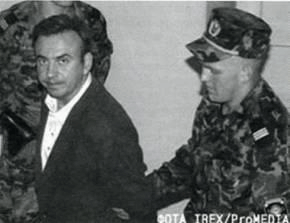 The first of these, in 1999, was the sudden interruption of the research work of Yuri Bendazhevsky, and his arrest and imprisonment for “activities threatening state security”.
The event provoked an international movement of support and call for his release, which paradoxically gave world visibility to his research results—results that contradict the optimistic appraisals of the health consequences of the Chernobyl accident published by international organizations.
The nuclear industry understands the impact of nuclear disasters to be the effect of a single event like an explosion of a reactor. Only those who die or are effected during that time frame are categorized as attributable to the disaster.
However, other scientists, citing fundamental scientific knowledge about the genesis of cancer, understand the disease as a multi-stage process. If not merely external irradiation but also internal contamination at the level of a given organ is taken into account as relevant to the cancer process, it becomes necessary to attend to the effects of two types of exposure: extremely brief exposure of the entire body – termed acute exposure – and extremely low doses from point sources that hit very near target organs over a long period of time – chronic exposure -but vary in terms of internal movements and whether the organism responds by retaining or purging itself of inhaled or ingested radioactive particles.
This video does a great job of explaining the different sides to the argument. Which side do you believe?
http://vimeo.com/33724891
Text citation: http://www.lit.kobe-u.ac.jp/philosophy/images/pdf/Paul_JOBIN/ThebaudMony-PrefaceEnglishEd.pdf
No comments yet.
1 This Month

of the week – Shut Down Drone Warfare!


Tell the Ukrainian Government to Drop Prosecution of Peace Activist Yurii Sheliazhenko

Petition to revoke the licensing of the Near Surface Nuclear Disposal Facility (NSDF) at Chalk River. https://www.ourcommons.ca/petitions/en/Petition/Details?Petition=e-7247
To see nuclear-related stories in greater depth and intensity – go to https://nuclearinformation.wordpress.com
-
Archives
- March 2026 (237)
- February 2026 (268)
- January 2026 (308)
- December 2025 (358)
- November 2025 (359)
- October 2025 (376)
- September 2025 (257)
- August 2025 (319)
- July 2025 (230)
- June 2025 (348)
- May 2025 (261)
- April 2025 (305)
-
Categories
- 1
- 1 NUCLEAR ISSUES
- business and costs
- climate change
- culture and arts
- ENERGY
- environment
- health
- history
- indigenous issues
- Legal
- marketing of nuclear
- media
- opposition to nuclear
- PERSONAL STORIES
- politics
- politics international
- Religion and ethics
- safety
- secrets,lies and civil liberties
- spinbuster
- technology
- Uranium
- wastes
- weapons and war
- Women
- 2 WORLD
- ACTION
- AFRICA
- Atrocities
- AUSTRALIA
- Christina's notes
- Christina's themes
- culture and arts
- Events
- Fuk 2022
- Fuk 2023
- Fukushima 2017
- Fukushima 2018
- fukushima 2019
- Fukushima 2020
- Fukushima 2021
- general
- global warming
- Humour (God we need it)
- Nuclear
- RARE EARTHS
- Reference
- resources – print
- Resources -audiovicual
- Weekly Newsletter
- World
- World Nuclear
- YouTube
-
RSS
Entries RSS
Comments RSS
 nuclear-news
Leave a comment