Riot police attack Kudankulam anti nuclear protestors
 Indian riot police attack 4000 nuclear protesters, Examiner SLIDESHOW SEPTEMBER 10, 2012 BY: DEBORAH DUPRE Saturday and Sunday, Indian riot police opened fire one group and assaulted thousands of others with tear gas, mainlywomen and children on the beach protesting Kudankulam Nuclear Power Project (KNPP), the country’s largest nuclear power facility, due to fire up soon. By late Sunday, there was one dead and many injured as police began rampaging homes of protesters.
“A large riot-gear bedecked police force is in the frontline facing the people, and tear gas lobbers are apparently on stand-by,” a human rights defender informed Counter Currents Sunday morning.

“Police are intimidating people by moving closer, swaying batons,” Dr. S P Udayakumar at the scene texted in an SMS at 11:30 a.m. “Thousands of women and children are here. Officials threatened with naval intervention. Situation is very tense and dangerous. We need your appeals to the governments.”
Koodankulam anti nuclear protest – in photos
20,000 Villagers Occupy Koodankulam Nuclear Power Plant
http://www.salem-news.com/articles/september102012/india-koodankular-jjs.php
 PHOTOS Joseph John Sunder Special to Salem-News.com Includes timeline of events unfolding in India.
Special thanks to countercurrents.org (CHENNAI Countercurrents) – More than 20,000 villagers have put the Koodankulam nuclear power plant under siege to protest fuel loading in preparation for the commissioning of the plant. More than 4000 police personnel, including Rapid Action Force (RAF), are deployed around the plant. People are camping in front of the nuclear plant and refuse to go back to their homes.
Here are the days events as it happened -…..
Dispelling the myths of the pro nuclear astroturfers
 The top ten common myths of the nuclear cheerleaders, daryanenergyblog, “……Myth I – The Fukushima accident is a “Triumph” of nuclear technology, it proves it works safely – Reality: It raises some important questions about aspects of nuclear safety
Myth II – Only 56 people were killed by the Chernobyl accident – Reality: The death toll from Chernobyl was many times higher, in the thousands or possibly tens of thousands
Myth III – Radiation isn’t that dangerous at all, it’s over exaggerated by the media, why the impact of Chernobyl was no worse than a few dozen chest x-rays each, and TMI was no worse than you’d get eating a banana – Reality: The effects of radiation from artifical sources is potentially quite serious
Myth IV – Nuclear power is cheaper than any of the alternatives – Reality: Its actually more expensive than most of the alternatives!
Myth V – But we can’t rely on renewables, because of their intermittent nature – Reality: Nuclear power has its own issues with intermittency
Myth VI – there’s plenty of fissile material in the world – Reality: While no immediate supply problems are anticipated, ultimately the world’s stockpiles of fissile material are limited in scale
Myth VII – We can’t build Renewables fast enough only nuclear power plants can be built quickly enough to prevent climate change – Reality: The current build rate of nuclear power stations is a small fraction of the annual build rate of renewables, even the maximum ever build rate of NPP’s in the 70′s is still exceeded by the currrent build rate of renewable systems
Myth VIII – Yes, you’ve highlighted several problems but you see once we get these new fast reactors working all these problems will be solved – Reality:Fast-reactors are a failed series of white elephants that are unlikely to ever work
Myth IX – All these problems will be solved when we develop Fusion, which will happen in the near future – Reality: While we’re making progress, its far to early to say when Nuclear Fusion will become commercially viable….if ever!
Myth X – Disposal of nuclear waste is easily solved, indeed we’ve already sorted it out – Reality: While there are options available, the nuclear industry is not pursing them, this is leading to a gradually worsening problem which needs to be tackled soon
Stop press, Bonus feature! Myth XI – We need to use MOX and reprocessing to stop Terrorists getting their hands on Plutonium in the future – Reality: This statement merely shows how out of touch the nuclear industry is….with reality! http://daryanenergyblog.wordpress.com/2011/04/02/the-top-ten-common-myths-of-the-nuclear-cheerleaders/
Police shoot dead an anti nuclear fisherman in Southern India
One killed in India nuclear plant protest http://www.heraldsun.com.au/news/breaking-news/one-killed-in-india-nuclear-plant-protest/story-e6frf7k6-1226471469932 From: Herald Sun, AFP September 11, 2012 POLICE have shot dead a fisherman during a mass protest against the loading of uranium at a nuclear power plant in southern India.
Steel-helmeted officers ringed one of two 1000-megawatt nuclear reactors in Tamil Nadu state’s Koodankulam region as hundreds of activists tried to lay a siege of the Russia-backed project, television footage showed.
The protests then spread and a 48-year-old fisherman was killed when police opened fire at activists staging another rally in the nearby Tuticorin district, according to a report by the Press Trust of India.
“A number of people including police personnel have received injuries in the clashes,” another officer said while TV footage showed anti-riot personnel chase some of the activists, including women, into the nearby sea.
Monday’s violence comes six months after a lull in protests at the plant, which campaigners say could endanger the lives of locals in the case of a nuclear disaster.
The Press Trust of India said the new protests were in opposition to the loading of enriched uranium in the plant’s reactor…..
Since Fukushima, Indian activists have also campaigned to stop work scheduled to start in 2013 at Jaitapur in western Maharashtara state which would be one of the world’s biggest nuclear facilities.
Nuclear energy has been a priority for India since 2008 when then-US president George W. Bush signed into law a deal with New Delhi that ended a three-decade ban on US nuclear trade with the country.
Since then, France, Russia and private US and Japanese firms have been locked in fierce competition to sell new reactors to India.
The world’s most dangerous nuclear reactor – Monju, Japan
Problem plagued nuclear reactor called world’s most dangerous via ABC News, The Atomic Age, May 2012 http://lucian.uchicago.edu/blogs/atomicage/2012/09/10/problem-plagued-nuclear-reactor-called-worlds-most-dangerous-via-abc-news/
Japan’s Monju nuclear reactor was supposed to be a model of power generation in the future, but it’s had many problems and in two decades it’s only generated one hour’s worth of electricity.
EMMA ALBERICI, PRESENTER: It’s supposed to be the future of nuclear power generation, a reactor that produces its own fuel in a self-sustaining cycle. Known as Monju, the reactor on the country’s west coast is held up as the saviour of a nation without energy resources. But Monju has been plagued with problems and many call it the most dangerous reactor in the world. In part two of his series on Japan’s so-called nuclear alley, North Asia correspondent Mark Willacy was given an exclusive look inside Monju.
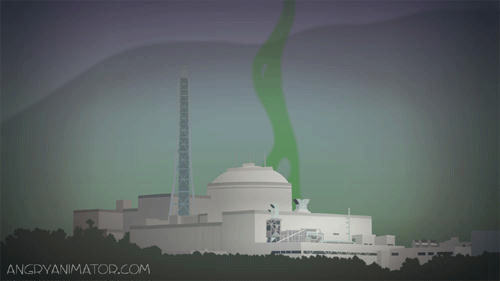
MARK WILLACY, REPORTER: People frolic in its shadow, a reactor its critics call the most dangerous in Japan. The name Monju comes from one of Buddha’s chief attendants, a purveyor of enlightenment depicted resting on the back of a lion, a beast whose phenomenal powers are controlled only by Monju’s wisdom.
But opponents of this prototype reactor fear its operators do not have the wisdom to harness its enormous energy.
KEIJI KOBAYASHI, FAST-BREEDER REACTOR EXPERT (voiceover translation): If a meltdown happens, it will get out of control very quickly. If the reactor core was to melt, the explosive energy would produce a blast like a nuclear bomb.
FUKIKO IKEJIMA, ‘STOP MONJU’ GROUP (voiceover translation): If a big accident were to happen, the impact would not stop in Japan, but spread around the world. It is our most dangerous reactor.
MARK WILLACY: And this is one of the reasons many Japanese fear Monju, because it uses sodium to cool a reactor, the substance that can ignite upon contact with oxygen. In 1995, a sodium leak at Monju caused a serious fire, one that resulted in the plant being out of operation for 15 years.
Lateline was given an exclusive tour of Monju, including an interview with the plant’s director-general, Satoru Kondo.
Continue reading at Problem plagued nuclear reactor called world’s most dangerous
Japan – no blackouts despite nuclear power almost completely shut down

 No summer blackouts: nuclear scaremongering in Japan proven false http://www.greenpeace.org/international/en/news/Blogs/nuclear-reaction/no-summer-blackouts-nuclear-scaremongering-in/blog/42057/
by Justin McKeating – September 10, 2012 Despite the dire warnings from the nuclear industry and its backers, Japan’s hot summer has passed with no power blackouts or shortages even though just two out of its 50 nuclear reactors were in operation. Continue reading
UK National Nuclear Laboratory says Thorium nuclear reactors risky
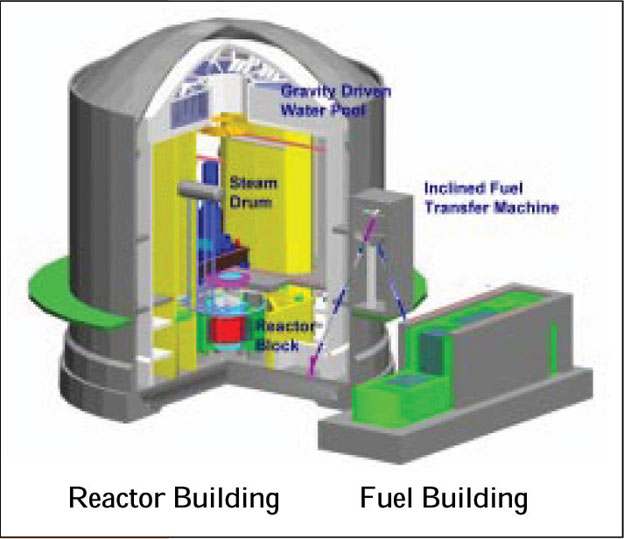 The Thorium Fuel Cycle – Summary An independent assessment by the UK National Nuclear Laboratory Summary NNL believes that the thorium fuel cycle does not currently have a role to play in the UK context, other than its potential application for plutonium management in the medium to long term and depending on the indigenous thorium reserves, is likely to have only a limited role internationally for some years ahead.
The technology is innovative, although technically immature and currently not of interest to the utilities, representing significant financial investment and risk without notable benefits. In many cases, the benefits of the thorium fuel cycle have been over-stated.
http://www.nnl.co.uk/media/27860/nnl__1314092891_thorium_cycle_position_paper.pdf
Thorium’s radioactive fission products
 the fission products from a Thorium reactor are a worry, Technetium-99 has a half life of 220,000 years, uranium-232 produces thallium-208 (a nasty wee gamma emitter), Selenium-79 (another gamma emitter with a 327,000 year half-life), evenThorium-232 is a problem with its half life of 14 Billion years (and while the T-232 isn’t a major worry, all the time during this 14 Billion years it will be decaying and producing stuff that is!).
Thorium Cycle questions and problems http://daryanenergyblog.wordpress.com/ca/part-8-msr-lftr/8-3-thorium-lftr/ Questions have also been raised by some nuclear scientists about the Thorium cycle, in particular the proposed one that the LFTR would use. I’m not a nuclear physicist so I’ll merely forward you on to the relevant paper here , and a rebuttal here . The crux of the argument seems to be the proliferation risk (I’ll come back to that one later), the fact that a number of its spend fuel outputs (such as Technetium-99) are “nasty stuff” with a long half life and the fact we’ll still need supplies of Uranium to get Thorium reactors going again whenever we have to turn it off (which will happen at least once a year or so during its annual maintenance shutdown). They also highlight a number of technical issues, which I discussed in the chapter on HTGR’s. Continue reading
Our uranium fuelled Fukushima – an Australian expresses shame
Australian uranium is now radioactive fallout that is contaminating Japan and beyond — but the response of the Australian government, Australian uranium producers and their industry association has been profoundly and shamefully deficient. Prime Minister Gillard speaks of business as usual, Resources Minister Martin Ferguson talks of the ‘unfortunate incident’ and the more bullish of the uranium miners have called the crisis a ‘sideshow’.
Fukushima and Australia’s uranium shame INDEPENDENT AUSTRALIA 11 September 2012 marked 18 months since the Fukushima crisis began. Dave Sweeney has just been to the radiation exclusion zone and is horrified by what he’s seen.
The signs that all is not as it was or should be start gently enough: weeds appear in fields, the roadside vegetation covers signs and structures and there are few people about. The country looks peaceful, green and sleepy — then the radiation monitor two seats away wakes up and starts clicking…..
Fukushima means ‘fortunate island’ ― but the region’s luck melted down alongside the reactor. Over 150,000 people cannot return to their homes and last September a United Nation’s special report detailed some of the massive impacts: ‘hundreds of billions of dollars of property damage’, ‘serious radioactive contamination of water, agriculture , fisheries’ and ‘grave stress and mental trauma’ to a swathe of people. Lives have been utterly disrupted and altered and the Fukushima nuclear accident was and remains a profound environmental and social tragedy…….
An earnest teacher is happy that the local school has re-opened, but sad that while once around two hundred and fifty kids used to attend, now there are sixteen. The local Mayor picks up the theme stating ‘we have very few young people or children’. Radiation hits hardest at growing cells and many parents are understandably concerned and have moved. The old remain and, in the absence of the young, the old look older. Continue reading
Pro Thorium astroturf pervading cyberspace
George Monbiot bites Thorium bait http://www.joabbess.com/2011/05/10/george-monbiot-bites-thorium-bait/ May 10th, 2011 Jo
George Monbiot in his new role as an apologist for the twice-bailed-out-of-insolvency British Nuclear Power industry, has now taken the Thorium bait, quite probably the most well-funded piece of astroturfing propaganda in existence…
Nuclear industry says it will take 40 years to decommission Fukushima nuclear reactors
It will take 40 years, the nuclear industry says, to decommission the reactors. (Not the 6 months the industry claimed would be required to bring the “slightly damaged” reactors back online.)
Slow progress containing problems at Fukushima, new ones arise http://nuclearhistory.wordpress.com/2012/09/11/slow-progress-containing-problems-at-fukushima-new-ones-arise/ September 11, 2012 The Asahi Shimbun Japan By TAKASHI SUGIMOTO/ Staff Writer The operator is having difficulty pumping water into destroyed reactors at the Fukushima No. 1 plant, tanks are rapidly filling with radioactive water, and hundreds of potentially volatile uranium fuel assemblies remain in a precarious storage pool that some warn could collapse in another strong earthquake. Continue reading
Cesium found in deep subsea mud along West coast of Japan
 Asahi: “Significant quantity” of cesium detected along West Coast of Japan — Concentrations rise as it gets deeper http://enenews.com/asahi-significant-quantity-of-cesium-detected-along-west-coast-of-japan-concentrations-rise-as-it-gets-deeper
September 11th, 2012 By ENENews
Title: Radioactive fallout detected far from Fukushima
Source: Asahi Shimbun
Author: NOBUTARO KAJI
Date: September 11, 2012
A significant quantity of radioactive cesium, likely from the crippled Fukushima No. 1 nuclear power plant, has turned up in subsea mud about 200 kilometers away, near the mouth of the Shinanogawa River on Japan’s northwestern coast.
Scientists said samples taken in 2011 at Nagaoka, Niigata Prefecture, contained concentrations of up to 460 becquerels per kilogram of dry mud
[…]
The highest concentration was 2-3 cm below the mud surface at a water depth of 30 m. That reading of 460 becquerels per kg compares to samples of over 400 becquerels around the mouth of the Arakawa river in Tokyo Bay in August 2011.
Both readings are dozens of times higher than contamination detected after past atmospheric nuclear tests.
At a depth of 20 m the maximum concentration was 318 becquerels per kg, while at 15 m it was 255 becquerels.
[…]
Radiation load on Fukushima cleanup workers
Tepco admits it will run out of workers in 5 years unless a way is found to reduce radiation exposure (VIDEO) http://enenews.com/nhk-tepco-says-it-will-run-out-of-help-in-5-years-unless-it-finds-a-way-to-reduce-workers-radiation-exposure-video
September 11th, 2012 By ENENews
Title: One and half years after Fukushima accident
Source: NHK WORLD English
Date: Sep. 10, 2012
“Tepco managers have had a tough time attracting workers. They say they will run out of help in 5 years unless they can find a way to reduce workers’ exposure to radiation.” -NHK Transcript
One and a half years have passed since the accident at the Fukushima Daiichi nuclear power plant. Tokyo Electric Power Company has many problems to overcome before achieving its promise to decommission the crippled plant in about 40 years.
[…]
TEPCO also wonders if it can secure enough workers for the next 5 years. It said it will see a shortage of workers unless it finds ways for them to avoid exposure to radiation.
Cesium increasing in Tochigi environment
Cesium from incineration ash of normal garbage is not decreasing in Tochigi, Fukushima Diary by Mochizuki September 10th, 2012 · It has been 16 months since 311, but still high level of cesium is found in incineration ash of normal garbage. It means a certain amount of cesium is still coming from Fukushima. Other nuclides are not analyzed.
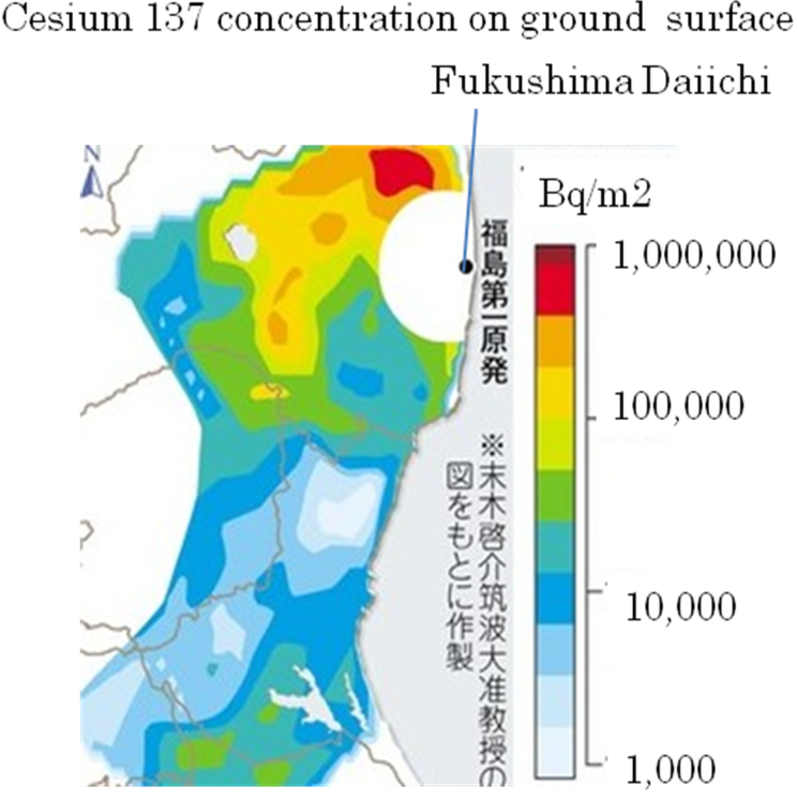
From the beginning of 2012, cesium from incineration ash is not decreasing in Ashikaga city, Tochigi. (185km from Fukushima) As the whole ecosystem, cesium is being accumulated in the environment.
On 8/30/2012, Ashikaga city government published the data of cesium detected from incineration ash. The incineration ash is not from disaster debris, only from normal garbage.
The cesium (Cs-134/137) amount in the total of fly ash and incineration ash is like below…… http://fukushima-diary.com/2012/09/cesium-from-incineration-ash-of-normal-garbage-is-not-decreasing-in-tochigi/#.UE4am9o5ekc.facebook
Kawasaki city serves students radioactive lunches
Kawasaki city mayor, “School serves radioactive lunch for educational
purpose.” http://fukushima-diary.com/2012/09/kawasaki-city-mayor-school-serves-radioactive-lunch-for-educational-purpose/#.UE6PhZVElhg.facebook by Mochizuki on September 10th, 2012 · Schools keep serving contaminated lunch for the students and they
don’t even solve the problem. (cf. Cesium from finished school lunch in Miyagi) Continue reading
-
Archives
- February 2026 (199)
- January 2026 (308)
- December 2025 (358)
- November 2025 (359)
- October 2025 (376)
- September 2025 (258)
- August 2025 (319)
- July 2025 (230)
- June 2025 (348)
- May 2025 (261)
- April 2025 (305)
- March 2025 (319)
-
Categories
- 1
- 1 NUCLEAR ISSUES
- business and costs
- climate change
- culture and arts
- ENERGY
- environment
- health
- history
- indigenous issues
- Legal
- marketing of nuclear
- media
- opposition to nuclear
- PERSONAL STORIES
- politics
- politics international
- Religion and ethics
- safety
- secrets,lies and civil liberties
- spinbuster
- technology
- Uranium
- wastes
- weapons and war
- Women
- 2 WORLD
- ACTION
- AFRICA
- Atrocities
- AUSTRALIA
- Christina's notes
- Christina's themes
- culture and arts
- Events
- Fuk 2022
- Fuk 2023
- Fukushima 2017
- Fukushima 2018
- fukushima 2019
- Fukushima 2020
- Fukushima 2021
- general
- global warming
- Humour (God we need it)
- Nuclear
- RARE EARTHS
- Reference
- resources – print
- Resources -audiovicual
- Weekly Newsletter
- World
- World Nuclear
- YouTube
-
RSS
Entries RSS
Comments RSS
 nuclear-news