The past week in nuclear news

Christina Macpherson’s websites & blogs
Japan’s government wrestles with its future energy policy, not yet decided. Very worrying reports keep coming out about the still dangerous state of the Fukushima nuclear reactors, and the anxious plight of Fukushima area residents.
Pakistan – a scare, as police report on afoiled (this time) attempt by suicide bombers to attack a nuclear facility.
India. Kudankulam anti nuclear movement continues their struggle, with legal cases to come.
USA. Nuclear Regulatory Commission to develop a new “Waste Confidence Rule” – (means they think that nuclear power could go ahead, because they believe that a waste disposal solution will be found, one day, ). Obama and Romney have different policies on renewable energy promotion – Obama basicall FOR, Romney AGAINST.
France – had a minor nuclear reactor incident – but not inspiring public confidence in the industry.
Savannah River Nuclear Bomb Plant – home of Radioactive Racism

 Race and Radiation: The Equal Opportunity Killer at the Savannah River Site DC Bureau By Joseph Trento, September 6th, 2012 The old Atomic Energy Commission did not give much thought to where they were going to put their new nuclear weapons processing plant in the 1950s other than it needed to be on the other side of the country from their World War II era facility in Hanford, Washington…..
At SRS, five reactors, two separation plants, thousands of miles of pipes and high level nuclear waste storage facilities were built on what amounts to a swamp with the worst earthquake fault in the South running under it. Towns were relocated and the orchards, hunting and fishing grounds that sustained the lives of poor residents were taken over by a country fighting a new kind of war – a cold war. The reactors were built five miles apart so if the Soviets attacked one, the others could survive and keep producing plutonium. Production wastes – deadly to humans – were buried in cardboard boxes in open trenches.
The ugliest of America’s nuclear weapons history is the cavalier way in which the old Atomic Energy Commission and later Department of Energy management allowed African American workers to be deliberately exposed to radiation at the sprawling Savannah River Site while sparing white workers from the same dangers. Continue reading
The USA nuclear industry is to get a new Waste Confidence Rule

USA to get another “Waste Confidence Rule”?
The Appeals Court ruled that the NRC should have considered the potential environmental effects in the event a permanent repository for disposing of spent fuel …. is never built
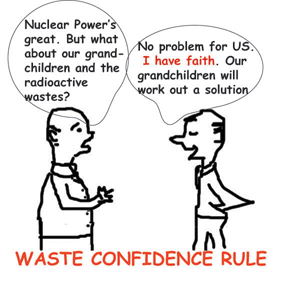
NRC staff to review nuclear reactor waste storage rules http://www.reuters.com/article/2012/09/06/us-utilities-nrc-waste-idUSBRE88515T20120906 by Scott DiSavino, Sep 6, 2012 (Reuters) – The U.S. Nuclear Regulatory Commission (NRC) directed its staff on Thursday to start an environmental review into the temporary storage of spent nuclear fuel, following a court ruling that led the agency to stop issuing new reactor licenses. Continue reading
Suicide bombers aimed for Pakistan nuclear plant

 Three would-be nuclear power plant assaulters killed in Bhakkar blast: Police http://tribune.com.pk/story/432428/3-killed-as-explosives-go-off-in-bhakkar-house/ By Owais Jafri September 6, 2012 PUNJAB: Police recovered bodies of three suicide bombers from a building near the border of Bhakkar district about 30km away from a nuclear plant in Garot, Khushab district on Thursday. The men, DPO Saifullah Khan Khattak said were terrorists and were planning to attack the nuclear plant.
The bodies were recovered from a devastated building next to a mosque in the village 46 D/B of Ali Khel area near the Bhakkar border. The area is deserted and the mosque and the building served as temporary residence for travellers.
Police officials estimated that the terrorists may have had more companions who had left the area before the police arrived as footprints of more than 12 people along with tracks of heavy vehicles could be seen at the site of the incident.
Police had arrived at the spot almost 11 hours after there were reports of a blast and had initially denied the reports. They had blamed the media for propagating terror in the area, but later confirmed the blast.
According to details, the terrorists were killed when three suicide jackets, each carrying 0.5 kg of explosives, went off as they were planning to leave their temporary residence.
Police have identified two of the terrorists as Mawia Tariq and Omar Irfan, both belonging to Mandi Bahauddin, and have shifted the bodies to DHQ Bhakkar for post mortem.
Investigations are under way to trace the companions of the terrorists and security has been tightened at all entrances of Bhakkar and Khoshab.
Earlier, intelligence reports had suggested that the Taliban were planning an assault on the nuclear power plant in Khushab, following which security around the plant had been beefed up.
The very real threat of nuclear terrorism in Pakistan
Nuclear safety http://tribune.com.pk/story/432507/nuclear-safety/ The Express Tribune, September 7th, 2012. The scenario drawn up by think-tanks in the US, of Pakistan’s nuclear weapons falling into militant hands, may just be more real than we think. This, of course, is a terrifying thought. So far, the possibility of such an event has been dismissed at home — but the high-level security alert put in place around Dera Ghazi Khan and the large-scale nuclear facility there, engaged mainly in mining and processing uranium, should force us to think otherwise.
The local police chief of Dera Ghazi Khan, Chaudhry Saleem, has confirmed that a heavy contingent of police and army personnel has been placed around the facility after the ISI intercepted a telephone call suggesting an attack was planned on the site housing nuclear material. Experts point out that these kinds of conversations picked up by intelligence agencies have proved to be accurate in the past.
It is also a fact that just weeks ago, a daring attack was made on the Kamra air base, which also houses our nuclear assets. The ability of the militants to enter high-security facilities is terrifying. It appears that in the latest case, the attacks are intended to act as revenge for the death of Abdul Ghaffar Qaisarani, killed in an encounter with the Dera Ghazi Khan police some time ago. Information about Qaisarani’s whereabouts had apparently come after the capture of other terrorists.
What is alarming, though, is the fact that key nuclear installations are becoming definite targets of the Tehreek-e-Taliban Pakistan (TTP). Despite the death of Qaisarani, which weakened the TTP considerably in the area, it is said to have been able to regroup, and in some parts of southern Punjab, is stated to be growing stronger and more dangerous. This also raises questions about why more action was not taken in the past to defeat the TTP in Punjab and prevent the southern part of the province from becoming what many say is a safe haven for militants — no less so than the tribal areas in the north. It has become essential that we deal with the pockets where extremist groups gather. The possibility of nuclear weapons somehow falling into their hands is one we simply cannot afford. We appear to be getting closer to this horrific reality by the day.
Obama promotes renewable energy markets, Romney opposes them
The candidates differ markedly, though, when it comes to creating a market for new energy technology. Obama supports policies that would create markets for new technologies, and Romney, by and large, doesn’t.
Romney… opposes a number of policies designed to create markets for new energy technology.
 Energy Innovation Under Romney and Obama Both candidates say they support renewable energy. Romney, though, would do little to create markets for it. Technology Review, KEVIN BULLIS , September 6, 2012 The energy positions of the presidential candidates and their respective parties have come into focus more sharply over the last two weeks. The Republicans and Democrats have both published their platforms, and the Republican nominee, Mitt Romney has published his energy plan.
For campaigns that have been at each other’s throats on many issues, there’s a surprising overlap between the rhetoric of Romney and President Obama on energy—both favor “all-of-the-above” approaches that include domestic energy sources such as fossil fuels and renewable energy. Both support funding energy research and development through organizations such as the Advanced Research Projects Agency for Energy (ARPA-E). Both talk up the possibility of energy independence, and bewail the inability of every president since Richard Nixon to achieve it. Continue reading
Obama campaign sets sights on renewable energy, energy efficiency
 Renewable Energy Is Obama Goal for Next Term, Aide Says , Bloomberg, By Kasia Klimasinska – Sep 6, 2012 President Barack Obama ’s effort to develop renewable power sources and persuade Congress to adopt a long-term energy policy will be priorities should he win a second term, his top climate and energy aide said.
Clean-energy programs and efficiency initiatives will be a focus for the president if he’s re-elected in November, Heather Zichal , Obama’s deputy assistant for energy and climate change, told reporters today in Washington .
“The big issue will remain engagement with Congress,” she said. “The president has talked continuously about the need for a long-term energy policy, and I think that will be something that he will obviously remain focused on in the second term.” As a candidate in 2008, Obama pledged to create 5 million green jobs over 10 years by investing in renewable sources such as solar and wind power. He promoted alternatives to fossil fuels as a way to cut U.S. dependence on imported fuel. The 2009 economic-stimulus plan spent a record $90 billion on clean energy, creating 225,000 green jobs after one year, according to the White House…. http://www.bloomberg.com/news/2012-09-06/renewable-energy-is-obama-goal-for-next-term-aide-says.html
Challenge to Florida law, letting nuclear companies screw the residents in advance
 Southern Alliance for Clean Energy Looking to Fight Off Rising Nuclear Power Costs for FPL Customers New Times, By Chris Joseph Sep. 6 2012 In 2006, the undaunted geniuses in the Florida Legislature came up with the Florida Renewable Technology and Energy Efficiency Act, a shady law that basically gives utility companies like FPL and Progress Energy Florida permission to charge customers for something that might be built or fixed, without even having to reimburse the customer if they decide, meh, that nuclear power plant doesn’t need to be built or fixed after all… Ah well! But hey, thanks for the extra two bucks on that electric bill, yo!
The Southern Alliance for Clean Energy filed a Florida Supreme Court challenge to the law , saying that the statute is a tad too fuzzy and vague and gives utility companies too much free reign to go building (or not building) nuclear reactors willy-nilly at customers’ expense.
Meanwhile, FPL is now asking for $151.4 million to upgrade nuclear plants in St. Lucie as well as the plant in Turkey Point….
PEF customers might get screwed a little harder, with the company requesting $151.6 million for an upgrade at its Crystal River nuclear plant as well as a new plant in Levy County, which would add nearly $5 per monthly bill.
The Florida Public Service Commission held a hearing on Wednesday to determine if customers should be footing the bill for unbuilt, unfixed nuclear power plant projects.
The commission held off PEF on getting their grubby mitts on $9 million in repairs for the Crystal River plant, which has been just a giant stone thing sitting there doing nothing since 2009. PEF hasn’t even decided if it wants to rebuild the plant or just shut it down completely, yet there it is, asking for 9 mil like it’s loose change in Florida’s cup holder.
On July 10, the Office of Public Counsel called in consultant William R. Jacobs to testify that the Turkey Point plant upgrade costs have ballooned to more than half a billion dollars in the past 14 months. Jacobs also said that costs have been hidden because they are mixed in with other projects.
Think of it like a giant Reece’s peanut butter cup made of your money. Feel better now?….. http://blogs.browardpalmbeach.com/pulp/2012/09/nuclear_cost.php
“It is now clear that the Turkey Point EPU project is on a runaway course of its own, the extent of which is being buried by FPL’s composite approach,” Jacobs said.
Poor outlook for Romney’s energy plans
Romney’s energy plans don’t bode well for future, Sun Sentinel, September 6, 2012 Mitt Romney has officially given up on the future. At least, that’s the way it looks from the energy plan he released last month. Continue reading
TEPCO against developing renewable energy
Japan utility behind nuke crisis says can’t afford to develop renewable energy, WP, By Associated Press, September 6 The head of the Japanese utility that owns the tsunami-hit Fukushima nuclear power plant said Thursday that he believes nuclear power should be part of the country’s energy mix, even though the government and the public seem to feel differently.
COST CONCERNS: Naomi Hirose, president of Tokyo Electric Power Co., also said the utility can’t afford to invest in alternative energy since the earthquake-tsunami crisis last year, which wiped out the Fukushima Dai-ichi plant and caused extensive radioactive
meltdowns….. http://www.washingtonpost.com/business/japan-utility-behind-nuke-crisis-says-cant-afford-to-develop-renewable-energy/2012/09/06/e1b943a8-f84c-11e1-a93b-7185e3f88849_story.html
Savannah River nuclear site – killer radiation and coverup
 Race and Radiation: The Equal Opportunity Killer at the Savannah River Site DC Bureau By Joseph Trento, September 6th, 2012 “……The multiple lawsuits and harsh criticism of its practices have not seemed to stop some at SRS. …..
While some SRS management discriminates against black workers, the reality is everyone in the region – regardless of color – have been misled about the dangers at the Site. South Carolina and Georgia politicians used the conservative and patriotic culture to make sure the health effects at SRS received no serious monitoring.
The local hospitals and doctors did not establish tumor registries, and local physicians never spoke out about the effects of the plant on workers and residents. Like any other company town, Aiken and the surrounding communities did not dare challenge a federal government agency that provided high-paying jobs and enriched the communities with contributions and donations…..
with the money came unspoken danger. Unannounced radiation releases into the air exposed children to the most toxic nuclear materials on a regular basis during the 1950s and 1960s. Local officials and residents made no effort to ask questions about what went on at SRS. As a result, today SRS is the most radioactively contaminated single site in the world. Though a Superfund Site, the EPA has no legal power to stop the National Nuclear Security Administration from creating more high-level nuclear waste. The NNSA continues to amass more high-level waste every day at SRS. Since the Yucca Mountain nuclear storage facility was abandoned, SRS has become the de facto high-level nuclear waste dump for the United States.
In recent weeks, the DOE-appointed Citizens Advisory Board that does “outside environmental monitoring” at the Site has shown signs of abandoning its traditional DOE rubber stamp role and began asking hard questions that had been reserved for environmental critics of SRS. The reality that radioactivity cannot be mitigated, just segregated and stored for the thousands of years it takes to decay, makes the entire Savannah River Site and the communities near it what former DOE official Robert Alvarez says is “a national sacrifice zone.”
Even South Carolina area political officials who have run for office again and again on the vast amounts of federal aid and contractor monies they enjoy are beginning to understand that the state’s reputation as a retirement haven may be less attractive if future retirees are reluctant to purchase homes adjoining the largest high-level waste nuclear dump site in the United States. The increased publicity and wariness toward SRS is making retirement and second homes from Aiken to Hilton Head less appealing.
As the troubled history of SRS becomes more personal to people in the surrounding communities, the acceptance of DOE’s continued pollution may become politically untenable.
“We were basically revisiting what transpired 46 years ago and yet this story is still being told again and it’s still a tragic story,” Richard Lindsay said. “The same elements are there. These are human beings whose lives are being affected and yet there are other people who seem to be indifferent to it. Sometimes I just get a sense that people don’t get it.” http://www.dcbureau.org/201209067618/national-security-news-service/race-and-radiation-the-equal-opportunity-killer-at-the-savannah-river-site.html
Dishonest smear on renewable energy in Republican claims about Solyndra
Five things you should know about Solyndra http://reneweconomy.com.au/2012/five-things-you-should-know-about-solyndra-during-the-2012-campaign-77889 By Stephen Lacey 7 September 2012 One year ago today, the solar manufacturer Solyndra filed for bankruptcy after receiving a $527 million loan guarantee. The bankruptcy set off a political firestorm in Congress, and eventually worked its way into the presidential campaign.
Today, the Republican party is using Solyndra as a key tool in its campaign against Obama —smearing the entire clean energy industry in the process.
If you’ve been paying attention to the issue over the last year, you’ve likely heard the name “Solyndra” so many times it makes you nauseous. But most Americans are only now paying attention to the campaign, so it’s likely that many are hearing the name for the first time. If you’re wondering what the GOP claims on Solyndra are all about, here are some facts to put the issue in context:
1. The loan guarantee program supporting Solyndra has been a success Continue reading
Public to pay upfront nuclear costs? Florida Public Service Commission hearing
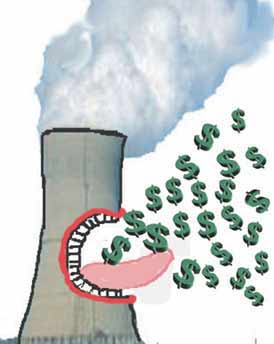 Florida regulators holding nuclear costs hearing By Bill Kaczor on September 06, 2012 Businessweek Bloomberg TALLAHASSEE, Fla. (AP) — The Florida Public Service Commission opened a hearing Wednesday on whether to pass the costs of incomplete nuclear power plant projects to customers of the state’s two largest electric utilities but decided immediately to delay action on a request from Progress Energy Florida and soon went into recess.
The panel heard a single Florida Power and Light Co. witness, who was taken out of order due to a scheduling conflict, before recessing the hearing until Monday, when FPL and consumer advocates will make their opening statements. FPL is a unit of NextEra Energy Inc.
FPL, the larger of the two utilities, is seeking $151.5 million to upgrade existing facilities at its St. Lucie plant and add two new reactors to its Turkey Point plant……
Utilities historically were not allowed to pass on power plant construction costs until those facilities went into service, but the Legislature made an exception for nuclear facilities in 2006 to encourage the development of that form of energy.
Consumer advocates and nuclear opponents argue that consumers may wind up paying for facilities that never get built. http://www.businessweek.com/ap/2012-09-06/florida-regulators-holding-nuclear-costs-hearing
Lynas rare earths gets temporary license, but strong opposition persists
 Protests Promised Over License for Malaysia Rare Earth Plant NYT, By LIZ GOOCH KUALA , 6 Sept, LUMPUR — Activists who have waged a lengthy campaign against a rare earth refinery in Malaysia refused to back down Thursday after the authorities gave the Australian company behind the project the green light to proceed.
One group has vowed to blockade the port in the Malaysian town of Kuantan, near the plant, if the company, Lynas, tries to import raw earth materials from Australia.
“We are prepared to paralyze the whole port until the raw materials leave our port,” said Wong Tack, chairman of the group, Himpunan Hijau. “The world will witness one of the biggest civil disobedience events in this nation.”…. Lynas said that it would address the “principal cause of the community anxiety” — what to do with the radioactive byproducts from the plant — by turning the material into “processed co-products” for use mainly in manufacturing, like materials for roads and buildings. The materials would be exported, the company said. The company’s statement did not say to which countries it might export the products……
activists are not satisfied that the plant, estimated to cost 2.5 billion ringgit, or $802 million, will be safe.
“We will not allow an ounce of raw material to reach our shores,” said Mr. Wong, adding that Himpunan Hijau would recruit “thousands of people” to block the port 24 hours a day when the raw earth material arrived.
“We need to send the strongest warning to Lynas — don’t even dream about operation. This is an all-out war,” he said.
Another group, Save Malaysia Stop Lynas, said it was considering filing for a court injunction to try to stop the plant from operating.
Tan Bun Teet, the group’s chairman, said Save Malaysia Stop Lynas had already obtained leave from the courts for a judicial review of both the Atomic Energy Licensing Board’s approval of the temporary operating license and of the decision by the minister of science, technology and innovation not to revoke the license.
He insisted that the board should have waited for the outcome of those judicial reviews before issuing the license…… The committee’s findings — that Lynas should receive the license because it had fulfilled legal provisions and standards more stringent than international standards — were dismissed by activists who claimed the committee was an attempt to “whitewash” the issue. http://www.nytimes.com/2012/09/07/business/global/protests-promised-over-license-for-malaysia-rare-earth-plant.html?_r=1
1 This Month

of the week – Shut Down Drone Warfare!


Tell the Ukrainian Government to Drop Prosecution of Peace Activist Yurii Sheliazhenko

Petition to revoke the licensing of the Near Surface Nuclear Disposal Facility (NSDF) at Chalk River. https://www.ourcommons.ca/petitions/en/Petition/Details?Petition=e-7247
To see nuclear-related stories in greater depth and intensity – go to https://nuclearinformation.wordpress.com
-
Archives
- March 2026 (237)
- February 2026 (268)
- January 2026 (308)
- December 2025 (358)
- November 2025 (359)
- October 2025 (376)
- September 2025 (257)
- August 2025 (319)
- July 2025 (230)
- June 2025 (348)
- May 2025 (261)
- April 2025 (305)
-
Categories
- 1
- 1 NUCLEAR ISSUES
- business and costs
- climate change
- culture and arts
- ENERGY
- environment
- health
- history
- indigenous issues
- Legal
- marketing of nuclear
- media
- opposition to nuclear
- PERSONAL STORIES
- politics
- politics international
- Religion and ethics
- safety
- secrets,lies and civil liberties
- spinbuster
- technology
- Uranium
- wastes
- weapons and war
- Women
- 2 WORLD
- ACTION
- AFRICA
- Atrocities
- AUSTRALIA
- Christina's notes
- Christina's themes
- culture and arts
- Events
- Fuk 2022
- Fuk 2023
- Fukushima 2017
- Fukushima 2018
- fukushima 2019
- Fukushima 2020
- Fukushima 2021
- general
- global warming
- Humour (God we need it)
- Nuclear
- RARE EARTHS
- Reference
- resources – print
- Resources -audiovicual
- Weekly Newsletter
- World
- World Nuclear
- YouTube
-
RSS
Entries RSS
Comments RSS
 nuclear-news