French losing faith in nuclear industry following latest incident
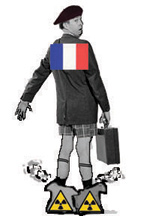 confidence is taking a further hit because on 5 September Electricite de France, denied reports of a fire at the Fessenheim nuclear power plant (NPP) in eastern France
Not quite what France’s BFM television reported,…that local authorities said the incident was “the beginning of a fire.”
the “incident” at Fessenheim NPP in fact raises troubling issues about aging French NPPs.
French Nuclear “Incident” Raises Concerns By John Daly | Wed, 05 September 2012 In the 1960s, as the U.S. “Atoms for Peace” program got into full swing, promoting civilian nuclear electricity propagation, no European country bought into the concept more deeply than France.
Seduced by the concept of electricity “too cheap to measure,” France began developing a massive nuclear energy program with minimal public debate after the first oil crisis in 1974 and continued to support nuclear power even after the 1986 Soviet Chernobyl disaster.
The March 2011 debacle at Japan’s Fukushima Daiichi nuclear complex heightened the French public’s concerns, but France abandoning nuclear power is an order of magnitude more difficult than neighbouring Germany.
On 30 May 2011, in the aftermath of Japan’s Fukushima nuclear disaster
two months earlier, German Chancellor Angela Merkel announced an
“energy revolution” and that Germany would close all of its 19 nuclear
power plants (NPPs) between 2015 and 2022, which produce about 28
percent of the country’s electricity. The shortfall was to be made up
with an increased emphasis on renewable energy sources.
French nuclear energy giant Areva SA, majority owned by the French
state, operates the country’s 59 nuclear reactors, which generate 78.8
percent of France’s electricity, the highest percentage in the world.
Six months ago France’s Institut de Radioprotection et de Surete
Nucleaire (Institute for Radioprotection and Nuclear Safety) issued
its 2012 Barometer IRSN Perception of Risks and Safety for the French.
Issued annually since 1988, the IRSN Barometer is designed to measure
the changes in public opinion towards the nuclear and radiological
risks to which the public are subjected. The 2012 edition of the IRSN
Barometer introduction states bluntly, “The confidence of the French
people that government action will protect them from nuclear risks is
severely damaged (because of Fukushima) and the population is
increasingly likely to be concerned about the risks associated with
nuclear power plants.”
That confidence is taking a further hit because on 5 September Electricite de France, denied reports of a fire at the Fessenheim nuclear power plant (NPP) in eastern France even as it acknowledged that two workers there suffered slight hand burns in a blast of steam
at the country’s oldest nuclear reactor (opened in 1978.)
Seeking to ally public concern EDF downplayed the incident as simply a
“release of steam” related to handling of hydrogen peroxide, which
occurred in an auxiliary building which had “no environmental impact.”
Not quite what France’s BFM television reported, which stated that six
other workers were slightly injured as well and said that local
authorities said the incident was “the beginning of a fire.”….
the “incident” at Fessenheim NPP in fact raises troubling issues about aging French NPPs.
But Fessenheim NPP has become a political issue, which the incident
will do little to dispel. …
http://oilprice.com/Alternative-Energy/Nuclear-Power/French-Nuclear-Incident-Raises-Concerns.html
No comments yet.
1 This Month

of the week – Shut Down Drone Warfare!


Tell the Ukrainian Government to Drop Prosecution of Peace Activist Yurii Sheliazhenko

Petition to revoke the licensing of the Near Surface Nuclear Disposal Facility (NSDF) at Chalk River. https://www.ourcommons.ca/petitions/en/Petition/Details?Petition=e-7247
To see nuclear-related stories in greater depth and intensity – go to https://nuclearinformation.wordpress.com
-
Archives
- March 2026 (237)
- February 2026 (268)
- January 2026 (308)
- December 2025 (358)
- November 2025 (359)
- October 2025 (376)
- September 2025 (257)
- August 2025 (319)
- July 2025 (230)
- June 2025 (348)
- May 2025 (261)
- April 2025 (305)
-
Categories
- 1
- 1 NUCLEAR ISSUES
- business and costs
- climate change
- culture and arts
- ENERGY
- environment
- health
- history
- indigenous issues
- Legal
- marketing of nuclear
- media
- opposition to nuclear
- PERSONAL STORIES
- politics
- politics international
- Religion and ethics
- safety
- secrets,lies and civil liberties
- spinbuster
- technology
- Uranium
- wastes
- weapons and war
- Women
- 2 WORLD
- ACTION
- AFRICA
- Atrocities
- AUSTRALIA
- Christina's notes
- Christina's themes
- culture and arts
- Events
- Fuk 2022
- Fuk 2023
- Fukushima 2017
- Fukushima 2018
- fukushima 2019
- Fukushima 2020
- Fukushima 2021
- general
- global warming
- Humour (God we need it)
- Nuclear
- RARE EARTHS
- Reference
- resources – print
- Resources -audiovicual
- Weekly Newsletter
- World
- World Nuclear
- YouTube
-
RSS
Entries RSS
Comments RSS
 nuclear-news
Leave a comment