Japan’s handling of nuclear disaster far worse than Soviet Russia’s in Chernobyl
If Japan takes evacuation measures equivalent in scale to that following the Chernobyl disaster, it will need to relocate several millions of people in this densely populated country,
 *Asahi* Japan Physicist: Several millions will need to be evacuated from around Fukushima plant if gov’t used same scale as after Chernobyl — Japan’s handling of disaster “far worse” than Soviet Union http://enenews.com/asahi-japan-physicist-several-millions-will-need-to-be-evacuated-from-around-fukushima-plant-if-govt-used-same-scale-as-after-chernobyl-japans-handling-of-disaster-is-far-worse August 9th, 2012
By ENENews (Subscription Only) Title: INTERVIEW/ Yuko Fujita: Lone
wolf physicist calls for Nagasaki’s awakening
Source: AJW Asahi Shimbun
Author: HIROSHI MATSUBARA
Date: August 10, 2012 Continue reading
Report: “Global public sentiment is still vehemently anti-nuclear” —
Report: “Global public sentiment is still vehemently anti-nuclear” — “Extreme public resistance” in Japan, Italy, Germany, Belgium, Switzerland… http://enenews.com/report-global-public-sentiment-is-still-vehemently-anti-nuclear-extreme-public-resistance-in-japan-italy-germany-belgium-switzerland August 8th, 2012
By ENENews
Title: Safety and technology advances not easing nuclear anxiety
Source: ESI Africa
Date: August 7, 2012
[…]
Title: Safety and technology advances not easing nuclear anxiety
Countries including Japan, Italy, Germany, Belgium and Switzerland have all experienced extreme public resistance and policy changes regarding nuclear power, with the latter three nations opting to completely end production by 2034.
Prior to the Fukishima catastrophe, Japan had ambitious plans to construct nine new reactors by 2020, and another five by 2030. Japan will continue to use nuclear power as part of its energy mix, but the shock of 2011 compounded by the following public backlash has forced the government to rethink its plans.
TEPCO ‘doctored’ video of Fukushima conference
Yomiuri: Tepco has ‘heavily altered’ video footage — Expert suspects images have been altered more than necessary http://enenews.com/yomiuri-tepco-has-heavily-altered-video-footage-expert-suspects-images-have-been-altered-more-than-necessary August 7th, 2012 By ENENews
Title: TEPCO video heavily altered / Alternation shows utility’s reluctance to make information available
Source: The Yomiuri Shimbun
Date: Aug. 8, 2012
The recently disclosed video of Tokyo Electric Power Co. teleconferences that took place just after the outbreak of the crisis at the Fukushima No. 1 nuclear power plant has been significantly altered, with many images blurred and audio heavily obscured. Continue reading
Renewable energy – matching electricity supplies to demands
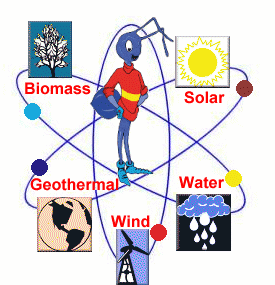 MATCHING SUPPLIES OF ELECTRICITY TO VARIABLE DEMANDS FOR ELECTRICITY, DESERTEC UK, 9 Aug 12 It is sometimes suggested that renewable sources of electricity cannot provide more than about 20% of our electricity supplies because they are intermittent or variable. But all sources of electricity are intermittent because they need to be taken out of service for scheduled maintenance and because, like any kind of equipment, they are liable to unscheduled breakdowns. With all sources of power, load factors are normally well short of 100%.
The variability of sources such as wind power is much less of an issue than is sometimes suggested, as described in Managing Variability (PDF, 402 KB, a report by independent consultant David Milborrow commissioned by Greenpeace, WWF, RSPB, Friends of the Earth, July 2009).
Not only are all sources of electricity intermittent, and many of them are variable, but the demand for electricity is variable too—and there can be quite large changes from one minute to the next. The often-quoted example is how there can be a sharp peak in demand for electricity when there is a commercial break in a popular TV programme and many people go and put the kettle on to make a cup of tea.
There is a range of techniques available for matching supplies with constantly varying demands. When electricity supply systems are properly engineered, they should be able to accommodate sources of electricity that are 100% renewable.
Any or all of the following techniques may be used:
Large-scale ‘HVDC’ transmission grids. In an area like Europe, there are several potential benefits from building a ‘supergrid’ of highly-efficient HVDC transmission lines to link existing HVAC transmission grids (see electricity transmission grids). One of the most important benefits is that this kind of large-scale grid can make it much easier to match variable supplies with variable demands. For example, the wind may stop blowing in any one spot but it almost never stops blowing everywhere across a wide area like Europe. If there is a peak in demand in any one area, it can almost always be met from spare capacity in one or more other areas. Large-scale storage facilities, such as pumped-storage systems in Norway and the Alps, may be widely shared. Submarine HVDC transmission lines that have been laid between Norway and Denmark and between Norway and the Netherlands enable both pairs of countries to benefit in this way.- Complementary sources of power……
- Power on demand. … . http://www.desertec-uk.org.uk/elec_eng/supply_demand.html
How USA secretly transferred nuclear weapons research to Japan
United States Circumvented Laws To Help Japan Accumulate Tons of Plutonium, DC Bureau By Joseph Trento, April 9th, 2012 National Security News Service The United States deliberately allowed Japan access to the United States’ most secret nuclear weapons facilities while it transferred tens of billions of dollars worth of American tax paid research that has allowed Japan to amass 70 tons of weapons grade plutonium since the 1980s, a National Security News Service investigation reveals. These activities repeatedly violated U.S. laws regarding controls of sensitive nuclear materials that could be diverted to weapons programs in Japan. The NSNS investigation found that the United States has known about a secret nuclear weapons program in Japan since the 1960s, according to CIA reports.
The diversion of U.S. classified technology began during the Reagan administration after it allowed a $10 billion reactor sale to China. Japan protested that sensitive technology was being sold to a potential nuclear adversary. The Reagan and George H.W. Bush administrations permitted sensitive technology and nuclear materials to be transferred to Japan despite laws and treaties preventing such transfers. Highly sensitive technology on plutonium separation from the U.S. Department of Energy’s Savannah River Site and Hanford nuclear weapons complex, as well as tens of billions of dollars worth of breeder reactor research was turned over to Japan with almost no safeguards against proliferation. Japanese scientist and technicians were given access to both Hanford and Savannah River as part of the transfer process.
While Japan has refrained from deploying nuclear weapons and remains under an umbrella of U.S. nuclear protection, NSNS has learned that the country has used its electrical utility companies as a cover to allow the country to amass enough nuclear weapons materials to build a nuclear arsenal larger than China, India and Pakistan combined.
This deliberate proliferation by the United States fuels arguments by countries like Iran that the original nuclear powers engage in proliferation despite treaty and internal legal obligations. Russia, France, Great Britain as well as the United States created civilian nuclear power industries around the world from their weapons complexes that amount to government-owned or subsidized industries. Israel, like Japan, has been a major beneficiary and, like Japan, has had nuclear weapons capabilities since the 1960s.
A year ago a natural disaster combined with a man-made tragedy decimated Northern Japan and came close to making Tokyo, a city of 30 million people, uninhabitable. Nuclear tragedies plague Japan’s modern history. It is the only nation in the world attacked with nuclear weapons. In March 2011, after a tsunami swept on shore, hydrogen explosions and the subsequent meltdowns of three reactors at the Fukushima Nuclear Power Plant spewed radiation across the region. Like the bombs dropped on Hiroshima and Nagasaki, Japan will face the aftermath for generations. A twelve-mile area around the site is considered uninhabitable. It is a national sacrifice zone. ……..http://www.dcbureau.org/201204097128/national-security-news-service/united-states-circumvented-laws-to-help-japan-accumulate-tons-of-plutonium.html
Belgium Halts One Nuclear Reactor On Suspicion of Cracks
Belgium Halts One Nuclear Reactor On Suspicion of Cracks – Regulator Fox Business August 08, 2012 Dow Jones Newswires Belgium has temporarily shut one of its seven nuclear power reactors on suspicion that one of its components might be cracked, the
country’s atomic power regulator said Wednesday.
“We have found anomalies,” said Karina De Beule, spokesman for the ACFN, the federal agency for nuclear control….. GDF Suez SA (GSZ.FR), the French energy giant that operates Belgian nuclear plans through its unit Electrabel, confirmed that the reactor will remain closed. “The reactor has been halted since June for regular control. Halt for maintenance has been extended, to allow additional inspections,” a company spokesman said.
The reactor that’s been shut is expected to be decommissioned in 2022.
http://www.foxbusiness.com/news/2012/08/08/belgium-halts-one-nuclear-reactor-on-suspicion-cracks-regulator/#ixzz235hmrmgc
According to prosecution, 82 year old anti nuclear nun is “violent”, “a danger to community”
Prosecutor Kirby……asserting that their action was a “crime of violence.” Kirby got worked up enough to hiss, “Their description of nonviolence is not right. They are willing to die for what they believe. That’s violence.”
Unarmed Octogenarian Nun Called ‘Danger to Community’ by Prosecutors Nuclear Security Unmasked by JOHN LaFORGE, AUGUST 08, 2012 “……. something our nuclear war mafia hates as much as vampires hate daylight — is that the gravity of the Y-12 shut-down, along with the government’s wish to keep the interveners behind bars, moved prosecutors to up the charges. The three were at first charged only with federal trespass.
On Aug. 3, prosecutors added a felony count — “willful and malicious destruction or injury to a structure, conveyance, personal or real property” or its attempt — which carries a max of 5 years in prison, 3 years’ probation, and/or a $250,000 fine. Continue reading
USA’s mounting nuclear wastes influenced NRC decision to halt reactor licensing
 More than 65,000 tons of spent nuclear fuel is stored at operating and shuttered reactor sites across the country. But those 72 sites in 34 states are filling up. Some 2,000 additional tons of waste are produced each year, according to a report released this year by the president’s Blue Ribbon Commission on America’s Nuclear Future. …..
As Nuclear Waste Problem Persists, Federal Regulators Freeze Licensing for Reactors Aug. 8, 2012 Jim Malewitz, Stateline.org The U.S. Nuclear Regulatory Commission (NRC) won’t sign off on licenses for news and existing nuclear power plants until the commission addresses a decades-old problem plaguing states: what to do with spent fuel rods and other hazardous waste piling up at storage sites across the country.
In a unanimous decision on Tuesday (August 7), the commission said it
will hold off licensing plants that are new or up for renewal. That’s
until it responds to a court’s ruling that the NRC failed to consider
the environmental impacts of continuing to store waste at sites meant
to be temporary.
Licensing reviews will continue, the commission said, but no final
decisions will be made.
More than 65,000 tons of spent nuclear fuel is stored at operating and shuttered reactor sites across the country. But those 72 sites in 34 states are filling up. Some 2,000 additional tons of waste are produced each year, according to a report released this year by the
president’s Blue Ribbon Commission on America’s Nuclear Future. …..
In June, a federal appeals court threw out the commission’s “waste
confidence rule” and “temporary storage rule,” decisions that
collectively approved the status quo for onsite storage. Siding with
environmentalists and four states led by New York, the court said the
commission’s rulemaking process was flawed in that it did not
calculate the environmental effects of failing to secure a permanent
disposal site _ “a possibility that cannot be ignored,” the court
ruled. The NRC also, according to the court, “failed to examine future
dangers and key consequences,” in its determination that spent nuclear
fuel could be safely stored at nuclear sites for up to 60 years after
their license expires. ….
Eric Schneiderman, New York’s attorney general, hailed the NRC’s
decision to halt the licensing of reactors.
“The storage of nuclear waste at nuclear power facilities poses
long-term health and environmental risks, including the risk of leaks
from spent fuel pools and fires, he said in a statement yesterday.
“The NRC’s commitment is a welcome step toward ensuring a full, fair
and open examination of the numerous critical questions about the
safety and environmental impact of Indian Point before any decisions
are made about extending its operating licenses for another 20 years.”
Australia’s inadequate nuclear safety agencies
Inadequate Safety Practices at Lucas Heights and Inadequate Regulation by ARPANSA, Friends of the Earth 10 Aug 12 Since 2007, a saga has been unfolding regarding contamination accidents at the Australian Nuclear Science and Technology Organisation (ANSTO), ANSTO’s handling of those incidents, ANSTO’s treatment of whistleblowers, the handling of the matter by the Australian Radiation Protection and Nuclear Safety Agency (ARPANSA), and the independence or otherwise of ARPANSA.
The saga has exposed inadequate safety practices at ANSTO and an inadequate performance by the regulator ARPANSA. The problems would not have been exposed and partially rectified if not for a number of ANSTO whistleblowers.
A few snapshots of this saga are noted below and more details can be found on the Friends of the Earth website: Continue reading
Uranium lobbyists spent 100s of $1000s for Virginia mining: doesn’t make it safe
Proponents of mining, who spent more than $150,000 lobbying the General Assembly this year, understandably want a quick decision in their favor, most likely in the 2013 session. But with many serious and unanswered questions, no regulatory staff in the executive branch, no regulations and guidelines and strong opposition from across the political spectrum, we believe extreme caution is called for. In a matter such as this, there isn’t the luxury of a “do-over.”
Uranium Mining: Let’s Be Cautious The News & Advance August 09, 2012 Down the road in Pittsylvania County, just off U.S. 29 near Chatham, is Coles Hill Farm, which has been in Walter Coles’ family for more than 200 years.
It’s also ground zero in what is shaping up to be a monumental battle over whether Virginia’s almost-30-year-old moratorium on mining uranium, for beneath the rolling hills and pastures of Coles Hill Farm lies one of the nation’s largest deposits of the ore.
The General Assembly first imposed the moratorium in 1982 when Marline Uranium Corp. expressed interest in mining the deposit. Environmental and safety concerns were foremost in the minds of legislators who supported the moratorium. Continue reading
How bureaucrats worked secretly to subvert laws on nuclear weapons proliferation
U.S. and international law strictly limited the technology developed in the Clinch River program, particularly reprocessing technology used to separate plutonium from spent nuclear fuel. And the plan would require hundreds of international shipments of weapons-grade plutonium and high level nuclear waste on ships.
United States Circumvented Laws To Help Japan Accumulate Tons of Plutonium, DC Bureau By Joseph Trento, April 9th, 2012“…..Giving to Both Sides – Nuclear deals with China and Japan Westinghouse AP 1000 in China In 1984 the Westinghouse Corporation had struck a deal to supply nuclear reactors to China worth as much as $10 billion. The deal was an incredible windfall for the American nuclear industry and would be a cornerstone in [bureaucrat] Richard Kennedy’s efforts to make the United States dominate in the world’s nuclear commerce. The only problem was China’s abysmal record of sharing nuclear secrets with all bidders.
In a bitter session on the Senate floor, then Democratic Assistant Majority Leader Alan Cranston charged that the Reagan administration on [bureaucrat Richard] Kennedy’s watch had “systematically withheld, suppressed and covered up information – known virtually throughout the executive branch – which Congress might find worrisome.” China was already known to have sold nuclear technology to five international nuclear outlaws: Pakistan, Iran, South Africa, Brazil and Argentina. By 1984, Cranston and most of the American government knew that China had given sophisticated nuclear weapons designs to Pakistan. Beijing had also sold the enriched uranium that would find its way into South Africa’s nuclear bombs. China sold heavy water for use in Argentina’s bomb program, while also selling nuclear materials to arch rival Brazil and negotiating nuclear agreements with Iran.
China’s nuclear proliferation track record could hardly have been worse, but instead of negotiating ironclad safeguards, Kennedy returned from Beijing with an agreement so ambiguous that both sides could interpret it however they liked. Continue reading
U.S. To Provide Access To Marshall Islands Nuclear Test Documents
Marshalls maintains demand for full disclosure of classified information By Giff Johnson SAIPAN, CNMI (Marianas Variety, Aug. 8, 2012) – In response to a strong statement of concern from the Marshall Islands government about the lack of access to classified information about United States nuclear testing in this western Pacific nation more than 50 years ago, a top State Department official has promised to initiate a review of data available for public release.
“Some documents provided in the past were so heavily redacted as to make them unreadable,” said Assistant Secretary of State for East Asian and Pacific Island Affairs Kurt Campbell at a media conference after meeting with President Christopher Loeak in Majuro Thursday evening. “It is fair to ask the United States to see if we’ve provided the Marshall Islands with the information it needs to understand more fully (the nuclear test legacy).”…. http://pidp.org/pireport/2012/August/08-08-09.htm
Fukushima student addresses Nagasaki peace meet
http://www3.nhk.or.jp/daily/english/20120808_28.html Aug. 8, 2012 A high school girl from Fukushima Prefecture has spoken at a peace gathering in Nagasaki about the situation in her community after the nuclear accident last year.
Sakura Takano from Minamisoma City near the Fukushima Daiichi nuclear plant is visiting Nagasaki to attend a memorial ceremony on Thursday — the 67th anniversary of the atomic bombing of the city.
She has been appointed a “High School Peace Ambassador” — the first from Fukushima — and will deliver a petition against nuclear weapons to the United Nations.
At the peace meeting of high school students from across the country on Wednesday, Takano said the nuclear accident is continuing and that the affected areas are being devastated. She added that people are still living in temporary housing about a year and a half after the accident.
Takano said she wants everyone to learn about the situation in Fukushima and to help reconstruction efforts in the area. After the meeting, Takano stood in front of Nagasaki Station to collect signatures for a petition calling for the elimination of nuclear weapons and the realization of world peace.
She will visit the UN European headquarters in Geneva, Switzerland, with other high school ambassadors to deliver the petition later this month.
Off the Chart: University researchers film while measuring radiation levels in evacuation zone
 — “‘Over’ means it’s beyond the capacity of the measuring device” (VIDEO) http://enenews.com/off-the-chart-university-researchers-film-while-measuring-radiation-levels-in-evacuation-zone-over-means-its-beyond-the-capacity-of-the-measuring-device-video « Fukushima Plant Chief after 3/11: Off the Chart: University researchers film while measuring radiation levels in evacuation zone — “‘Over’ means it’s beyond the capacity of the measuring device” (VIDEO) August 8th, 2012 By ENENews
Aug 8, 2012Inside the Barricaded Fukushima Nuclear Zone by: yohkawano Filmed: July 18, 2012
Description: The following depicts a one day journey inside the barricaded Fukushima Nuclear taken on July 18, 2012, almost a year and a half after the Nuclear Disaster. Read the entire story here
Group of academics from Niigata University and UCLA measuring radiation levels around the Fukushima nuclear plant At 2:45 in
[Camera shows radiation dose quickly climbing to ~30 microsieverts per hour]
Narrator: ‘Over’ means it’s beyond the capacity of the measuring device.
At 4:00 in
[Camera shows computer screen]
Narrator: Here, the measurements go beyond the height of the chart.
USA to halt licensing of nuclear plants: no assurance of nuclear waste solution
 U.S. Regulator Halts Nuclear-Plant Licensing, WSJ, By REBECCA SMITH And RYAN TRACY August 7, 2012, Court Rules That NRC Can No Longer Accept Assurances a Permanent Waste Repository Is Coming
The U.S. Nuclear Regulatory Commission said it would stop issuing licenses for nuclear plants until it addresses problems with its nuclear-waste policy that were raised by a recent federal appeals court decision. Continue reading
1 This Month

of the week – Shut Down Drone Warfare!


Tell the Ukrainian Government to Drop Prosecution of Peace Activist Yurii Sheliazhenko

Petition to revoke the licensing of the Near Surface Nuclear Disposal Facility (NSDF) at Chalk River. https://www.ourcommons.ca/petitions/en/Petition/Details?Petition=e-7247
To see nuclear-related stories in greater depth and intensity – go to https://nuclearinformation.wordpress.com
-
Archives
- April 2026 (7)
- March 2026 (251)
- February 2026 (268)
- January 2026 (308)
- December 2025 (358)
- November 2025 (359)
- October 2025 (376)
- September 2025 (257)
- August 2025 (319)
- July 2025 (230)
- June 2025 (348)
- May 2025 (261)
-
Categories
- 1
- 1 NUCLEAR ISSUES
- business and costs
- climate change
- culture and arts
- ENERGY
- environment
- health
- history
- indigenous issues
- Legal
- marketing of nuclear
- media
- opposition to nuclear
- PERSONAL STORIES
- politics
- politics international
- Religion and ethics
- safety
- secrets,lies and civil liberties
- spinbuster
- technology
- Uranium
- wastes
- weapons and war
- Women
- 2 WORLD
- ACTION
- AFRICA
- Atrocities
- AUSTRALIA
- Christina's notes
- Christina's themes
- culture and arts
- Events
- Fuk 2022
- Fuk 2023
- Fukushima 2017
- Fukushima 2018
- fukushima 2019
- Fukushima 2020
- Fukushima 2021
- general
- global warming
- Humour (God we need it)
- Nuclear
- RARE EARTHS
- Reference
- resources – print
- Resources -audiovicual
- Weekly Newsletter
- World
- World Nuclear
- YouTube
-
RSS
Entries RSS
Comments RSS
 nuclear-news