Unsatisfactory meeting of anti nuclear activists with Japan’s PM
Fukushima Watch: Anti-Nuclear Activists Unimpressed by Meeting With PM, August 22, 2012, http://blogs.wsj.com/japanrealtime/2012/08/22/fukushima-watch-anti-nuclear-activists-unimpressed-by-meeting-with-prime-minister/ By Eleanor Warnock
After almost five months of protesting outside Prime Minister Yoshihiko Noda’s official residence in downtown Tokyo, anti-nuclear activists finally got inside for an audience with Mr. Noda himself Wednesday. But following the 30-minute meeting, the activists were
unimpressed. Continue reading
Rocketing costs of upgrading B61 bomb
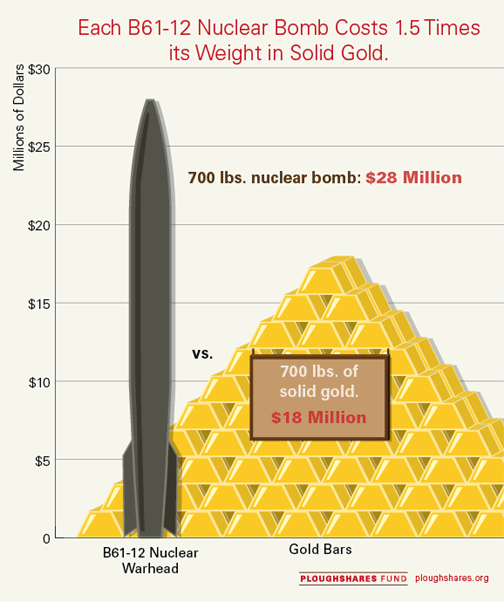 Cost of Nuclear Bomb Upgrade Doubles to $8 Billion,http://blogs.ottawacitizen.com/2012/08/22/cost-of-nuclear-bomb-upgrade-doubles-to-8-billion/ Ottawa Citizen, August 22, 2012 One of the oldest nuclear weapons in the U.S. arsenal is the B-61 gravity bomb. It was first designed in the 1960s to be dropped over a target by airplane. The U.S. government is in the process of getting ready to do a life extension (ie. upgrade) on the bomb.
The upgrade was estimated in 2010 to cost $2 billion. That has now doubled to $8 billion. But there is also an independent Pentagon cost estimate noting the program will come in at $10 billion. The number of bombs to be upgraded is classified.
Here is the Washington Post’s view on this project:
“Who will be deterred by the refurbished B-61? Is the symbolism of deploying the nuclear gravity bomb in Europe worth the billions of dollars? Does it make sense to embark on a $10 billion program to refurbish a weapon that could be put on the table in negotiations with Russia a few years from now? In an age of scarce resources, such questions can’t be slighted. “
Overuse of medical radiation lifts cancer rates
Medical Radiation Soars, With Risks Often Overlooked NYT, By JANE E. BRODY AUGUST 20, 2012, Radiation, like alcohol, is a double-edged sword. It has indisputable medical advantages: Radiation can reveal hidden problems, from broken bones and lung lesions to heart defects and tumors. And it can be used to treat and sometimes cure certain cancers.
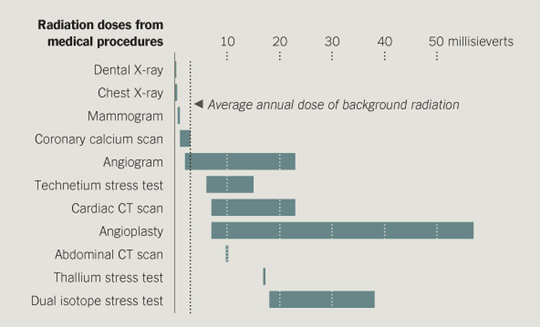
But it also has a potentially serious medical downside: the ability to damage DNA and, 10 to 20 years later, to cause cancer. CT scans alone, which deliver 100 to 500 times the radiation associated with an ordinary X-ray and now provide three-fourths of Americans’ radiation exposure, are believed to account for 1.5 percent of all cancers that occur in the United States. Continue reading
Problem of doctors referring patients to radiation clinics that they own
Doctors Who ‘Self-Refer’ to Radiation Clinics Add to Patients’ Burden: Study
In Texas, prostate cancer patients had to travel longer distances to use physician-affiliated center Aug. 21 (HealthDay News) — The practice of referring a cancer patient to a radiation clinic with links to the referring doctor can be difficult for patients, a new study finds.
The study focused on urologists in Texas. It found that the practice caused some men with prostate cancer to travel more than three times farther to receive the treatment they needed.
The researchers said the findings call into question this practice, known as physician self-referral, and highlight concerns about the increase in urology-owned radiation oncology practices.
“Travel time to cancer care centers is crucial, especially for older men with advanced disease, because external radiation therapy often requires daily treatment for six to eight weeks,” Dr. Colleen Lawton, president-elect of the American Society for Radiation Oncology, said in a news release from the organization. …..
The study is published in the Sept. 1 issue of the International Journal of Radiation Oncology, Biology, Physics.
More information The U.S. Centers for Medicare and Medicaid Services has more about physician self-referral. http://www.ivillage.com/doctors-who-self-refer-radiation-clinics-add-patients-burden-study/4-a-482061#ixzz24P9awDtk
UN Secretary-General Ban Ki-moon to visit Iran
UN chief to visit Iran in defiance of US, Israel China Daily, 2012-08-23
* Ban to attend non-aligned summit in Iran – UN
* U.S., Israel had urged Ban to boycott Tehran summit
* UN chief to raise concerns about Iran nuclear work, Syria
* Ban hopes to meet with Iran’s supreme leader, president Continue reading
Zero nuclear energy the favoured choice for Japanese
Japan Citizens Favor Zero Nuclear In Debate Over Energy Options Bloomberg, By Tsuyoshi Inajima and Yuji Okada – Aug 21, 2012 Japan ’s public wants the government to phase out nuclear power according to the results of town hall-like forums to give the public a say in the debate on the nation’s energy supply post-Fukushima.
The forums brought together 286 citizens for two days in early August in Tokyo from thousands surveyed by phone. They were broken into smaller groups to discuss and vote on three energy supply options the government proposed: Zero nuclear, 15 percent nuclear, and 20 percent to 25 percent nuclear.
A total 47 percent opted for zero nuclear, 16 percent favored the nuclear ratio at 15 percent, while 13 percent endorsed 20-25 percent, according to a report by Yasunori Sone , a professor of political science at Keio University and the head of the group that organized the survey for the government. The remainder chose more than one option, said Sone’s report.
The poll results “indicate Japanese citizens are prepared for a policy shift to green energy from nuclear power and consequent lifestyle changes and cost burdens,” according to the report….. http://www.bloomberg.com/news/2012-08-22/japan-finds-47-of-citizens-support-zero-nuclear-power-option.html
Areas of naturally high radiation have also higher cancer rates
2004 Study: Two of Brazil’s High Background Radiation Areas Have Higher Cancer Mortality Via : http://ex-skf.blogspot.com.au/2012/04/2004-study-two-of-brazils-high.html quote: APRIL 14, 2012
I have been told numerous times that “People in naturally high background radiation areas in the world suffer no ill effect from the high radiation.” I just stumbled upon one study in 2004 on such areas in Brazil.
Conclusion of this particular study: Cancer mortality in “Poços de Caldas, and Guarapari is higher than would be expected for their respective reference population”, whereas “cancer mortality for the Araxá population is lower than would be expected”.
International Congress Series
Volume 1276, Pages 3-468 (February 2005)
Link http://www.sciencedirect.com/science/journal/05315131/1276
High Levels of Natural Radiation and Radon Areas: Radiation Dose and Health Effects, Proceedings of the 6th International Conference on High Levels of Natural Radiation and Radon Areas, Osaka, Japan
6–10 September 2004… http://nuclearhistory.wordpress.com/2012/08/23/2004-study-two-of-brazils-high-background-radiation-areas-have-higher-cancer-mortality/
Sources of plutonium found around Fukushima

 Gundersen: I think plutonium being reported around Fukushima is raw, unoxidized pieces of nuclear rods that were blown out from Unit 3′s spent fuel pool August 22nd, 2012 Regarding the recent test results that detected plutonium at 10 locations in Fukushima, Fairewinds’ Arnie Gundersen writes to ENENews:
Pu came from the damaged fuel rods, obviously. The question is whether it was the damaged rods inside U1/2/3 reactors or whether it was the U3 spent fuel pool. Given U1/2/3 had a containment around the cores (even if damaged), this data leads me to continue to believe that the U3 SFP detonation is the most likely location for the release.
When asked if the plutonium could have been transported by smoke from the burning fuel rods inside the reactors, Gundersen replies:
Burning is oxidation, so U or Pu combines with oxygen to create U oxide… just like Carbon combines with oxygen to make CO2…. small micron size particles….. I think the Pu at Fuku is raw, unoxidized, blown out, not burned
3 Fukushima towns selected for 12 storage sites of radioactive debris, for now!
NATIONAL AUG. 20, 2012
“…FUKUSHIMA —
The government on Sunday announced that it has chosen three towns in Fukushima Prefecture as potential locations for long-term storage of radioactive debris and topsoil resulting from decontamination activities in the area around the stricken Fukushima Daiichi nuclear power plant.
Environment minister Goshi Hosono, who is also the minister in charge of the nuclear crisis, said 12 sites will be built in Futaba (two), Okuma (nine) and Naraha (one), Fuji TV reported. Speaking at a meeting of municipal officials, Hosono said the government plans to conduct geological surveys to establish the suitability of the 12 sites for the storage of radioactive materials.
Hosono told a news conference after the meeting that the government plans to ask for further cooperation from other towns and villages in the future, Fuji reported….”
Japanese Diplomat: “Worsening situation” at Fukushima Daiichi — 40+ more years of radiation contamination coming out of plant may have sizeable effects in neighboring countries
August 20th, 2012
By ENENews
Title: Fukushima Needs a Hero: Responsibility and Democracy in Japan
Author: Akio Matsumura
Date: August 20, 2012
[…]
I have growing concerns about the management of the national crisis where the central government, local government, TEPCO and media have barriers to speak out about the worsening situation [See also: Fukushima Nuclear Situation Deteriorating].
[…]
On the other end of the spectrum, in age at least, are the three girls of Soma High School who staged a play about the suicide of a friend in the wake of the accident. Young colleagues in the United States, calling themselves Friends of Fukushima, admired their courage and created English captions that allowed it to be watched around the world.
Friends of Fukushima has been offered by their friends in Pakistan, Germany, France and others to translate it into their languages. In democratic countries, those old enough are able to express our opinions with our vote. If you’re too young, this opportunity—the focal point of democracy—is lost. However, YouTube provided a place to grieve and call for something different. Their message was of despair tinged with hope. It is hard for me to understand why Soma High School had YouTube remove the video. (They claim there is a copyright issue). They should be encouraging their students’ brave messages, not censoring them.
It is fundamental issue for democracy that the freedom of speech for those too young to vote is guaranteed.
Mr. Yamada is a hero of the older generation. The three actresses are heroines of the young. I am ashamed that those in the middle generation, those who have the power to tackle the largest issues, are weak, cowering behind the excuse of a stoic culture. Hiding in the anonymity of bureaucracy. Bowing to an unshakeable status quo. Fearing for their careers and reputation while their country’s health is at stake.
Fukushima needs a hero. Where are the champions of this current generation?
[…]
Here is my impressions and memory of the play.
3 girls are talking about normal interests but the dynamics of the girls personalities change throughout.. the play move into the darker side of their existence and they then start talking about the issues except one girl who is more playful and animated, she ignores the conversation at annoyance of the other two.
Eventually, the lively happy girl succumbs to the conversation and joins in.. much to the surprise of the other two girls. she then makes a good breakdown of the tragedy and then the school bell rings for home time..
The other two girls then make to leave and the lively girl says she needs to sort through her bag and for them to go on..
The two girls leave and the lights dim, the child slowly transforms and becomes slower and slumped.. she sits down and says a few sad words.. end of scene..
The new scene opens with the three chairs and the two girls occupying two of them. the third chair has flowers on it.
The two remaining girls start a conversation about why there friend committed suicide. they had some guilt about they way they treated her but the conversation was about her normal behaviour before and then as the conversation deepened they realised that she had a more difficult time because of the disaster than they had realised.
This summary from memory is as close as i could get.. it was a very powerful and emotive play.. i have not seen anything with that much power. the girls acting was superb and the script and concept were worthy of great acclaim. frankly i didnt think i would see anything any where near as good from a school play. well i was wrong! i am sorry that i can not provide links to this play but the ones i have are now dead links.
Here is the summary that came with the video
VIDEO: Lessons not learned from the Fukushima catastrophe

 http://www.fairewinds.org/content/cctv-live-five-margaret-harrington-and-arnie-gundersen CCTV Host Margaret Harrington and Fairewinds Energy Education’s Arnie Gundersen discuss the urgent need to empty spent fuel pools into dry cask storage to prevent a serious but avoidable accident. They also discuss the economic cost to nuclear plants if they where forced to withstand natural calamities, the future of Yucca Mountain, and the radiological contamination caused by depleted uranium weapons….
1 This Month


Tell the Ukrainian Government to Drop Prosecution of Peace Activist Yurii Sheliazhenko

Petition to revoke the licensing of the Near Surface Nuclear Disposal Facility (NSDF) at Chalk River. https://www.ourcommons.ca/petitions/en/Petition/Details?Petition=e-7247


of the week – STOP SMALL MODULAR REACTORS IN CANADA
To see nuclear-related stories in greater depth and intensity – go to https://nuclearinformation.wordpress.com
-
Archives
- March 2026 (204)
- February 2026 (268)
- January 2026 (308)
- December 2025 (358)
- November 2025 (359)
- October 2025 (376)
- September 2025 (258)
- August 2025 (319)
- July 2025 (230)
- June 2025 (348)
- May 2025 (261)
- April 2025 (305)
-
Categories
- 1
- 1 NUCLEAR ISSUES
- business and costs
- climate change
- culture and arts
- ENERGY
- environment
- health
- history
- indigenous issues
- Legal
- marketing of nuclear
- media
- opposition to nuclear
- PERSONAL STORIES
- politics
- politics international
- Religion and ethics
- safety
- secrets,lies and civil liberties
- spinbuster
- technology
- Uranium
- wastes
- weapons and war
- Women
- 2 WORLD
- ACTION
- AFRICA
- Atrocities
- AUSTRALIA
- Christina's notes
- Christina's themes
- culture and arts
- Events
- Fuk 2022
- Fuk 2023
- Fukushima 2017
- Fukushima 2018
- fukushima 2019
- Fukushima 2020
- Fukushima 2021
- general
- global warming
- Humour (God we need it)
- Nuclear
- RARE EARTHS
- Reference
- resources – print
- Resources -audiovicual
- Weekly Newsletter
- World
- World Nuclear
- YouTube
-
RSS
Entries RSS
Comments RSS
 nuclear-news