Overuse of medical radiation lifts cancer rates
Medical Radiation Soars, With Risks Often Overlooked NYT, By JANE E. BRODY AUGUST 20, 2012, Radiation, like alcohol, is a double-edged sword. It has indisputable medical advantages: Radiation can reveal hidden problems, from broken bones and lung lesions to heart defects and tumors. And it can be used to treat and sometimes cure certain cancers.
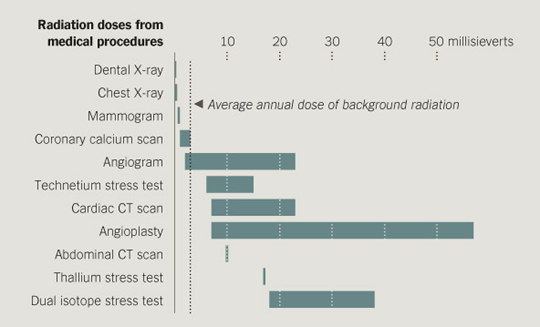
But it also has a potentially serious medical downside: the ability to damage DNA and, 10 to 20 years later, to cause cancer. CT scans alone, which deliver 100 to 500 times the radiation associated with an ordinary X-ray and now provide three-fourths of Americans’ radiation exposure, are believed to account for 1.5 percent of all cancers that occur in the United States.
Recognition of this hazard and alarm over recent increases in
radiological imaging have prompted numerous experts, including some
radiologists, to call for more careful consideration before ordering
tests that involve radiation.
“All imaging has increased, but CTs account for the bulk of it,” said
Dr. Rebecca Smith-Bindman, a specialist in radiology and biomedical
imaging at the University of California, San Francisco. “There’s
clearly widespread overuse. More than 10 percent of patients each year
are receiving very high radiation exposures.”
The trick to using medical radiation appropriately, experts say, is to
balance the potential risks against known benefits. But despite the
astronomical rise in recent years in the use of radiation to obtain
medical images, this balancing act is too often ignored. The
consequences include unnecessary medical costs and risks to the future
health of patients……
the amount of radiation used medically rivals that of the background
radiation, adding three millisieverts each year to the average
person’s exposure. (A mammogram involves 0.7 millisieverts, a dose
that is doubled with a 3-D mammogram.)
There are many reasons for this increase. Doctors in private practice
who have bought imaging equipment tend to use it liberally to recoup
the expense. The same goes for hospitals just a few miles apart that
needlessly duplicate certain equipment so they can boast of having the
latest and greatest capacity to detect disease. Doctors ordering tests
suffer no adverse effects, and patients feel they are getting the most
that modern medicine can offer.
Dr. Lauer wrote in a commentary about cardiac tests, “Most physicians
who order imaging tests experience no consequences for incurring costs
for procedures of unproven value. On the contrary, they or their
colleagues are paid for their services, and their patients don’t
complain because the costs are covered by third parties. Patients are
pleased to receive thorough evaluations that involve the best
cutting-edge technologies.”
According to a new study, the rise in medical imaging clearly goes
beyond financial motives. Dr. Smith-Bindman and her colleagues
reported in June in The Journal of the American Medical Association
that a dramatic rise in imaging rates from 1996 to 2010, including a
tripling of CT scans, occurred in six large prepaid health systems
where the financial incentive ought to have encouraged fewer, not
more, tests. The increased testing doubled the proportion of patients
who received high or very high radiation exposures……
http://well.blogs.nytimes.com/2012/08/20/medical-radiation-soars-with-risks-often-overlooked/
No comments yet.
1 This Month


Tell the Ukrainian Government to Drop Prosecution of Peace Activist Yurii Sheliazhenko

Petition to revoke the licensing of the Near Surface Nuclear Disposal Facility (NSDF) at Chalk River. https://www.ourcommons.ca/petitions/en/Petition/Details?Petition=e-7247


of the week – STOP SMALL MODULAR REACTORS IN CANADA
To see nuclear-related stories in greater depth and intensity – go to https://nuclearinformation.wordpress.com
-
Archives
- March 2026 (204)
- February 2026 (268)
- January 2026 (308)
- December 2025 (358)
- November 2025 (359)
- October 2025 (376)
- September 2025 (258)
- August 2025 (319)
- July 2025 (230)
- June 2025 (348)
- May 2025 (261)
- April 2025 (305)
-
Categories
- 1
- 1 NUCLEAR ISSUES
- business and costs
- climate change
- culture and arts
- ENERGY
- environment
- health
- history
- indigenous issues
- Legal
- marketing of nuclear
- media
- opposition to nuclear
- PERSONAL STORIES
- politics
- politics international
- Religion and ethics
- safety
- secrets,lies and civil liberties
- spinbuster
- technology
- Uranium
- wastes
- weapons and war
- Women
- 2 WORLD
- ACTION
- AFRICA
- Atrocities
- AUSTRALIA
- Christina's notes
- Christina's themes
- culture and arts
- Events
- Fuk 2022
- Fuk 2023
- Fukushima 2017
- Fukushima 2018
- fukushima 2019
- Fukushima 2020
- Fukushima 2021
- general
- global warming
- Humour (God we need it)
- Nuclear
- RARE EARTHS
- Reference
- resources – print
- Resources -audiovicual
- Weekly Newsletter
- World
- World Nuclear
- YouTube
-
RSS
Entries RSS
Comments RSS
 nuclear-news
Leave a comment