UK’s dangerous plan to make its piles of nuclear waste a commercial asset
Britain’s previous attempts to convert plutonium into Mox fuel which could then be burned in conventional reactors have proved disastrous, culminating in the premature closure last year of the £1.34bn Sellafield Mox Plant, which was a commercial and technical failure.
 ‘Untested’ nuclear reactors may be used to burn up plutonium waste Feasibility study looks at building revolutionary new facility at Sellafield to dispose of stockpile The Independent, STEVE CONNOR 20 AUGUST 2012 An ambitious plan to rid Britain of its civil plutonium stockpile – the biggest in the world – has come a step closer with the submission of a feasibility study for building revolutionary nuclear reactors to “burn” the waste at Sellafield in Cumbria.
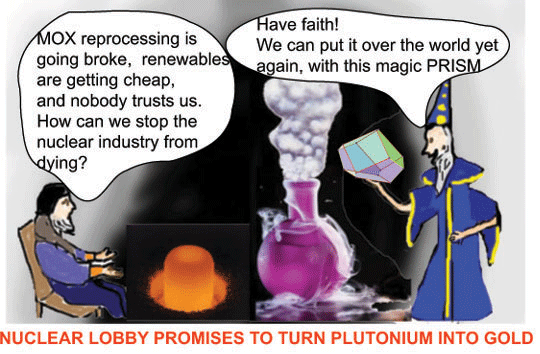
The plan envisages the construction of twin nuclear “fast reactors” at Sellafield that can dispose of the plutonium directly as fuel to generate electricity while ridding the country of a nuclear-waste headache that has dogged governments for half a century.
Britain’s Nuclear Decommissioning Authority (NDA), which is in overall
charge of Sellafield, requested the study last year in a remarkable
U-turn in its stated policy of dealing with the 112 tonnes of civil
plutonium that has accumulated as a result of the reprocessing of
spent nuclear fuel.
Critics say that fast reactors are still at the research stage of
development and are not yet ready to be deployed for such a critical
task.
The American company behind the proposal, GE Hitachi Nuclear Energy,
still has a long way to go to convince experts that it can deliver
reactors that can work as promised, as well as being delivered on time
and to budget. The NDA has consistently said that its “preferred
option” to deal with the plutonium waste is to first convert it to
mixed oxide (Mox) fuel and then burn it in conventional,
pressurised-water reactors. However, the authority is keeping other
“credible options” open, including fast reactors…….
The feasibility study is now being reviewed by the NDA and a decision
on whether to proceed to the next stage of the process will be made
later this year.
A spokesman for the authority said: “NDA has previously stated that
fast reactors, such as Prism, have been screened out as not credible
at this time. It was not considered that they would be commercially
available for several decades,” he said. “Though the technology was
well developed at the research reactor stage, the supply chain has yet
to give indication of any substantive commercial development of these
systems in the short-to-medium term. At this time, NDA believe that
this is still the case. However, we are considering the recent
proposal from GE Hitachi to assess its credibility.”
Britain’s previous attempts to convert plutonium into Mox fuel which could then be burned in conventional reactors have proved disastrous, culminating in the premature closure last year of the £1.34bn Sellafield Mox Plant, which was a commercial and technical failure.
Despite the debacle over Mox fuel, however, the NDA and officials with
the Department for Energy and Climate Change have advised the
Government to build a second Mox fuel plant, for an estimated cost of
£3bn, as a way of dealing with the plutonium problem.
This plan would involve the French nuclear company Areva, which is
also involved in building a similar Mox operation in the US to deal
with its military plutonium stockpile. However, this troubled plan is
11 years behind schedule and between six and 10 times over budget….. http://www.independent.co.uk/news/science/untested-nuclear-reactors-may-be-used-to-burn-up-plutonium-waste-8061660.html
No comments yet.
1 This Month

of the week – Shut Down Drone Warfare!


Tell the Ukrainian Government to Drop Prosecution of Peace Activist Yurii Sheliazhenko

Petition to revoke the licensing of the Near Surface Nuclear Disposal Facility (NSDF) at Chalk River. https://www.ourcommons.ca/petitions/en/Petition/Details?Petition=e-7247
To see nuclear-related stories in greater depth and intensity – go to https://nuclearinformation.wordpress.com
-
Archives
- April 2026 (103)
- March 2026 (251)
- February 2026 (268)
- January 2026 (308)
- December 2025 (358)
- November 2025 (359)
- October 2025 (376)
- September 2025 (257)
- August 2025 (319)
- July 2025 (230)
- June 2025 (348)
- May 2025 (261)
-
Categories
- 1
- 1 NUCLEAR ISSUES
- business and costs
- climate change
- culture and arts
- ENERGY
- environment
- health
- history
- indigenous issues
- Legal
- marketing of nuclear
- media
- opposition to nuclear
- PERSONAL STORIES
- politics
- politics international
- Religion and ethics
- safety
- secrets,lies and civil liberties
- spinbuster
- technology
- Uranium
- wastes
- weapons and war
- Women
- 2 WORLD
- ACTION
- AFRICA
- Atrocities
- AUSTRALIA
- Christina's notes
- Christina's themes
- culture and arts
- Events
- Fuk 2022
- Fuk 2023
- Fukushima 2017
- Fukushima 2018
- fukushima 2019
- Fukushima 2020
- Fukushima 2021
- general
- global warming
- Humour (God we need it)
- Nuclear
- RARE EARTHS
- Reference
- resources – print
- Resources -audiovicual
- Weekly Newsletter
- World
- World Nuclear
- YouTube
-
RSS
Entries RSS
Comments RSS
 nuclear-news
Leave a comment