Japan gov’t concealed Reactor No. 3 explosion until just before it happened — Ordered that alarming spike of pressure inside containment vessel be kept from public
http://enenews.com/japan-govt-concealed-explosion-of-reactor-no-3-until-just-before-it-happened-ordered-that-alarming-spike-of-pressure-inside-containment-vessel-be-kept-from-public
Published: August 16th, 2012 at 7:26 pm ET
By ENENews
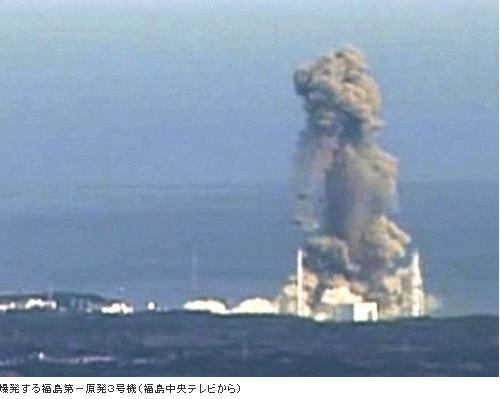
after pressure inside the reactor 3 containment vessel suddenly spiked to alarming levels around 6 a.m. March 14.
The agency then made an announcement shortly after 9 a.m. March 14 — just two hours before a hydrogen explosion destroyed the upper part of the structure housing reactor 3.
and from another article
NISA told Tepco to delay reporting looming explosion
“NISA officials are blocking any release of information on the matter,” a person who appears to be a head office employee says in the video images. “The agency’s officials are saying that (Tepco) should not be the entity to announce this either.”
Another voice on the recordings can be heard stating that NISA had refused to give Tepco permission to announce the pressure surge, saying, “We’ve been strongly requested, instructed not to announce this.”
NISA has said it kept Tepco’s announcement on hold because officials were unable to get in touch with its chief to obtain the necessary permission.
http://www.japantimes.co.jp/text/nn20120816a4.html
15 August 2012 Thousands of Naraha residents can return to homes and businesses during daylight hours
Article posted to World Nuclear News
Another evacuation order lifted
“…The town lies 13 kilometres to the south of Fukushima Daiichi nuclear power plant that suffered a multiple reactor accident and radiation release after the natural disasters of 11 March 2011. The town’s border includes a portion of the Fukushima Daini plant that also saw an emergency situation last year. All of the municipality’s 7200 residents were evacuated by the end of April 2011, but the area did not suffer any serious radioactive contamination.

Now, Japanese authorities consider the area safe for daylight visits with no need for monitoring equipment or protective clothing. This means people may return to businesses and properties, a large number of which need serious repair or even total redevelopment as a result of the earthquake and tsunami….”
“..Controls on entry to the area were relaxed at midnight on 10 August by the Ministry of Economy, Trade and Industry (METI). It is the fourth revision the ministry has made as it assesses evacuated areas and works towards normalisation of as much as possible. At the same time it changed restrictions at sea, reducing the no-go zone for shipping from 20 kilometres to five. .. “
“..Many residents were evacuated after the meltdown, but by August 2011, approximately half had returned. A voluntary screening program for levels of cesium, known to be representative of total internal radiation exposure, was conducted between September 2011 and March 2012 for all residents ages 6 years or older. Total cesium exposure was converted into committed effective dose (sievert, Sv)…”
“…Residents may return at will to areas marked green to visit and work without the use of protective equipment. The only restriction is that they may not stay overnight…”
“…In the orange ‘restricted’ areas people can carry out specific jobs without being monitored or using protective equipment…
….People entering these zones are advised to avoid doing so unnecessarily, to refrain from working outdoors, to use cars rather than to walk for more than a short period and to wash upon re-entering a building…”
“….The third category of area is known as ‘difficult’ to return to because of an ambient dose rate of over 50 millisieverts per year, which is not expected to go below 20 millisieverts per year before March 2016…”
http://www.world-nuclear-news.org/RS_Naraha_evacuation_order_lifted_1508121.html
10 times more deformed worms in Fukushima town — Some have 2 abdomens, legs with necrosis, damaged feelers
Published: August 16th, 2012 at 4:38 am ET
By ENENews
Follow-up to: Japan Paper: Malformations in 10% of cotton worms from Fukushima town -Entomologist (PHOTO)
Report from the Hokkaido Shinbun with a summarized translation by Fukushima Diary:
“..Prof. Akimoto [of Hokkaido University] collected 200 samples from Japanese elms to find about 10% of them deformed.
Their bodies and the cast-off skins showed their legs had necrosis,or feelers are damaged, and also some of them had 2 abdomens…”
Click on links for more
A week of hypocrisy – Japan, USA, Australia

Christina Macpherson’s websites & blogs
Japan is very quiet on the health effects of Fukushima radiation. Nuclear lobby writers are out in force – attempting to discredit ionising radiation “low levl” as a cause of cancers and genetic malformations. Indeed they’re still pushing the “hormesis” idea – (“low level” radiation is good for you) meanwhile scientific findings on butterflies in Japan reveal the harmful effects of low level radiation, that are passed down through generations.
In USA the mainstream media are putting a calm face on the decision by the Nuclear Regulatory Commission to halt licensing of nuclear reactors, because – well, a court has ruled that there’s no confidence in the NRC’s Waste Confidence Rule. That rule has allowed nuclear reactors to be licensed, even though nobody knows what to do with the radioactive wastes. There is also a calm face on the USA’s current extreme heat wave, which is causing one nuclear reactor after another to slow down , or shut down – due to problems of hot cooling water.
The Australian government is pretty disgustingly hypocritical over the fate of Australian citizen Julian Assange. Their two-faced Foreign Minister, Bob Carr, pretends that USA has no intention of extraditing Assange from Sweden, to be tried for espionage. Prime Minister Julia Gillard is now shutting up about it, bust has previously backed USA’s view that Assange (of Wikileaks fame) has been some sort of traitor.
The Australian uranium industry – very much in the doldrums, is to embark on a “community education” campaign. Not likely to persuade investors, with Paladin Uranium losing $39 billion in 9 months, recently.
Lest we forget – thermonuclear bombs exploded over the Pacific Ocean
 Going Nuclear Over the Pacific , Past Imperfect, Smithsonian.com August 15, 2012“…Fifty years ago this summer there were strange doings in the skies above earth as well….. But of all the things happening in the skies that summer, nothing would be quite as spectacular, surreal and frightening as the military project code-named Starfish Prime . Just five days after Americans across the country witnessed traditional Fourth of July fireworks displays, the Atomic Energy Commission created the greatest man-made light show in history when it launched a thermonuclear warhead on the nose of a Thor rocket, creating a suborbital nuclear detonation 250 miles above the Pacific Ocean. Continue reading
Vigil to make the World Health Organisation independent of the nuclear industry
 The Hippocratic Vigil For the independence of WHO http://independentwho.org/en/hippocratic-vigil/ «The World Health Organisation (WHO) is failing in its duty to protect those populations who are victims of radioactive contamination.» The aim of the silent vigil is to remind the World Health Organisation of its duties. It was Hippocrates who formulated the ethical rules for health practitioners. The World Health Organisation ignores these rules, when it comes to protecting the health of the victims of the consequences of the nuclear industry.
Since the 26th April 2007, the Hippocratic Vigil has been held in front of the WHO headquarters in Geneva. It has been maintained, each working day between 8am and 6pm, to remind this United Nations body of its duties as they are defined in its Constitution.
Placards display the messages that the Vigil seeks to convey to WHO
Up to now, 300 people have participated in the Vigil in front of the WHO headquarters. They come from several European countries, as well as some from America. About 40 of them are either Swiss or French living within a radius of about 50km from Geneva. These are the people who relieve others for lunch breaks or for “anti-freeze” breaks in the middle of winter. We are able to call upon a group of “stalwarts” in unforeseen circumstances, such as health problems, last-minutes cancellations.
The vigil is maintained by individuals on their own or in groups up to a maximum of three. People sign up for half a day, a full day, a few days or the whole week. Those who come to do the Vigil are offered accommodation by a network of “hosts” (numbering 20). The people taking part in the vigil have to pay for their travel to Geneva and for their food themselves.
The General Assembly of the Vigil, decided unanimously on february 2012 to continue the Vigil for an indeterminate period, and the matter will be discussed again at the next General Assembly on september 2012.
For additional information, or to sign up for the vigil, write to Paul Roullaud paul@independentwho.org or telephone him on +33 (0)240 87 60 47
Climate change heat might mean the end of the nuclear industry
 Extreme Heat, Drought Show Vulnerability of Nuclear Power Plants Reactor shutdown in Connecticut is latest sign that nuclear energy would face challenges from climate change. By Robert Krier, InsideClimate News, 15 Aug 12, Will 2012 go down as the year that left the idea of nuclear energy expansion in the hot, dry dust?
Nuclear energy might be an important weapon in the battle against climate change, some scientists have argued, because it doesn’t emit greenhouse gases. But separate of all the other issues with nuclear, that big plus would be moot if the plants couldn’t operate, or became too inefficient, because of global warming. In June, InsideClimate News reported on the findings of Dennis Lettenmaier, a researcher at the University of Washington. His study found that nuclear and other power plants will see a 4 to 16 percent drop in production between 2031 and 2060 due to climate change-induced drought and heat.
The U.S. is getting plenty of both this year. Just Sunday, the Millstone nuclear plant in Waterford, Conn., had to shut down one of its two reactors because seawater was too warm to cool it. It was the first time in the plant’s 37-year history that the water pulled from the Long Island Sound was too warm to use.
So the question becomes, is the future already here?
Heat records have been falling by the thousands since spring, and on Aug. 9 theU.S. Drought Monitor map showed that 62.46 percent of the nation is under moderate to exceptional drought conditions. That’s down slightly from the peak of 63.86 percent last month, the highest percentage since the Drought Mitigation Center began producing the map in 2000. But the percentage of the country that is experiencing extreme to exceptional drought continued to rise and is now at 24.14 percent, almost a fourth of the country.
Much of the drought and unusual heat has been in areas that rely in part on nuclear plants: the upper Midwest, the Southeast and parts of New England.
When all of the nation’s 104 nuclear plants are fully operational, they supply about 20 percent of the energy generated in the United States. Those plants need water to operate, and in most cases, they need fresh water. There’s not a lot of fresh water to go around in much of the nation this summer, and that is putting nuclear energy to the test.
It’s also raising questions about how freshwater supplies should be managed in a world further taxed by climate change. Inevitably, there will be increased competition for water from a growing population, agriculture and the energy sector.
(Plants that use saltwater for cooling generally don’t have the same issues, because they never have a shortage of water. But the shutdown at Millstone shows they can still be vulnerable to heat waves.)
About 40 percent of the nation’s fresh water use goes toward energy generation, with nuclear energy considered a very water-intensive energy source….. http://insideclimatenews.org/news/20120815/nuclear-power-plants-energy-nrc-drought-weather-heat-water utm_source=feedburner&utm_medium=feed&utm_campaign=Feed:%20solveclimate/blog%20(InsideClimate%20News
UK govt to take unprecedented action for its ally USA, against Julian Assange

 Ecuador to announce Assange asylum, Britain threat to raid
  embassy http://wwwnews.com.au/technology/ecuador-to-announce-assange-asylum-britain-threat-to-raid-embassy/story-e6frfro0-1226451411725#ixzz23kTVyVq3 Charles Miranda, wires From: News Limited Network August 16, 2012 Reports suggest British police have been seen entering the Ecuadorian embassy.
The Press Association had earlier reported officers arriving outside the Ecuadorian Embassy, close to the Harrods store in Knightsbridge, London.
EARLIER BRITAIN is threatening to raid the Ecuadorian embassy to arrest Wikileaks’ founder Julian Assange.
Ecuador’s foreign minister, Ricardo Patino, told a news conference that the South American nation had received a written and verbal threat on Wednesday from Britain that “it could assault our embassy” if Assange was not handed over.\
Patino also said that Ecuador “has made a decision” on Mr Assange’s asylum bid and will announce it on Thursday at 7am local time (10pm AEST).
“Ecuador rejects in the most emphatic terms the explicit threat of the British official communication,” he told a press conference in Quito. He said such a threat was “improper of a democratic, civilised and rule abiding country”.
“If the measure announced in the British official communication is enacted, it will be interpreted by Ecuador as an unacceptable, unfriendly and hostile act and as an attempt against our sovereignty. It would force us to respond,” he said.
“We are not a British colony.” He said the threat was delivered to Ecuador’s foreign ministry and
ambassador in London.
The letter said: “You need to be aware that there is a legal base in the UK, the Diplomatic and Consular Premises Act 1987, that would allow us to take actions in order to arrest Mr Assange in the current premises of the Embassy.
“We sincerely hope that we do not reach that point, but if you are not capable of resolving this matter of Mr Assange’s presence in your premises, this is an open option for us.”
“No way that banks would provide financing” for nuclear power , says bank chairman

 Bank chairman stands defiant with blunt anti-nuclear message, The Mainichi, 15 Aug 12, I was hardly getting anywhere trying to write about “hope” and the general election that’s supposed to come sooner or later when Tsuyoshi Yoshiwara, chairman of Johnan Shinkin Bank, appeared on television.
“Can the member corporations of the Keidanren (the Japan Business Federation) buy out nuclear reactors themselves and operate them?” he asked, point blank.
“There’s no way banks would provide financing,” he continued. “Corporations propose something (the continuation of nuclear reactors) that they can’t even do on their own, knowing full well that the burden will ultimately fall on the public. And yet they say that what they propose is ‘realistic.’ That makes no sense, and is most irresponsible.” Continue reading
Disease and death toll from Fukushima radiation needs careful, patient, tracking
[in the 12 months after Fukushima] an excess of 38,700 Japanese deaths, with no obvious cause.
Nobody should yet race to conclusions that 38,700 Japanese died from Fukushima exposure in the first year after the disaster.
The final element needed before conclusions are made is patience; vital statistics must continue to be tracked, and compared with radiation exposures to the Japanese people.
[In 2009] A team of Russian researchers, led by Dr. Alexey Yablokov, published results of 5,000 reports and articles on Chernobyl – many in Russian languages never before made public. Yahlokov’s team concluded that near Chernobyl, increases in disease sand deaths were observed for nearly every human organ system.
 Let the Counting Begin Fukushima’s Nuclear Casualties http://www.counterpunch.org/2012/08/15/fukushimas-nuclear-casualties/ by JOSEPH MANGANO, 15 Aug 12 It’s been nearly 18 months since the disastrous nuclear meltdown at Fukushima. There have been many reports on the huge amounts of radioactivity escaping into the air and water, unusually high levels in air, water, and soil – along with atypically high levels of toxic chemicals in food – that actually “passed” government inspection and wasn’t banned like some other food.
Conspicuously absent are reports on effects of radiation exposure on the health of the Japanese people. Have any health officials publicly announced post-March 2011 numbers on fetal deaths, infant deaths, premature births, birth defects, cancer, or other health conditions? The answer so far is an emphatic “no.”
The prolonged silence doesn’t mean data doesn’t exist. Japanese health officials have been busy with their usual duties of collecting and posting statistics on the Internet for public inspection. It’s just that they aren’t calling the public’s attention to these numbers.
Thus, it is the public who must find the information and figure out what it means. After locating web sites, translating from Japanese, adding data for each of 12 months, and making some calculations, mortality trends in Japan after Fukushima are emerging. Continue reading
List of USA’s nuclear power plants badly affected by extreme heat
 Extreme Heat, Drought Show Vulnerability of Nuclear Power Plants By Robert Krier, InsideClimate News, 15 Aug 12, “……— The Vermont Yankee plant near Brattleboro had to limit output four times in July because of low river flow and heat. At one point, production was reduced to 83 percent of capacity.
— FristEnergy Corp’s Perry 1 reactor in Ohio dropped production in late July to 95 percent of capacity because of above-average temperatures.
— Operators of the Braidwood, Ill., nuclear plant 60 miles southwest of Chicago sought and were granted a waiver from the Environmental Protection Agency to raise the temperature of a cooling pond to 102 degrees—2 degrees above the established limit. The pond holds water cycled through the plant for cooling and then discharged. If the plant had not received the waiver, it would have had to scale back production in the middle of an intense heat wave. Kraft said the nuclear plants’ operating difficulties are part of a recurring pattern. In the summer of 1988, drought, high temperatures and low river volumes forced Commonwealth Edison to reduce power by 30 percent or shut down, in some cases, at the Dresden and Quad Cities plants in Illinois.
“That was the first wake-up call that plants would be vulnerable in a climate-disrupted world,” Kraft said.
There have been many more instances since:
— Europe, summer of 2003. During the heat wave that killed more than 30,000 people, France, Germany and Spain had to choose between allowing reactors to exceed design standards and thermal discharge limits and shutting down reactors. Spain shut down its reactors, while France and Germany allowed some to operate and shut down others.
— Illinois, summer of 2005. EPA and state officials considered easing thermal discharge standards because of drought, but a break in the weather made it unnecessary.
— Illinois, Minn., July 29 to Aug. 2, 2006. The Prairie Island (Minn.) plant had to reduce output by 54 percent. The Quad Cities, Dresden and Monticello plants in Illinois also cut power to moderate water discharge temperatures.
— Michigan, July 30, 2006. The Donald C. Cook reactors in Michigan were shut down during a severe heat wave because temperatures in a containment building exceeded the regulatory limit of 120 degrees.
— Southeast U.S, Aug. 5-12, 2008. The Tennessee Valley Authority lost a third of nuclear capacity due to drought conditions. All three Browns Ferry reactors in Alabama were idled to prevent overheating of the Tennessee River.
— France, July 2009. France had to purchase power from England because almost a third of its nuclear generating capacity was lost when it had to cut production to avoid exceeding thermal discharge limits.
— Southeast U.S., July, August 2011. The TVA reduced power at Browns Ferry to stay within discharge limits. At one point, all three of the reactors cut output to about 50 percent. Had the plant been operating at full capacity, the downstream temperature on the Tennessee River would have exceeded the 90-degree limit…. http://insideclimatenews.org/news/20120815/nuclear-power-plants-energy-nrc-drought-weather-heat-water?utm_source=feedburner&utm_medium=feed&utm_campaign=Feed:%20solveclimate/blog%20(InsideClimate%20News)
No confidence in USA’s “Waste Confidence Rule” – so nuclear licensing stopped
puts waste where it belongs, front and center in the debate over the future of nuclear power in this country
NRC elevates nuclear waste to front and center of debate http://www.thereporteronline.com/article/20120815/OPINION01/120819748/nrc-levates-nuclear-waste-to-front-and-center-of-debate&pager=2 08/15/12 BECAUSE THE U.S. Nuclear Regulatory Commission is a part of the federal bureaucracy, it can make even groundbreaking news seem mundane.
Take this understated sentence in its ruling Aug. 7 delaying the final issuance of any nuclear permits, for existing or new power plants:
“Waste confidence undergirds certain agency licensing decisions, in particular new reactor licensing and reactor licensing renewal.”
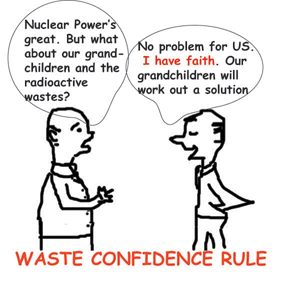
Translation: The country cannot continue to talk about building new nuclear plants without figuring out what it is going to do with the dangerous waste that literally is stacking up at sites all over the country, including at Ameren Missouri’s Callaway County plant.
That means that because Americans can have no confidence that the NRC has seriously dealt with the growing problem of nuclear waste, the NRC will stop making the problem worse by extending nuclear plant licenses. Continue reading
Investigation into dirty work at the NRC crossroads
 (includes video ) http://www.huffingtonpost.com/2012/08/15/william-ostendorff-nuclear-safety_n_1778989.html William Ostendorff, GOP-Appointed Regulator, Under Investigation For
  Thwarting Nuclear Safety Probe HUFFINGTON POST, Ryan Grim, 08/15/2012 WASHINGTON – The inspector general at the Nuclear Regulatory Commission has launched an investigation into a GOP political appointee for attempting to thwart an agency probe into safety concerns at a Michigan plant, NRC insiders tell The Huffington Post.
In late May, Gregory Jaczko, then the chairman of the NRC, paid a rare visit to the controversial Palisades Power Plant on Lake Michigan. Activists are agitating for the plant’s closure due to safety issues. The plant is represented in Congress by Energy and Commerce Chairman Fred Upton, a Michigan Republican who has long been close to the nuclear industry.
While Jaczko was touring the plant on May 31st, according to the sources, a significant leak of potentially radioactive water was pouring into the control room. Less than two weeks later, the plant was shut down to repair the leak. Yet Jaczko was never made aware of the issue while inspecting the plant. He asked the NRC’s Office of Investigations to look into why the leak was kept from him.
Commissioner William Ostendorff, however, wanted no such investigation to take place. Shortly after Jaczko ordered it, Ostendorff shouted at the top agency investigator, Cheryl McCrary, in front of several NRC employees. He told her that the inquiry should be halted and that it was a “waste of agency resources,” according to the sources, who were briefed on the exchange by witnesses. The probe into Ostendorff is the latest tussle in an ongoing war inside the agency over how to regulate the industry — whether to take a trusting, hands-off approach, or to apply the rules in a serious way. It’s a battle being fought all across Washington, as longtime advocates of deregulation argue that government bureaucrats are stifling job creation. Inside some industries, deregulation might tilt the balance of power away from consumers and workers, but in the nuclear industry, the consequences involve life and death.Pro-industry forces won a round in May, just before Jaczko visited Palisades, when he announced his resignation, finally stepping down June 29th when a new chair was confirmed. Jaczko’s resignation was the result of a scorched-earth campaign waged against him by the other commissioners, backed by the industry’s lobbying arm, the Nuclear Energy Institute. Senate Majority Leader Harry Reid (D-Nev.), Jaczko’s former boss, fired back at the leader of the campaign against him, Democrat Bill Magwood, calling him a “treacherous, miserable liar,” among many other things.
The upheaval has altered the mood within the NRC; before the anti-Jaczko campaign, pro-regulation sources were largely unwilling to speak to HuffPost about internal disputes. But as a full-fledged war wages on, some of that resistance is slackening…… http://www.huffingtonpost.com/2012/08/15/william-ostendorff-nuclear-safety_n_1778989.html
Video: New NBC TV show trivialises war
 Nobel Peace laureates vs NBC scandalous reality show http://www.youtube.com/watch? v=IYIiW4VvRBw&feature=share Aug 14, 2012 by RTAmerica NBC has come up with a new show, which the critics say ‘glorifies war.’ It debuted last night and is called “Stars and Stripes” but has a cast of people you can barely call stars. It can be sold as way to honor US troops but many don’t see it that way. Jody Williams, a long time peace activist and 1997 Nobel Peace Prize winner, joins RT’s Liz Wahl for more.
The psychological toll on nuclear workers in Japan
Nuclear Workers Stressed After Japanese Quake Med Page Today, By Michael Smith, August 14, 2012 Reviewed by Dori F. Zaleznik, MD; Associate Clinical Professor of Medicine, Harvard Medical School, Boston and Dorothy Caputo, MA, BSN, RN, Nurse Planner
Action Points
This study of psychological distress and post-traumatic stress response among workers at two nuclear power plants involved in the Fukushima earthquake/tsunami found high levels of self-reported distress especially among workers at the plant that suffered the meltdown…
Psychological distress and post-traumatic stress response (PTSR) were common among workers at two Japanese nuclear plants in the wake of the March 11, 2011 earthquake, researchers reported. But rates were significantly higher among workers at the Daiichi
plant, which suffered a meltdown, than they were at the Daini plant, which was damaged but remained intact, according to Takeshi Tanigawa, MD, PhD, of Ehime University Graduate School of Medicine in Ehime, Japan, and colleagues.
Both groups of workers were exposed — at much the same rate — to slurs and discrimination because the Tokyo Electric Power Company, which operates the plants, was widely criticized for its response to the disaster, Continue reading
1 This Month
Chernobyl: The Lost Tapes – A good documentary on Chernobyl on SBS available On Demand for the next 3 weeks– https://www.sbs.com.au/ondemand/tv-program/chernobyl-the-lost-tapes/2352741955560

of the week–London Campaign for Nuclear Disarmament

Tell the Ukrainian Government to Drop Prosecution of Peace Activist Yurii Sheliazhenko
To see nuclear-related stories in greater depth and intensity – go to https://nuclearinformation.wordpress.com
-
Archives
- April 2026 (139)
- March 2026 (251)
- February 2026 (268)
- January 2026 (308)
- December 2025 (358)
- November 2025 (359)
- October 2025 (376)
- September 2025 (257)
- August 2025 (319)
- July 2025 (230)
- June 2025 (348)
- May 2025 (261)
-
Categories
- 1
- 1 NUCLEAR ISSUES
- business and costs
- climate change
- culture and arts
- ENERGY
- environment
- health
- history
- indigenous issues
- Legal
- marketing of nuclear
- media
- opposition to nuclear
- PERSONAL STORIES
- politics
- politics international
- Religion and ethics
- safety
- secrets,lies and civil liberties
- spinbuster
- technology
- Uranium
- wastes
- weapons and war
- Women
- 2 WORLD
- ACTION
- AFRICA
- Atrocities
- AUSTRALIA
- Christina's notes
- Christina's themes
- culture and arts
- Events
- Fuk 2022
- Fuk 2023
- Fukushima 2017
- Fukushima 2018
- fukushima 2019
- Fukushima 2020
- Fukushima 2021
- general
- global warming
- Humour (God we need it)
- Nuclear
- RARE EARTHS
- Reference
- resources – print
- Resources -audiovicual
- Weekly Newsletter
- World
- World Nuclear
- YouTube
-
RSS
Entries RSS
Comments RSS
 nuclear-news