Why molten salt nuclear reactors and thorium nuclear reactors are duds
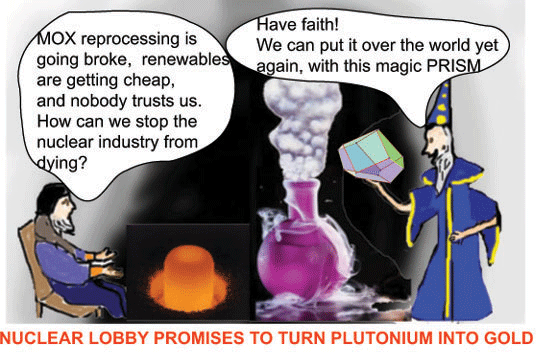 Thorium: Not ‘green’, not ‘viable’, and not likely Oliver Tickell, April / May 2012. 1. Introduction ”With uranium-based nuclear power continuing its decades-long economic
collapse, it’s awfully late to be thinking of developing a whole new fuel cycle whose problems differ only in detail from current versions.” Amory Lovins, Rocky Mountain Institute, March 2009.
A number of commentators have argued that most of the problems associated with nuclear power could be avoided by both:
using thorium fuel in place of uranium or plutonium fuels
using ‘molten salt reactors’ (MSRs) in place of conventional solid fuel reactor
designs.
The combination of these two technologies is known as the Liquid Fluoride Thorium Reactor or LFTR, because the fuel is in form of a molten fluoride salt of thorium and other elements.
In this Briefing, we examine the validity of the optimistic claims made for thorium fuel, MSRs and the LFTR in particular.
We find that the claims do not stand up to critical scrutiny, and that these technologies have significant drawbacks including:
the very high costs of technology development, construction and operation.
marginal benefits for a thorium fuel cycle over the currently utilised uranium /
plutonium fuel cycles
serious nuclear weapons proliferation hazards
the danger of both routine and accidental releases of radiation, mainly from
continuous ‘live’ fuel reprocessing in MSRs
the very long lead time for significant deployment of LFTRs of the order of half a century – rendering it irrelevant in terms of addressing current or medium term energy supply need….
…. We therefore see little prospect that LFTRs will present an economic solution if and when they are ever ready for large scale deployment. Any money invested in LFTRs,
whether by governments, utilities or other investors, is likely to be wasted.
Far better to invest in the renewable technologies that are already shaping our national and global future, and whose cost is rapidly falling – in the process developing valuable UK-based expertise and technologies, and accelerating the renewables revolution. http://www.nuclearpledge.com/reports/thorium_briefing_2012.pdf
No comments yet.
1 This Month
Chernobyl: The Lost Tapes – A good documentary on Chernobyl on SBS available On Demand for the next 3 weeks– https://www.sbs.com.au/ondemand/tv-program/chernobyl-the-lost-tapes/2352741955560

of the week–London Campaign for Nuclear Disarmament

Tell the Ukrainian Government to Drop Prosecution of Peace Activist Yurii Sheliazhenko
To see nuclear-related stories in greater depth and intensity – go to https://nuclearinformation.wordpress.com
-
Archives
- April 2026 (139)
- March 2026 (251)
- February 2026 (268)
- January 2026 (308)
- December 2025 (358)
- November 2025 (359)
- October 2025 (376)
- September 2025 (257)
- August 2025 (319)
- July 2025 (230)
- June 2025 (348)
- May 2025 (261)
-
Categories
- 1
- 1 NUCLEAR ISSUES
- business and costs
- climate change
- culture and arts
- ENERGY
- environment
- health
- history
- indigenous issues
- Legal
- marketing of nuclear
- media
- opposition to nuclear
- PERSONAL STORIES
- politics
- politics international
- Religion and ethics
- safety
- secrets,lies and civil liberties
- spinbuster
- technology
- Uranium
- wastes
- weapons and war
- Women
- 2 WORLD
- ACTION
- AFRICA
- Atrocities
- AUSTRALIA
- Christina's notes
- Christina's themes
- culture and arts
- Events
- Fuk 2022
- Fuk 2023
- Fukushima 2017
- Fukushima 2018
- fukushima 2019
- Fukushima 2020
- Fukushima 2021
- general
- global warming
- Humour (God we need it)
- Nuclear
- RARE EARTHS
- Reference
- resources – print
- Resources -audiovicual
- Weekly Newsletter
- World
- World Nuclear
- YouTube
-
RSS
Entries RSS
Comments RSS
 nuclear-news
Leave a comment